


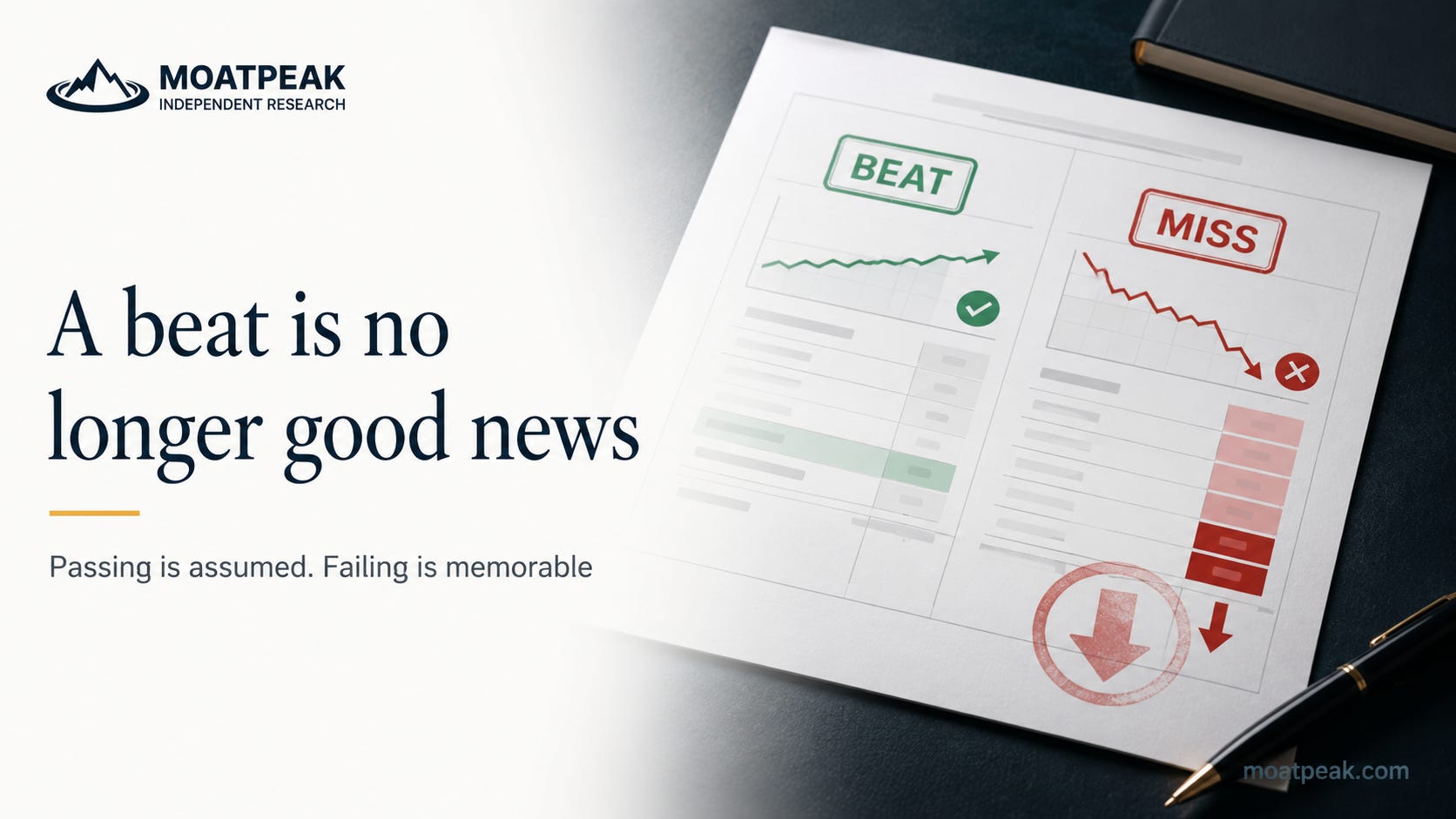
The big banks just delivered the kind of quarter investors are supposed to like.
Goldman put up record revenue. JPMorgan printed huge profits. Bank of America’s earnings climbed. Citi posted its best quarterly revenue in a decade. Morgan Stanley joined in with record revenue and a big trading and dealmaking quarter.
Yet the stocks didn’t all behave like the news was great.
Goldman jumped. JPMorgan and Bank of America drifted higher. Citi and Wells Fargo fell. Morgan Stanley’s move barely reflected how much it beat expectations.
That’s because the market wasn’t really grading the quarter.
It was grading whether it could trust the next one.
That difference matters. The idea of “good earnings” has been quietly distorted by success.
Lately, about 65 percent of companies beat expectations, versus a long-term average closer to 49 percent. Management teams have trained investors to expect a beat. The surprise stopped feeling like a surprise.
Normal good news no longer reprices a stock.
The reaction data shows it clearly. On the day after a recent earnings beat, the median stock earned only about 23 basis points of excess return. Historically, the reward was closer to 98 basis points.
Misses still hurt, though.
The recent penalty was about 254 basis points, slightly worse than the long-term average.
This is a one-way exam.
Passing is assumed. Failing sticks.
The bank results showed what has quietly replaced the old beat-or-miss test.
Investors are now grading the bill.
Citi is the clean example. It delivered its strongest quarterly revenue in a decade, and profit rose sharply. The stock still fell after management said spending would be higher in the second half.
The market wasn’t saying the business was broken. It was saying management has not earned a blank check.
Goldman spent too, but record revenue in its markets and banking businesses made the higher costs feel earned.
This quarter revealed a new kind of moat in financials: the ability to invest without losing your shareholders’ trust.
Some companies have that permission. Some don’t.
That permission comes from consistency, not from a good story. Investors will tolerate a higher bill when the revenue engine is already visible. They push back on the same bill when the payoff lives mostly in management’s future tense.
Bank previews had already flagged expenses as the big swing factor across the group. The results proved it.
And this is why bank earnings matter beyond banks.
The hyperscalers are about to sit for the same exam.
They can beat on revenue. They can beat on earnings. But they still need to explain why the next dollar of AI capital spending deserves to be spent.
AI infrastructure is driving an outsized share of index earnings growth, and Wall Street already knows it. A clean quarter is now table stakes. The real question is whether the next wave of spending still earns a credible return.
An AI platform that beats on revenue but can’t explain the cash return on a bigger buildout may learn the same lesson Citi did.
Investors can like the business and still reject the bill.
So stop obsessing over the first question everyone asks during earnings season.
Did they beat?
Ask the questions that actually move the stock.
What expectations were already in the price?
What did it really cost to deliver this quarter?
Did the results improve the next twelve months, or just confirm the last three?
A beat is no longer good news.
It’s just your ticket into the discussion.
Free weekly explainers like this. Daily research, levels, and the Daily Compass are at moatpeak.com.
Educational research only. Not investment advice. MB “MoatPeak Group”