


Most investment mistakes come from buying good companies at prices that already assume everything will go perfectly, not from picking bad companies.
First Solar is a good example since it rates highly on almost every quality measure. The real question is what price you pay.
What is genuinely good
First Solar has a contracted backlog of 45.1 GW through 2030, worth about $13.6 billion. This shows clear demand, but it is not the same as revenue guidance or a delivery guarantee.
First Solar has $1.7 billion in net cash and about $38 million in debt. In a capital-heavy, cyclical industry, this is a real advantage because it lets the company keep building during downturns when others cannot.
First Solar is disciplined with pricing. US bookings are about $0.36 per watt, while Indian bookings are closer to $0.20. A trade floor of $0.38 per watt will begin in December.
The main point is that this company does not have a problem.
Now the number that reframes it
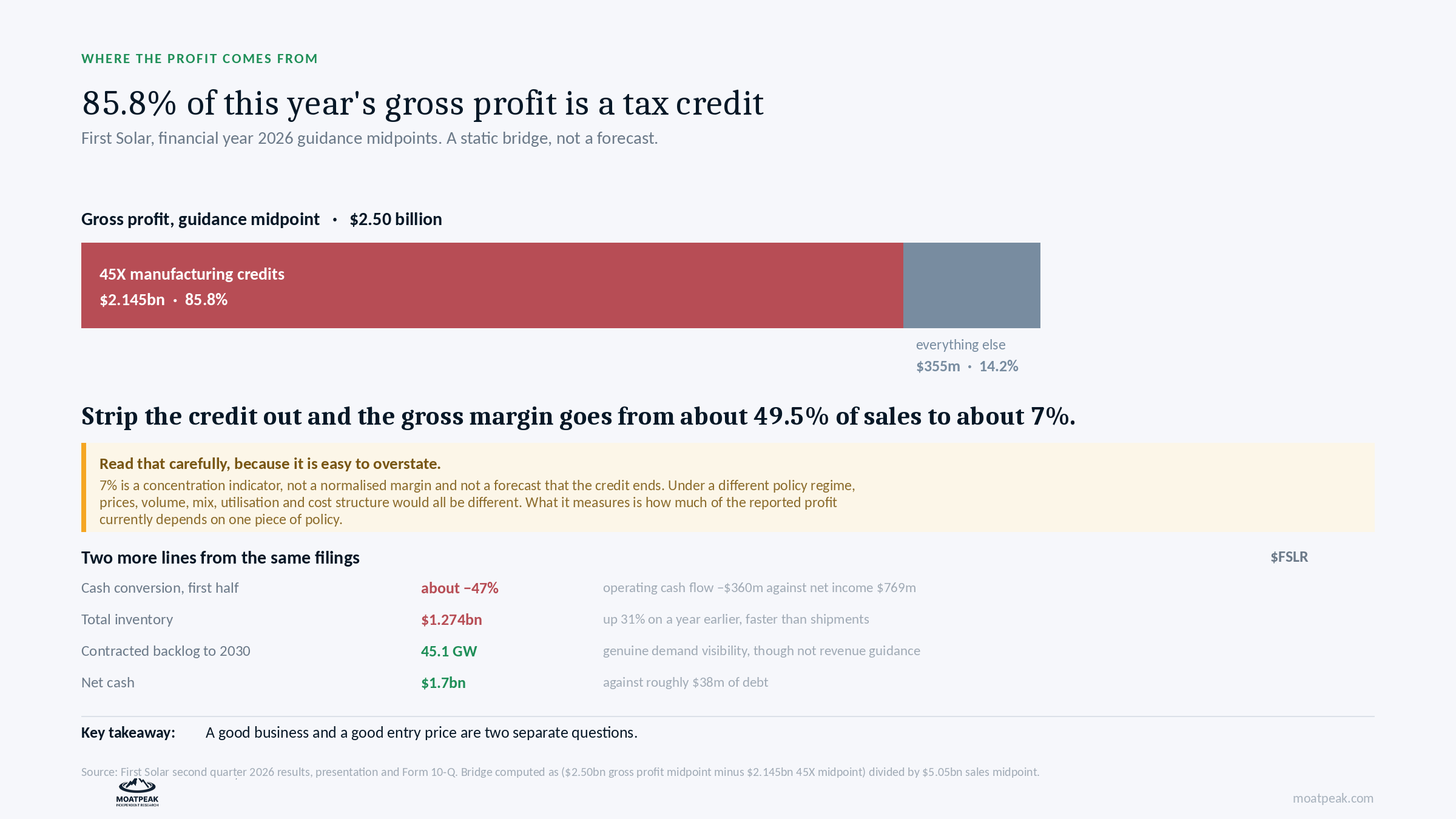
The company expects gross profit for this financial year to be around $2.50 billion.
Of that, $2.145 billion comes from manufacturing tax credits.
This makes up 85.8% of the gross profit.
If you take out the tax credits, the remaining gross profit is $355 million on $5.05 billion in sales. That means a gross margin of about 7%, compared to the reported margin of about 49.5%.
The 7% margin is not a normal margin, and it does not mean the tax credit will go away. If policies change, prices, volumes, product mix, factory use, and costs would all change too. Companies cannot just absorb a change like that without other effects. This number really shows how much of today’s reported profit depends on one law staying in place. That is a real risk, and you can measure it using the company’s own guidance.
Two lines that complicate the picture
In the first half of the year, cash conversion was about minus 47%. Operating cash flow was minus $360 million, while reported net income was $769 million. Because this business is seasonal, half a year does not show the full picture, so it is better to watch the twelve-month trend. Still, when profit and cash move in opposite directions, it is worth paying attention. Total inventory is $1.274 billion, up 31% from last year. When inventory grows faster than shipments, it can mean two things: unused capacity or a backlog that is converting more slowly than it seems.
Neither issue is a big problem on its own. But both are things you want to watch closely, not discover after the fact.
Separating the company from the share
Here is the approach we recommend. It works for any investment.
Write down what you think the business will earn in three years and what price you would pay for it. Do this for a bad case, a middle case, and a good case. Then figure out what return each scenario gives from today’s price.
This exercise helps you see price as a variable, not a fixed number. A great business at a high price and an average business at a low price can give the same return, and writing it out makes that clear.
When we did this exercise, the middle case gave a return in the mid-single digits each year, while the worst case lost more than half. When the downside is bigger than the upside, that is what really matters, not just the quality of the technology.
What would change it?
There are three things to watch, whether or not you ever own the shares.
First, watch for cash conversion turning positive over twelve months, which would settle the profit-versus-cash question.
Second, look for evidence about the quality of the backlog, not just its size. A signed contract for a gigawatt is very different from one that is financed and under construction, but the company does not break out these details.
Third, watch what the December trade measures actually do. A 15% tariff and a $0.38 per watt import floor start on December 4.
The transferable version
Whenever a company shows unusually high margins, ask where they come from. If much of it comes from a subsidy, tariff, tax credit, or other policy, you are not just betting on the business. You are also betting on a political decision, and those can change at any time.
This does not mean the investment is wrong. It just means it is a different kind of investment than most people think.
Our full scenario model, the entry price at which the return becomes adequate, and the ten signals we track are at moatpeak.com.
Educational research only. Not personalized investment advice. MB “MoatPeak Group”.