


Last week the chips broke. Emerging markets fell almost 4 percent, the worst in six weeks, with the damage concentrated in Asia. Korea was the epicenter: its two big memory makers each fell more than 10 percent, and the exchange had to halt trading for twenty minutes. Global chip stocks have now shed roughly 3.3 trillion dollars since late June.
Everyone reached for the same word: bubble. But look at the trigger the headlines skated past. A major phone maker raised its prices, and the reason it gave was a memory-chip shortage. A separate report that a big AI lab might delay its IPO added to the mood.
The market’s response was to sell every chip stock on “demand and margin fears.” Read that back slowly, because it does not add up.
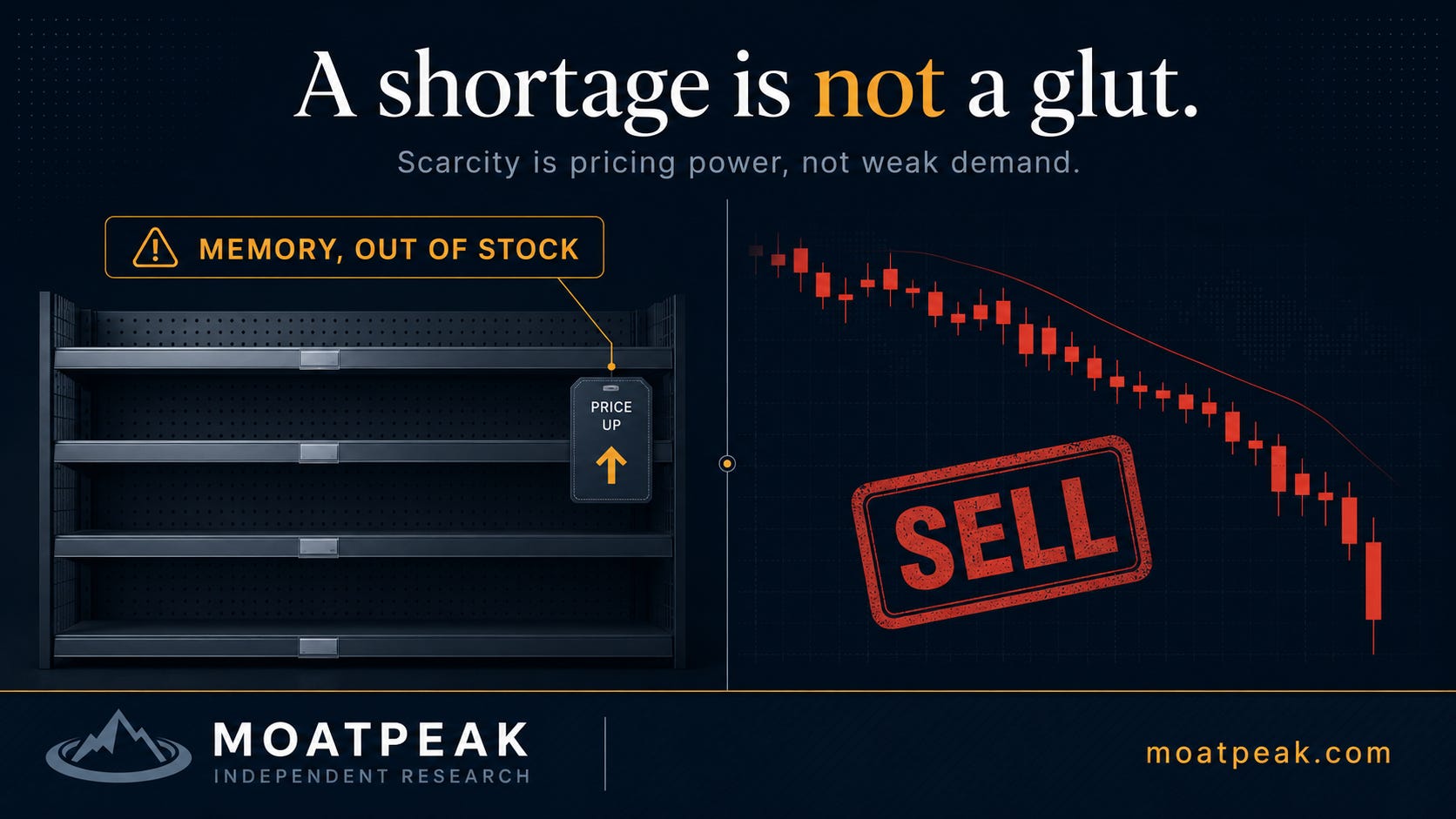
A shortage is the opposite of a glut. When a buyer as large as a global phone maker cannot secure enough memory, and has to pay up and pass the cost on, that is scarcity. Scarcity is the fingerprint of pricing power for whoever makes the scarce thing. It is not evidence that the customer is disappearing.
Two stories look identical on a red screen and mean opposite things. In a demand glut, orders get cancelled, inventory piles up, and prices fall. In a supply shortage, orders go unfilled, inventory drains, and prices rise. They call for opposite trades. Last week the market watched a price rise driven by shortage and reacted as if it were a glut.
Why would professionals get a distinction that basic backwards? Because the trade was crowded. When a position is packed with everyone who wanted in, any headline becomes a reason to sell, and the crowd reads every ambiguous signal in the direction it is already leaning. The shortage was the excuse. The crowding was the cause.
Here is the part we will not oversell, because a good thesis has to be falsifiable. A shortage can help the seller and hurt the buyer at the same time. The phone maker’s own margins can suffer even as the memory maker’s pricing improves. And shortages end. New supply eventually arrives, including from a Chinese memory challenger now scaling up, which is the real long-term risk to any memory super-cycle. So the claim is narrow and specific: selling the suppliers of a scarce good, on the news that the good is scarce, is reading the gauge upside down.
What we watch from here, without giving away the trade: whether memory contract prices keep climbing while the stocks keep falling. That gap is the tell that the move was about positioning, not fundamentals. And whether new low-cost supply actually shows up to turn the shortage into the glut the market already paid for.
The desk’s whole job is to separate the mechanism from the mood. A shortage is not a glut. When the tape screams both at once, believe the invoices, not the ticker. The full framework, and the levels we are watching, are at moatpeak.com.
Educational research only. Not personalised investment advice. MB “MoatPeak Group”.