


Envision a subscription business that has left its customer number, monthly price, and revenue unchanged compared to last year. Although customers are still working and spending, the company is earning less because more people are shopping around, leaving, and being replaced.
Even in the absence of a recession, AI could undermine the case for investing in consumer companies, since if it becomes easier and cheaper for customers to compare options and switch providers, those companies may lose the profits they earn when customers are not paying close attention.
The necessary technology is now beginning to emerge. OpenAI announced Instant Checkout in September 2025, a feature that enables users to make purchases within ChatGPT with confirmation and the merchant carrying out the transaction. In December 2025, Stripe launched the Agentic Commerce Suite, a service that connects merchants with multiple AI agents and provides payment support. OpenAI launch announcement, Stripe announcement.
The announcements provide the fundamental tools for carrying out transactions. Yet they do not indicate that AI agents have already caused a significant rise in subscription cancellations, nor do they show that many people are using AI to switch their insurance or telecom providers. The true opportunity for investors is to decide what to monitor before these changes appear in companies’ earnings.
Which switching costs protect the margin
A number of customers remain with a company because the product is better, the service is reliable, or switching would be risky. With others, however, the reason for staying is that spending the evening comparing options, reading the fine print, and completing forms would be better spent doing something else.
The two reasons might currently result in the same customer retention rate. However, if the software makes it easier to leave, these reasons won’t be as valid.
It would be helpful to picture a situation where a customer is given a skilled assistant who can compare similar offers and execute the switch if the offer is approved. Would the customer then choose their present provider at the same price?
The company could still have strong pricing power even if the reason for a yes is factors such as coverage, reliability, quality, or trust. However, if the only reason is that the customer never takes the trouble to open the renewal email, then part of that loyalty is simply due to the inconvenience of switching.
It is not necessary for AI to make the switching process completely effortless to affect the business; it only needs to persuade a sufficient number of customers that the effort involved in switching is now worthwhile. Conversely, if cancellation fees, the actual cost of integration, or trust are still theprimaryn reasonswhy peopleremainy, then easier comparisons may not make a great difference.e.
The earnings leak behind a stable customer count
Let’s consider an example: suppose there is a subscription company which has one million subscribers. Each customer pays $50 per month and generates $15 for the company before the company spends money on acquiring new customers. The cost of signing up a replacement customer is $300.
Let us assume that each customer who leaves is replaced within the same month, in which case the number of subscribers and the revenue remain unchanged. The only change in this scenario is that the monthly churn rate rises from 1% to 1.5%.
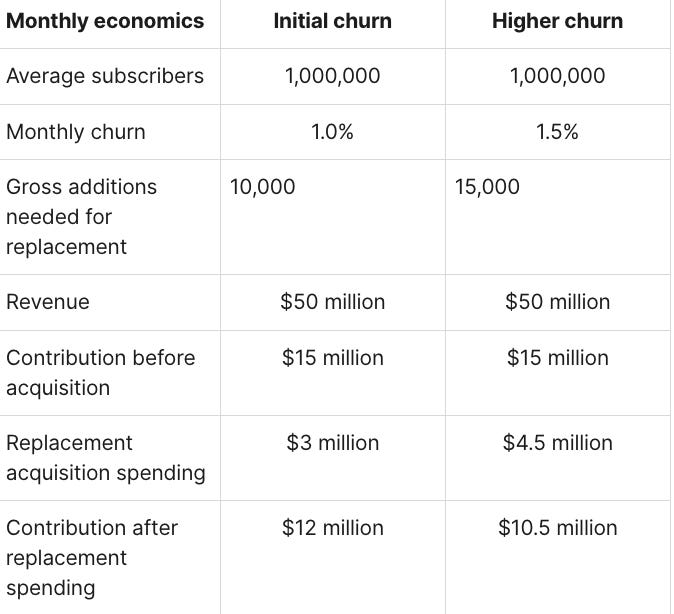
The business ends up losing 12.5 percent of its monthly contribution after spending money to replace its lost customers, even though both the number of customers and the revenue remain the same.
This is only an example and should not be regarded as a forecast for any particular company. It supposes that the cost of acquiring customers and the profit per subscriber remain unchanged, and it fails to take into account fixed costs, taxes, or accounting differences. The idea is that net additions can mask deteriorating business conditions, since a greater number of new customers might be required merely to maintain the status quo.
A company could prevent an increase in churn by offering larger discounts to retain its customers. Although the number of customers and the retention rate might then appear satisfactory, the actual prices it receives would decrease. The problem would then become evident in a different section of the financial statements.
The defense can consume the benefit
It is possible that company executives will argue that AI reduces customer service expenses or makes marketing more efficient. While such savings are significant, they do not, by themselves, provide a complete answer to the question.
In that example, the cost of replacing lost customers would be an additional $1.5 million per month, and the company would have to save that amount elsewhere to maintain the same level of profit. Even if the cost of acquiring a new customer fell from $300 to $200, the total cost of the higher number of replacements would still be $3 million, so the extra churn would be offset in this simple model.
A clear test is therefore available to investors. While AI agents can make it easier for customers to leave, the same technology can also reduce costs for companies when acquiring and serving new customers. The statement that “AI is good for margins” does not tell the whole story unless both sides are considered.
There is also the problem of who receives the value. If customers begin to use an agent to compare prices and make purchases, the company may lose some of its previous advantage and end up paying fees to a new intermediary. Consumers will not receive all the savings, as referral fees, commissions, and paid access can take a portion.
The company that controls the customer’s next purchase may end up being more important than the one that served them previously.
What to look for in reported results
Start by examining the figures on gross additions, gross departures, and acquisition spending since these are reported by companies. When net additions remain constant, but replacements increase, this situation should be explained. Moreover, care should be taken when defining churn since subscriber churn, account churn, and revenue churn have different meanings.
Now look at the real prices that customers are paying. Even if large renewal discounts are offered, fewer premium customers or more promotional months can keep the number of customers stable but reduce profits. Changes in average revenue can result from the product mix, so no single figure provides the full picture.
How long customers stay is another helpful sign. If new and long-time customers pay very different amounts, it could mean some revenue depends on people not checking their options. This is just a place to start looking, since older plans or different service levels can also explain the gap.
In the end, it is necessary to verify whether competitors can actually profit from customers who leave. A competitor offering a low initial price at a loss poses less of a threat than one that has genuine and sustained cost advantages. It is just as important to consider how long the challenger can survive as it is to assess how easy it is to spot them.
When retention earns its valuation
The case for switching is less strong when customers clearly favor their current provider after comparing available options, when switching involves risk, or when the amount of money saved by using AI is sufficient to offset the increased competition. Limits on how quickly people will switch also include trust, access to their transaction data, and clear permission to take action.
Before assigning a high valuation to a company, investors should investigate why customers remain. Although a long relationship may indicate excellent service, it might merely be because it is difficult to leave.
Loyalty that lasts even after customers compare their options is more valuable. As people get better tools, this difference might show up in company earnings before it shows up in overall spending.