


Most articles about AI and money follow the same pattern. They estimate how much value AI could create, point out how big that number is, and then assume AI companies will get all of it.
But that is not true. The most important thing we found this year is the size of the gap between value created and value collected.
In the past few weeks, we built something new: a model that shows how AI actually turns into cash. Rather than just measuring market size, we mapped out where the money goes and who gets it.
Here is what came out.
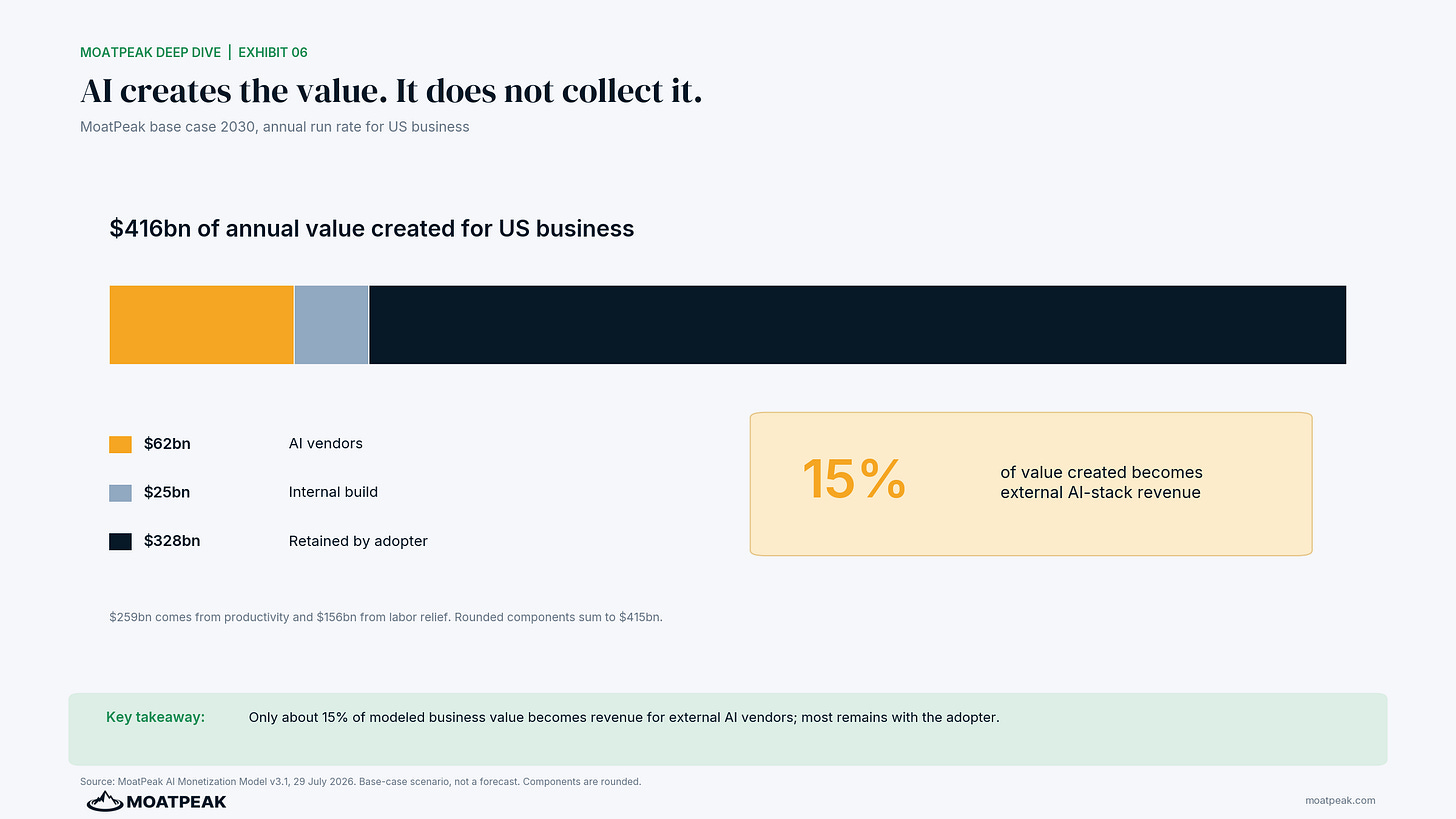
In our main scenario, by 2030, AI will create about $416 billion in value each year for American businesses. Of that, around $62 billion will go to AI vendors as revenue. About $25 billion will be spent on internal upgrades, and roughly $328 billion will stay with the businesses using AI or benefit their customers through lower prices.
So, only fifteen cents of every dollar created ends up with the companies selling AI.
This is a scenario model, not a prediction, and all the assumptions are ours and open to debate. Still, even if you question many of these assumptions, you will probably get a similar result. That outcome is what matters.
Creating value and capturing value are not the same thing.
Take the example of a spreadsheet.
Excel created huge value for the global economy. It changed entire professions. Microsoft earned a real, but relatively small, share of that value through license fees. Most of the benefit went to users, who got faster accounting and better decision-making.
This is typical for any truly useful general technology. As the tool becomes widespread, competition lowers its price close to the cost of providing it, so most of the benefit goes to users and their customers. So when you hear that AI is worth trillions, the real question is not whether that number is accurate, but who can actually charge for it. A business might gain $100 in value but only pay a small part of that to the model provider, cloud provider, software vendor, and systems integrator. As an investor, you only own that small part, not the full $100.Due, counted only once
AI generates money for a company in just two ways, and it is important not to consider the same benefit twice.
The first way is by doing more with the same people: more output, more revenue, faster turnaround, and fewer errors. In our base case, this adds up to about $259 billion, or roughly 62% of the total.
The second way is by needing fewer resources. Payroll costs rise more slowly because some roles are left unfilled, departing employees are not replaced, and fewer contractors are used. This accounts for about $156 billion, or the remaining 38%.
Many published estimates make a common mistake here. One productivity improvement cannot be counted as both extra output and lower payroll costs. If the benefit leads to more output, it does not also lower the wage bill. Our model separates these effects and then calculates how much of each becomes profit for the business as well as revenue for the AI industry.
If you see a forecast that adds productivity gains and labor cost savings together without separating them, it is double counting. The total will be about twice as high as it should be.
A test that is rarely done
So far, we have focused on how much value exists. The key question is whether that value is enough to cover the cost of building the AI infrastructure.
You cannot answer this by multiplying $416 billion by a price-to-sales ratio. That number shows value delivered to customers, not actual sales by vendors. Also, you cannot directly compare an annual flow to a total amount of invested capital.
So we took a different approach. We looked at the capital invested in chips, data centers, and power, calculated the annual revenue needed for a normal return, and compared that to what the AI industry can realistically sell.
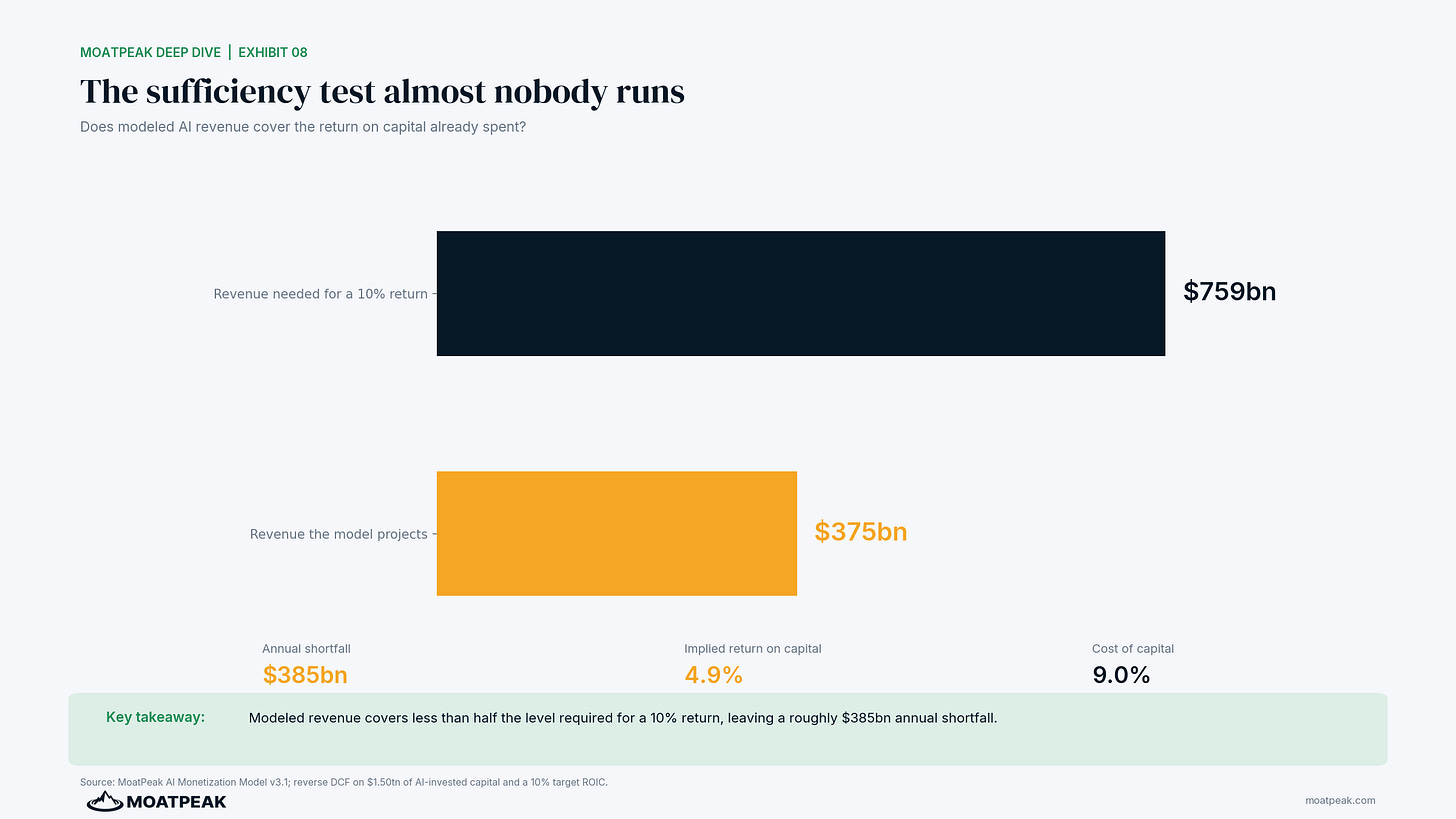
Based on our assumptions, about $1.5 trillion invested in AI would need around $759 billion in annual revenue to get a 10% return. The entire AI sector can actually sell about $375 billion. This is a generous estimate, as it covers the global market, includes budgets shifting from older software, cloud, and outsourcing, and accounts for new categories that did not exist before.
This covers just 49% of the revenue needed.
This means the implied return on that capital is 4.9%, while the cost of capital is about 9%. That leaves a gap of about $385 billion each year.
Read this carefully, because it is easy to misunderstand. We are not saying that AI will fail or that the technology will disappoint. Our point is more specific: a technology can work exactly as promised and still not generate enough returns to cover the cost of the capital invested in it.
This has happened before. Railways ran successfully and transformed countries, but many investors lost money. The same thing happened with fiber optic cables in 2000. The internet works, and the cables are still in use, but most of the companies that installed them did not survive to benefit from it.
Being useful and being profitable are not the same. Only profitability gives returns to investors.
So who really benefits financially?
This is the part most negative commentary misses.
If $328 billion out of $416 billion stays with the companies using AI, the real opportunity may not be with the companies selling AI. Instead, it could be with businesses quietly building a margin advantage because their costs are rising more slowly than their revenue. It’s a challenging investment. There is no stock symbol for it. You have to look at regular businesses and see if their revenue per employee is growing faster than the industry average.
The same logic applies within the AI industry. The part of the industry that spends the most capital does not keep the most profit. Compute and cloud services take about 30% of the external AI budget and most of the capital. Workflow software and integration earn a similar share of revenue but need much less capital.
If there is an oversupply of compute, profits shift to applications, integrators, owners of unique data, and customers. The technology succeeds, but the capital-heavy part of the industry earns less than its cost of capital. Both outcomes can happen at the same time, and they do not contradict each other. Many people think automation affects the lowest-paid workers first. That was true in previous waves, but it is not the case this time.
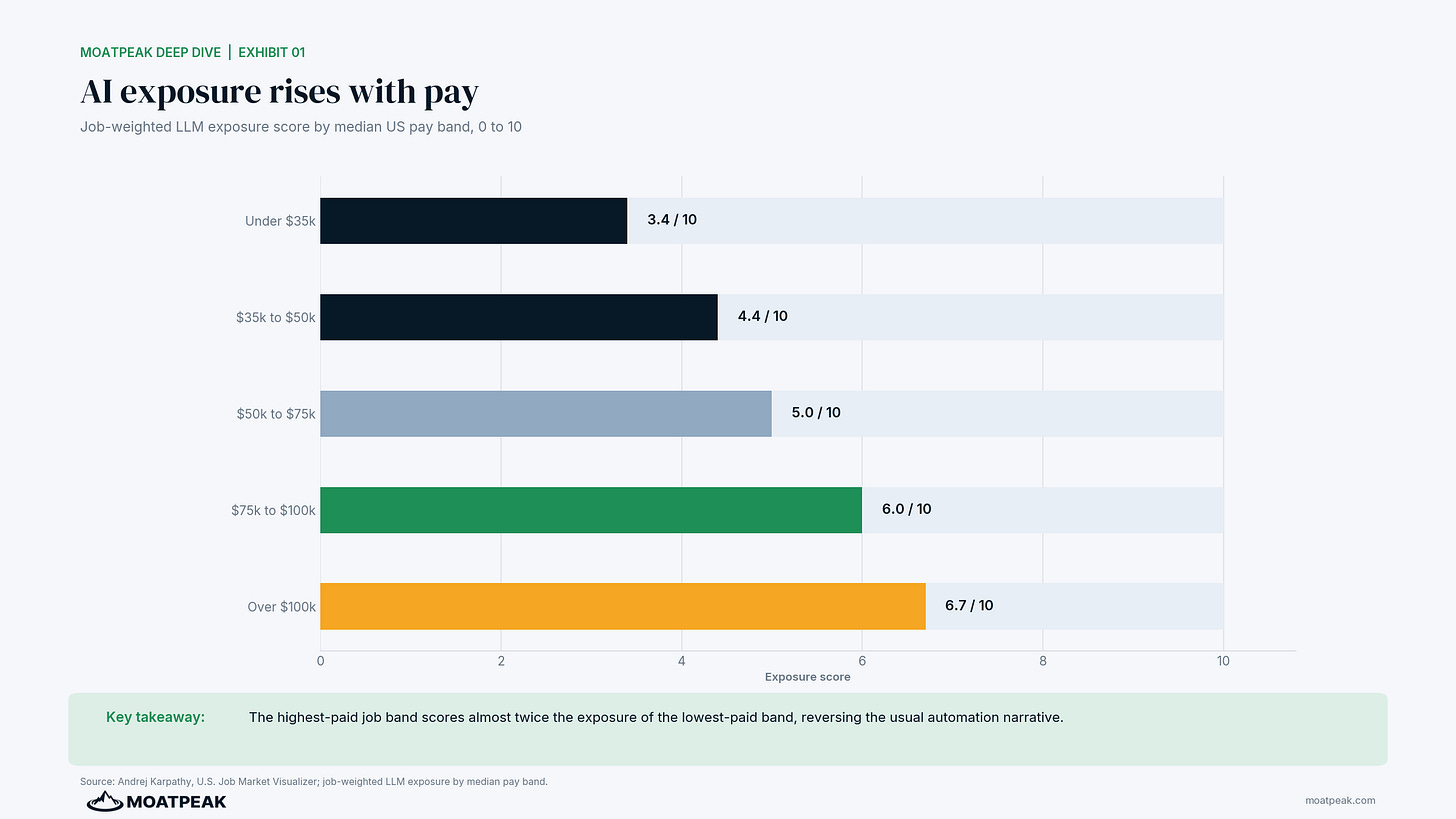
If you rate every US job by how much of the work AI can do, and then look at how many people have each job, you find that jobs paying over $100,000 score 6.7 out of 10. The average for all jobs is 4.9, while jobs paying under $35,000 score 3.4.
Higher-paid desk jobs are about twice as exposed to AI as lower-paid manual jobs. Software still struggles with moving physical objects in unstable environments, but it is very good at handling documents, code, contracts, and claims.
But exposure is not destiny, and this is where most articles on the subject stop too soon.
DataData scientists have an exposure score of 9 out of 10 and are expected to grow by 34%. Bookkeeping clerks also score 9 out of 10 but are projected to decline. Both have the same exposure, but opposite outcomes. The difference comes down to one question: when the work becomes cheaper, does demand increase or decrease? When analysis gets cheaper, companies do more of it, so demand grows. Cheaper bookkeeping does not make anyone want more bookkeeping; the amount stays the same, and the price drops.
That question, not the exposure score, decides whether a job or industry will grow. What is happening right now
It is important to base this discussion on what businesses actually report, not just on their public statements.
Researchers from the Atlanta Fed, Bank of England, Bundesbank, and Macquarie University surveyed nearly 6,000 CEOs and finance chiefs in four countries about AI’s real impact on their firms. The results were sobering, with both positive and negative findings.
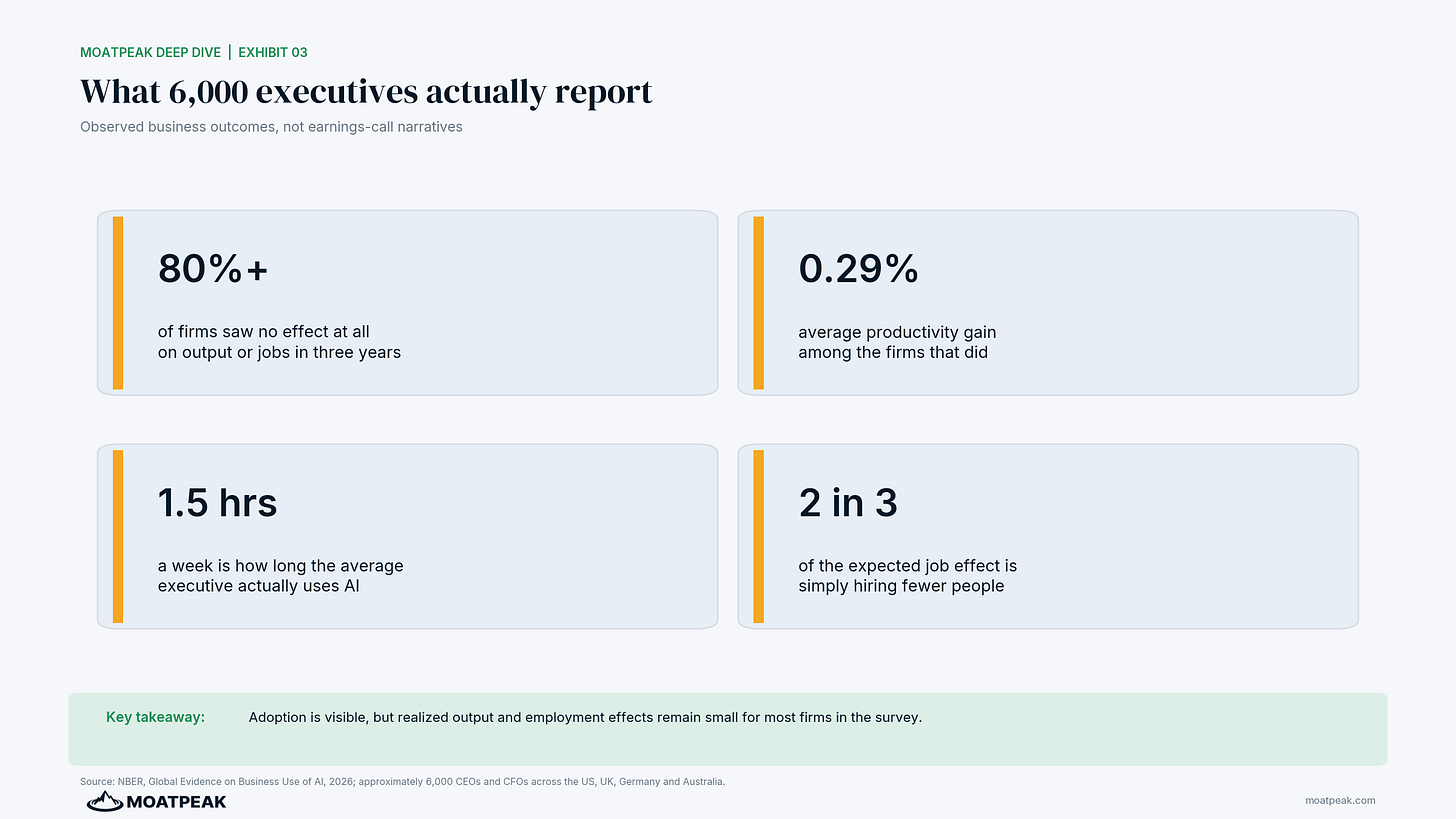
Over 80% reported no impact on employment or productivity in the past three years. For the few who did see a change, the average productivity gain was just 0.29%.
Two-thirds of these executives use AI themselves for about an hour and a half each week, while a quarter do not use it at all.
Projecting forward three years, they expect productivity to rise by 1.4%, employment to fall by 0.7%, and net output to go up by about 0.8%. About two-thirds of the job reduction comes from hiring fewer people, not from layoffs.
One detail stands out. The same researchers surveyed about 3,000 American employees. These workers use AI for 1.8 hours a week, a bit more than their executives. They expect AI to increase their company’s headcount by about 0.5% over three years, while their executives expect a 1.2% reduction.
The employees think AI will lead to more hiring, while the executives think it will result in fewer jobs. Both groups are talking about the same three-year period.
We wouWe would not bet against the people who control the budget. What could change our view is publishing this because it is the honest way to hand you a model.
The gap would close quickly if AI providers capture much more value than we assume, if the actual capital base is closer to $1 trillion instead of $1.5 trillion, or if global demand grows faster than we expect. Any of these would make the outlook more balanced.
The gap would widen if the remaining specialists become more expensive as headcount drops. If average pay rises as roles are reduced, the labor savings disappear, and so does much of the revenue that was meant to justify the investment. This risk is rarely discussed and is a warning sign for optimists. Our two estimates of the payroll channel, built from the top down and the bottom up, land 2.1% apart. That is a reassuring number, and it is not independent confirmation. They share too much logic. We would rather tell you that than call it validation.
What we are monitoring
We track nine indicators, but three are most important, and none of them is AI spending.
The key indicators are: revenue per employee growing faster than the industry average, compensation as a share of revenue falling compared to output, and the hiring counterfactual. This last one means jobs a company planned to add but quietly decided against.
The last indicator changes first and is silent. It is not a layoff announcement, but a job posting that never gets published.
The full model, every assumption, every lever, and the reverse DCF are in this week’s report.
Read it and more at moatpeak.com
Educational research only. Not customized investment advice. MB “MoatPeak Group”.