


Last week, the S&P 500 increased by 0.49 percent while the equal-weight version of that index decreased by 0.44 percent.
That is correct as well; it is the difference between the two that is most important.
The impact of one trading session was greater than that of the entire week.
On Thursday, 27 August, the S&P 500 gained 55.29 points. For the entire week, the net increase was 37.39 points, and the other four sessions lost 17.90 points in total.
Thursday’s gain amounted to 148 percent of the week’s total. On the Nasdaq, the figure was even more striking: it had risen by 411.15 points on a single day compared to a weekly gain of 221.97, or 185 percent. On the other four days, 189.18 points were lost.
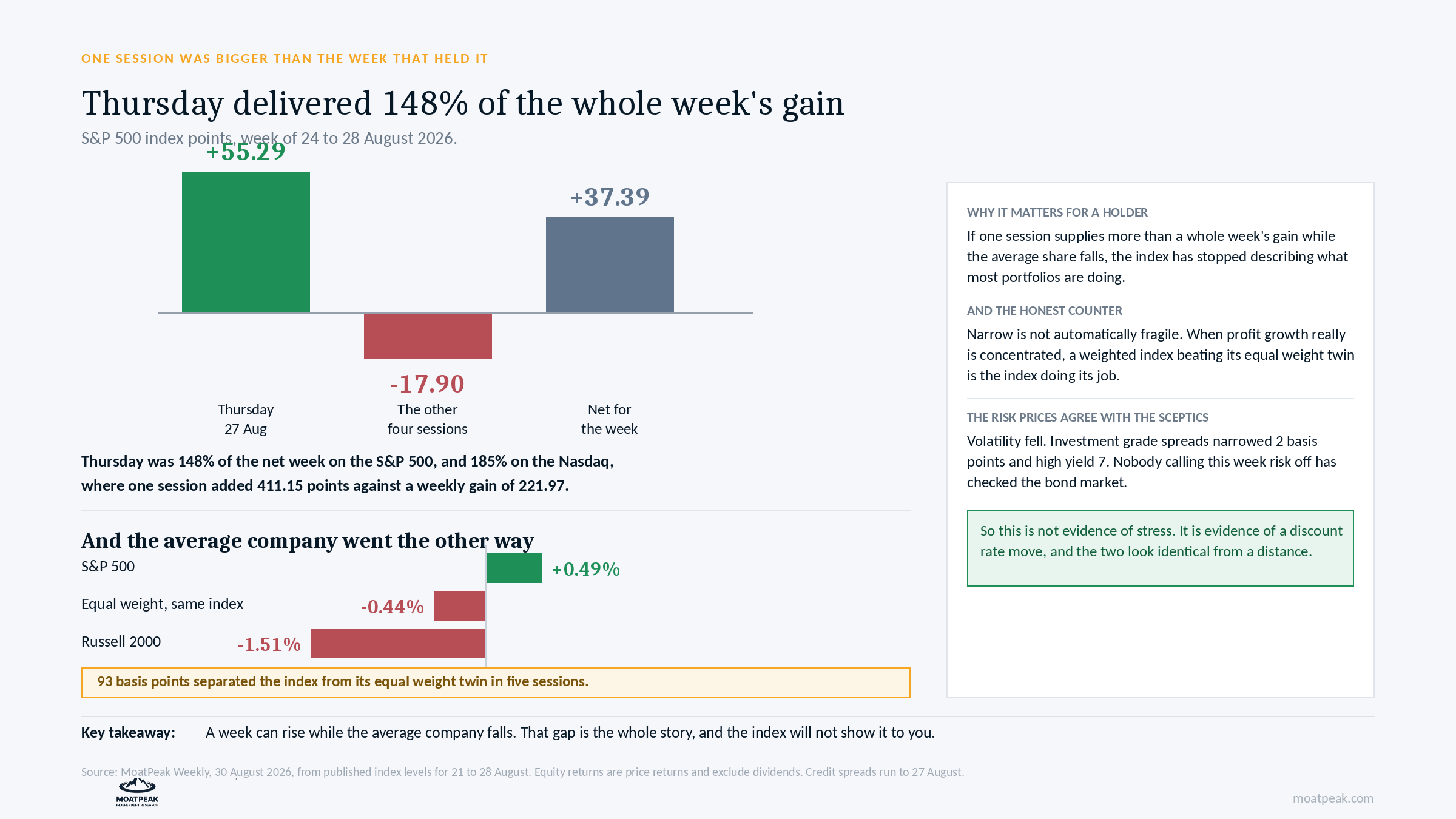
Most companies, underneath the surface, took the opposite course. The Russell 2000 fell by 1.51%. The proportion of S&P 500 stocks trading above their fifty-day average decreased from 57.76% to 53.47%. Over the course of five sessions, the main index had outperformed its equal-weight counterpart by 93 basis points.
There is a good argument against viewing this as an indication of weakness, and it should be given consideration. If profit growth is actually concentrated among a small number of companies, then a weighted index beating its equal-weight counterpart is only showing that situation, not pointing to a problem. Nvidia’s revenue increased by 106% over the last year, whereas the average company in the index did not.
The risk indicators align with the skeptics’ perspective since volatility had fallen from 15.13 to 14.46, with investment-grade credit spreads narrowing by 2 basis points and high-yield spreads narrowing by 7, both figures being those for Thursday. Generally, credit markets pick up on problems before the stock markets do, but this week they showed no signs of concern. People who are describing this as a risk-off week have not looked at the bonds, the credit markets, the dollar, or volatility.
The difference between us is less than it appears. The fact that there is a breadth gap is not proof of stress; it is instead a sign of a change in the discount rate, and such a change affects two channels simultaneously. When real rates rise, expensive growth companies are compressed due to their valuation duration, since a large part of their value is tied up in the distant future. At the same time, smaller companies are squeezed as a result of higher refinancing costs and their greater reliance on external capital. Though the mechanisms are different, the result is the same, and in both cases the effect is felt most where the index has the fewest holdings.
Nvidia performed better in every aspect, but it proved to be one of the least effective methods of investing in AI to own its stock this week.
Three companies gave their reports after the market closed on Wednesday. Nvidia’s results were almost perfect according to its own standards: it achieved revenue of $96.2 billion, which represented a year-on-year increase of 106% and a quarter-on-quarter rise of 18%, with data center revenue amounting to $89.0 billion and the gross margin remaining at 75.0%. The company stated that its guidance for the October quarter was about $108 billion, compared with consensus estimates of nearly $105 billion, and made it clear that the guidance assumes no data center computing revenue from China.
Nvidia’s share price increased by 1.32 percent that week.
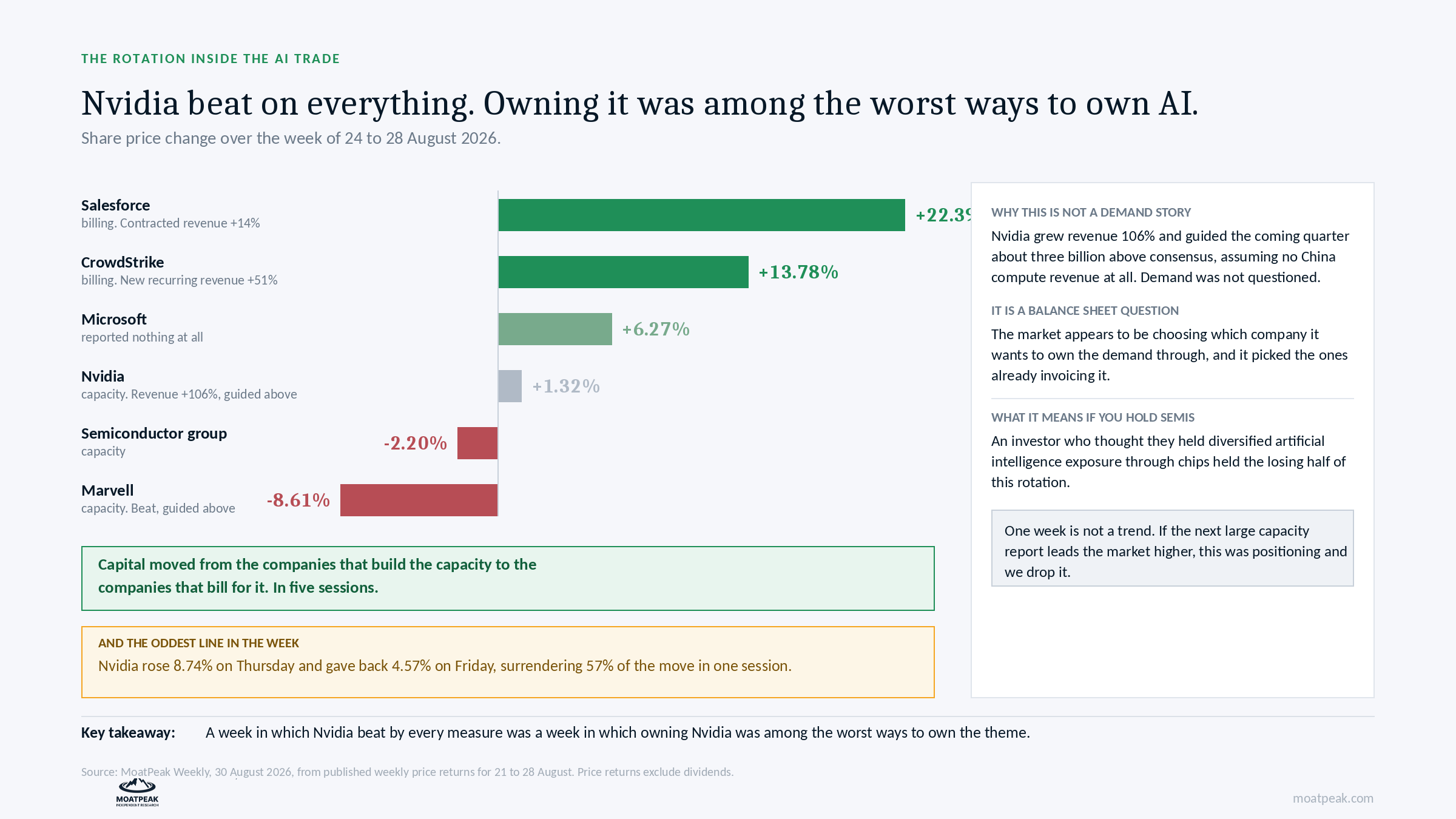
Salesforce rose by 22.39 percent, and CrowdStrike increased by 13.78 percent. Although Marvell surpassed its own guidance and had forecasted better results for the following quarter, its share price fell by 8.61 percent. The semiconductor sector as a whole declined by 2.20 percent.
Microsoft, since it had reported nothing, increased in value by 6.27 percent and was the most successful of the seven largest technology companies.
This is the key point of the week and it doesn’t indicate that investors doubt the demand for AI; rather, it reveals which companies’ balance sheets the market wants to gain from that demand. Over the course of five sessions, funds moved from companies that were developing their AI capabilities to those which were already earning money from them.
The most unusual action of the week was taken by Nvidia; its shares rose by 8.74% on Thursday before falling 4.57% on Friday and thus losing back 57% of the previous day’s gain within a single session.
The hawkish morning priced in less inflation, not more.
It is here that the majority of the reports made the mistake.
On Friday the chairman of the Federal Reserve delivered his first speech at Jackson Hole and the probability that interest rates would be increased in September rose from around 35 per cent to the upper 50s. The headlines emphasized a cautious central bank, higher yields and falling share prices, indicating that there was an inflation problem.
The market indicated the contrary.
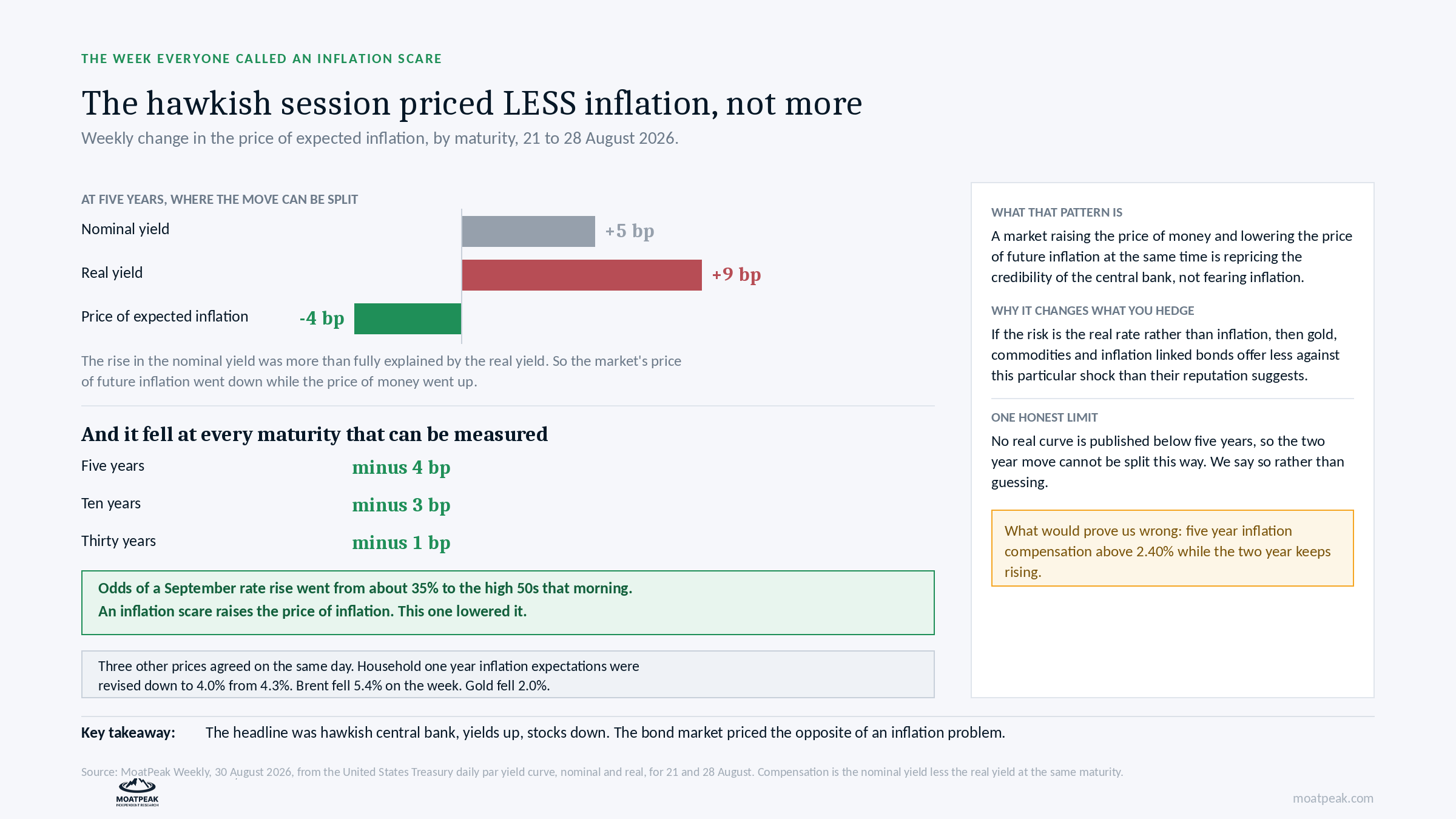
For the five-year maturity, which is the shortest at which this analysis is applicable, the nominal yield rose by 5 basis points and the real yield increased by 9; this indicates that the inflation compensation, which is the difference between the nominal and real yields, decreased by 4 basis points. At the ten-year point it decreased by 3, and at thirty years by 1.
Normally, an inflation scare causes the price of expected inflation to rise but this time it declined at all maturities for which it could be measured.
On the same morning, three other prices were agreed upon. The rate of inflation for households over the next year was lowered to 4.0% from an initial estimate of 4.3%, this figure being less than the 4.2% recorded in July. The October contract for Brent dropped by 5.38% during the week. Gold also declined by 2.04%.
When the market increases interest rates while at the same time lowering its expectations of future inflation, it is acting to demonstrate credibility, not out of fear of inflation.
One obvious limitation is that the Treasury does not provide a real yield curve for maturities of less than five years, so we can’t analyze the two-year change in the same way.
What it changes
The most important point for investors is the discount rate, not the company’s earnings. When the primary risk is higher real interest rates rather than inflation, gold, commodities, and inflation-linked bonds offer less protection against this type of shock than is generally expected. Moreover, at the present time, it is less risky to hold long-term bonds than to hold long-duration stocks. Investors who currently base their AI investments on rising valuations rather than higher earnings estimates face real rate risk, which has become both more expensive and more apparent this week.
Before they are reported elsewhere, here are two points to make clear.
The payrolls figure hasn’t actually been reduced. The statistics bureau has issued a preliminary estimate stating that employment in March 2026 will later be lowered by 79,000 and private employment by 178,000. Since both amounts are less than the average annual revision of 0.2% over the last ten years, this is a normal adjustment. The changes will not be reflected in the published payrolls until February 2027. People who claim the payrolls have just been cut by 79,000 are describing something that hasn’t happened.
Second, the majority of the retail margin increases this week were the result of tariff refunds, not because of improved business performance. For instance, 680 of the 850 basis points of margin gained by Dollar Tree, about 81 of the 127 gained by Dollar General, and 37.5 of the 60 gained by Best Buy were attributable to refunds. This shows that between 62.5% and 80% of the reported improvement came from one-off refunds. These are not subsidies, they won’t occur again, and next year’s comparison will be more difficult.
What would prove us wrong
If the two-year yield falls below 4.24 percent, yet the equal weight index continues to lag behind the cap-weighted index, then our explanation based on real rates for the breadth gap ceases to be valid, and some other factor must be involved. We will admit that if this situation arises.
With regard to inflation, if the five-year compensation rate goes above 2.40% while the two-year yield continues to rise, this would indicate that the market is anticipating an inflation issue which the central bank is having difficulty in controlling.
If the next large-cap report causes the market to rise next week, then this was a one-week positioning move and we should drop it.
The complete weekly report – this includes the cross-asset scoreboard, the daily breakdowns, a detailed analysis of the earnings for the week’s top performer, and a table listing the strongest evidence against our thesis – is available at moatpeak.com.
This content is for educational purposes only and does not constitute personal investment advice. MB “MoatPeak Group”.