


The strategic reserves are now at their lowest level in 44 years, refineries are running at their highest rate since 2018, gasoline stocks are 6 per cent below normal and, in the week ending on Labor Day, gas prices reached a record high while diesel prices also hit an all-time high.
A useful approach to examining the energy situation is to look at oil prices, whereas a better one is to consider the amount of capacity the system still has available to cope with new problems. This information can be obtained from five free reports issued by the government and motoring associations.
Five key numbers from one week
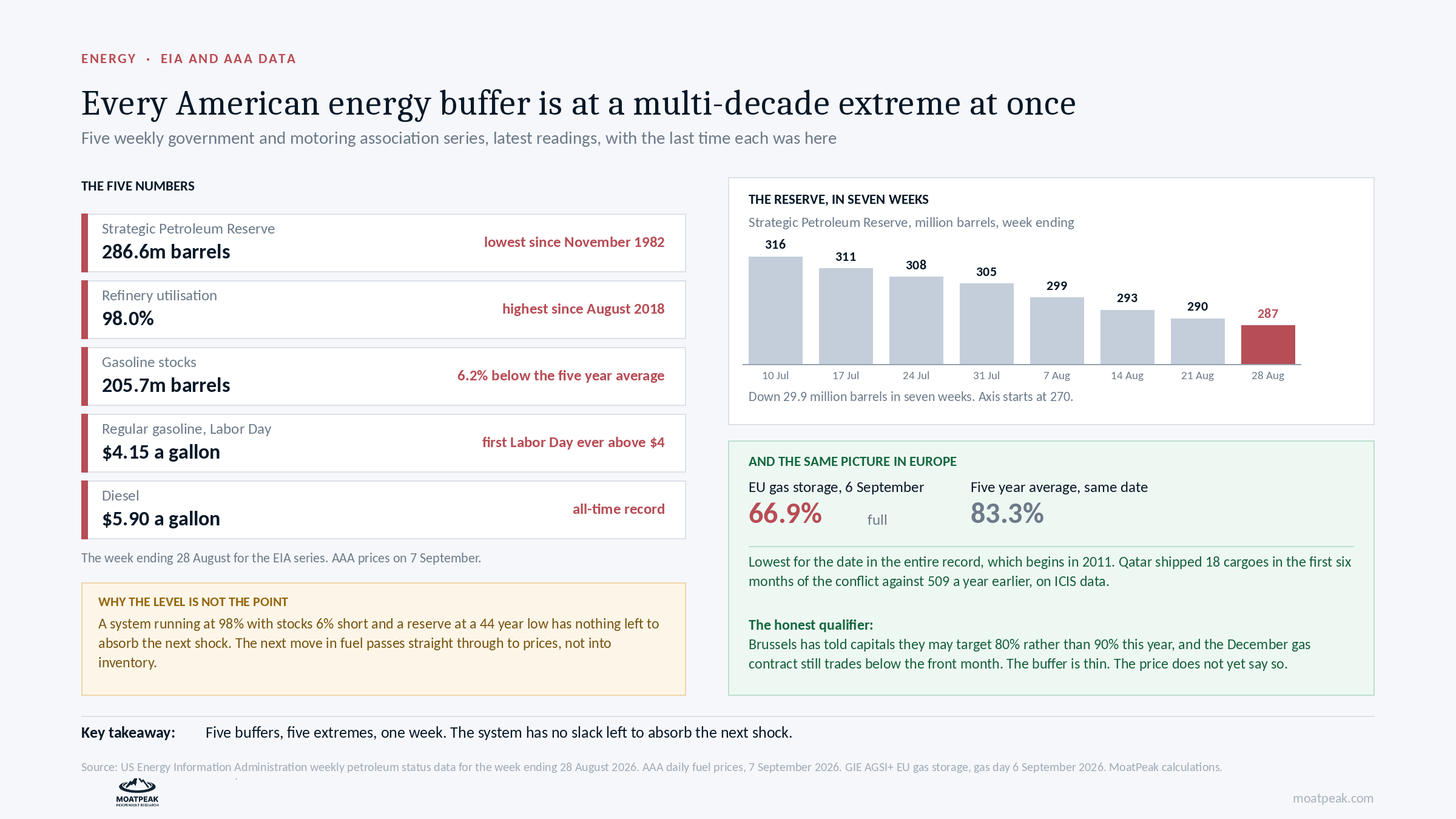
The Strategic Petroleum Reserve is at a level of 286.6 million barrels, which is its lowest point since November 1982; it has lost 29.9 million barrels in just seven weeks, the figure having been 316.5 million in mid-July.
The refineries are currently working at 98% of their capacity, which is the highest level seen since August 2018; the weekly record of 100.5%, achieved in 1998, means that there is very little room for an increase.
The amount of gasoline on hand is 205.7 million barrels, which is 6.2 percent less than the five-year average for this week.
On Labor Day, regular gasoline averaged $4.15, making it the first Labor Day to exceed $4 in the series’ history, the previous record having been $3.82 in 2012.
Diesel prices have hit $5.90, breaking the record for the highest ever.
Each of those numbers is significant by itself; having all five together indicates that the system has no reserves remaining, whether they are in oil storage or at the gas pump.
Why the level is not the point
Although gas prices will be in the headlines, they are in fact the least important of the five indicators.
A refinery operating at 98% cannot be increased to 103%, since if demand rises or supply falls there is no extra capacity to draw on and so prices rise rather than output being boosted. The fact that stocks are 6% below normal means there is a smaller amount of inventory available to meet any shortfalls. Because the reserve is at a 44-year low, the government now has a smaller buffer, particularly after having drawn down 30 million barrels this summer in order to maintain prices.
If you take all this into account, the next shock – no matter what it is – will go directly to consumer prices and company margins rather than being taken up by the reserves. The point here is concerning how shocks are passed on, not about predicting whether one will occur.
The same picture on the other side of the Atlantic
On June 6, European gas storage reached 66.9%, compared with the five-year average of 83.3% for that date, the lowest level seen since 2011. The weather is not to blame. ICIS data show Qatar shipped only 18 cargoes in the first six months of the conflict, compared with 509 the previous year, and its exports have not resumed.
There are two points worth mentioning. Although the legal target for storage is 90%, there is now a floor of 80%, and Brussels has permitted member states to use it this year; as a result, the gap between the current level and the required amount is smaller than in previous years. Moreover, the December gas contract is currently trading below that of the present month at around €74, indicating that the market believes winter will not be worse than autumn. Although the buffer is narrow, prices do not yet show this.
What is priced, and what is not
Brent oil for the present month is currently being traded at $99, whereas the March contract is at about $86. The $13 gap indicates that the market anticipates a return of supply to normal levels within six months. Yet the facts mentioned above do not depend on the idea being incorrect; instead, they show the kind of damage that could result from a wrong assumption.
The Federal Reserve will hold its meeting next week, with futures indicating that interest rates could be raised by around 60 basis points by the end of next year. Consumer price data will be released on Friday, and the ISM services price index is currently at 72.6, the same level as in August 2022. Available policy tools are poorly suited to price shocks caused by supply issues, since raising rates does not increase oil supply, and both rate cuts and fiscal support are currently limited.
What would change our reading
When the reserve is refilled or ceases to shrink, when refinery usage falls below 95% because demand has decreased (not due to a malfunction), and when gasoline stocks have reached the five-year average by the end of October, the system will have regained some buffer. If that situation arises, this article would refer to a peak. We shall continue to publish these three free weekly figures.
The habit
If a price is given in the headlines, then check the buffer associated with it—that is, the inventory, capacity, or reserve. The price reflects what has already taken place, while the buffer indicates what the next problem will cost.
For more information about our research, visit moatpeak.com.
Educational research only. Not personalized investment advice. MB “MoatPeak Group”.