


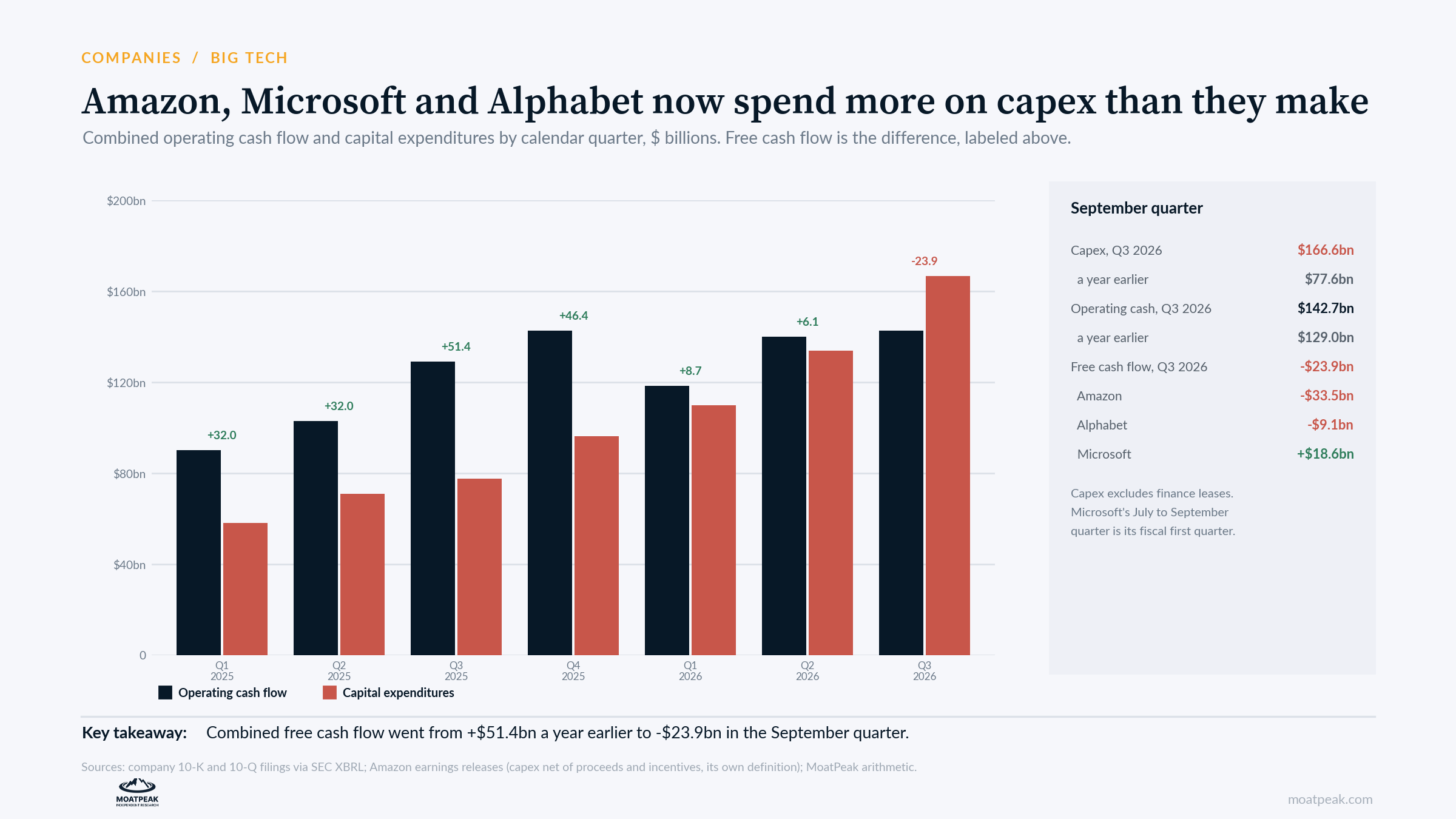
Amazon reported on Thursday, completing the picture for the three largest US cloud companies. Between July and September, Amazon, Microsoft and Alphabet together spent $166.6 billion on capital projects. A year earlier, they spent $77.6 billion.
Their combined operating cash flow grew too, by 11 percent to $142.7 billion. It did not keep up. Free cash flow, the cash left after capital spending, was minus $23.9 billion for the three together, against plus $51.4 billion in the same quarter last year.
Amazon’s quarter
Amazon’s business has rarely looked better. Operating income reached $28.1 billion, and the 13.9 percent operating margin was the highest in its history. AWS sales grew 39 percent to $46.0 billion, the fastest growth in nearly five years.
The cash looked very different. Operating cash flow was $42.4 billion, and capital spending, net of proceeds and incentives, was $75.9 billion. That left free cash flow of minus $33.5 billion in a single quarter, and minus $42.4 billion over the past 12 months, against plus $14.8 billion a year earlier.
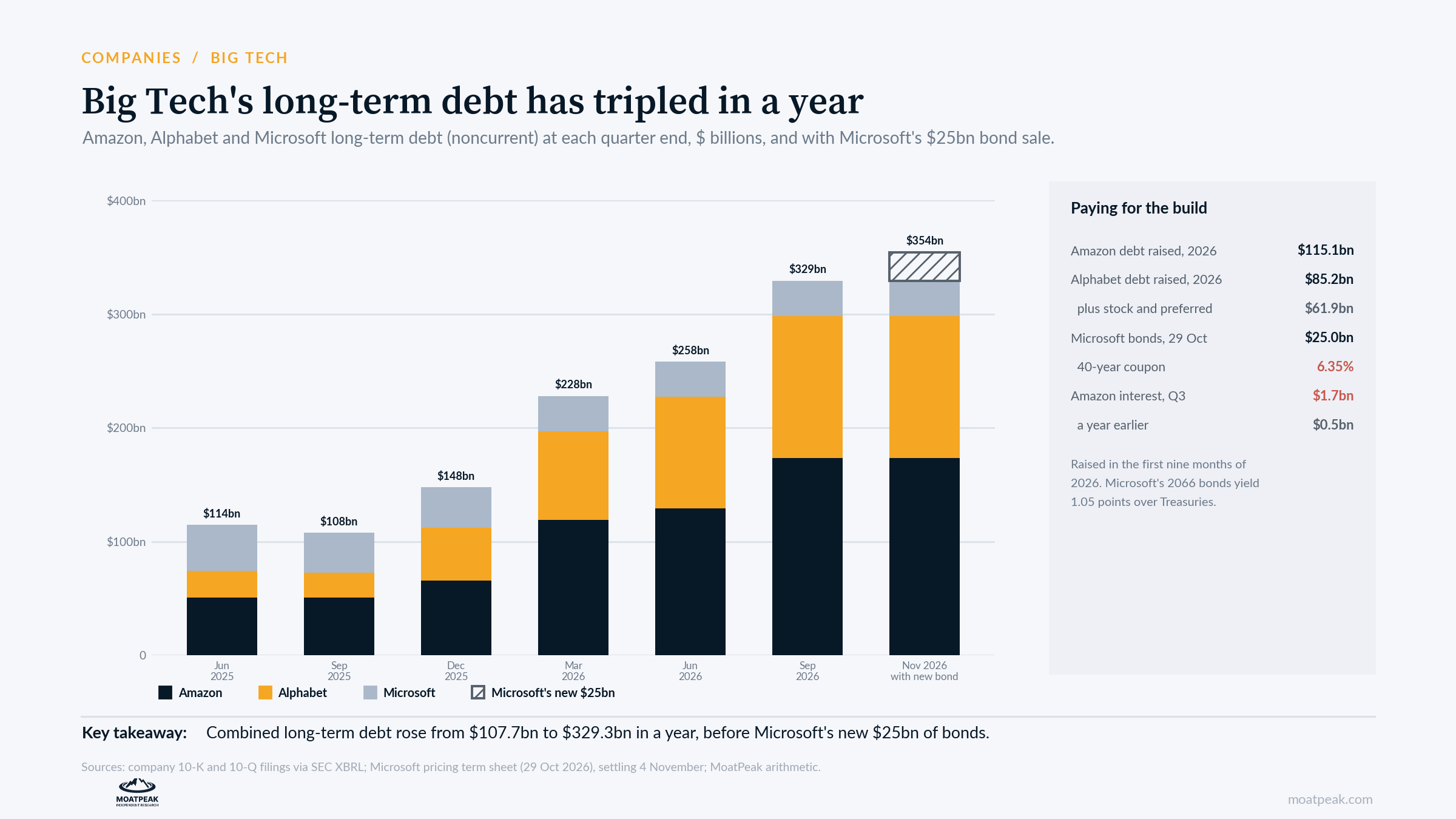
Amazon closed the gap with debt. It raised $115.1 billion of long-term debt in the first nine months of the year, including $48.1 billion in the third quarter. Long-term debt rose to $173.1 billion from $65.6 billion at the end of 2025, and quarterly interest expense more than tripled, to $1.7 billion from $0.5 billion.
The other two
Alphabet’s free cash flow was minus $9.1 billion, its second negative quarter in a row. This year it has raised $85.2 billion of debt and $61.9 billion of common and preferred stock, and it has bought back no shares.
Microsoft is the only one of the three still producing free cash flow, $18.6 billion in the quarter. On Thursday, it still sold $25 billion of bonds in 10 tranches, maturing from 2028 to 2066. The 40-year bonds carry a coupon of 6.35 percent, 1.05 percentage points above the Treasury benchmark, and Microsoft holds the highest credit rating there is.
Together, the three companies’ long-term debt has risen from $107.7 billion a year ago to $329.3 billion, before Microsoft’s new bonds settle on 4 November.
Our read
The AI build has outgrown the cash machines that started it. For years, the largest technology companies paid for capital spending out of operating cash and still bought back shares. Today, two of the three spend more than they generate, and all three are borrowing.
That changes what investors should watch. When capital spending came from surplus cash, the main question was whether it would eventually pay off. Now it is financed at a visible price, from 4.9 percent for two-year money to 6.35 percent for 40-year money at Microsoft, and higher for weaker borrowers. The new capacity has to earn more than that, and bondholders get paid before shareholders.
It also ties the build to the credit markets. As long as lenders stay open at these prices, the spending can continue. If they demand more, the cheapest place to save money is the capital budget.
The case against us
These are among the strongest balance sheets in the world. Amazon generated $168.3 billion of operating cash over the past 12 months, Alphabet holds $265.1 billion of cash and securities, and Microsoft borrowed at 0.25 to 1.05 percentage points over Treasuries. Borrowing at 5 to 6 percent to build assets that may earn far more is a rational choice.
The demand looks real. AWS growth accelerated to 39 percent, and Amazon expects growth above 40 percent in both 2027 and 2028. Microsoft’s Azure grew 48 percent, and Google Cloud more than doubled.
Capital spending can be lumpy. One quarter of very heavy spending, especially at Amazon, may overstate the run rate.
What it means for your money
Score free cash flow, not capital spending. Capex shows ambition. Free cash flow after the spending shows whether the business funds itself.
Watch the new bonds. Microsoft’s 2066 bonds now trade in the open market. If their yield gap over Treasuries widens, lenders are asking more to fund the build.
Check where the returns go. With buybacks shrinking and interest costs rising, more of the value these businesses create goes to lenders before it reaches shareholders.
What we are watching
Wednesday 4 November: the Treasury’s quarterly refunding announcement, which sets the supply of the long-term bonds that corporate debt is priced against.
4 November: settlement of Microsoft’s $25 billion of new notes.
Early next year: fourth-quarter results and capital spending plans for 2027 from all three.
Educational research only. Not personalized investment advice. MB “MoatPeak Group”.
The number that stuck with me is $329.3 billion of long-term debt against $107.7 billion a year ago. The build is no longer funded by the cash machine, it is funded by the bond market, which makes the marginal investor in AI capex a lender rather than a shareholder. Your Microsoft 2066 watch is the right instrument for this: the 1.05 point spread held at issue, and if it widens, the equity story has to carry weight it has not carried in years. One question: with AWS at 39% and guiding above 40% through 2028, is there a growth rate at which the negative free cash flow stops mattering, or does the debt number keep the question open no matter what the top line does?
Molto bello, ottimo articolo chiaro. Sembra che abbiano cominciato un ciclo di investimenti che durerà anni, non pochi trimestri o solo uno o due anni. Le spese non sono basse.