


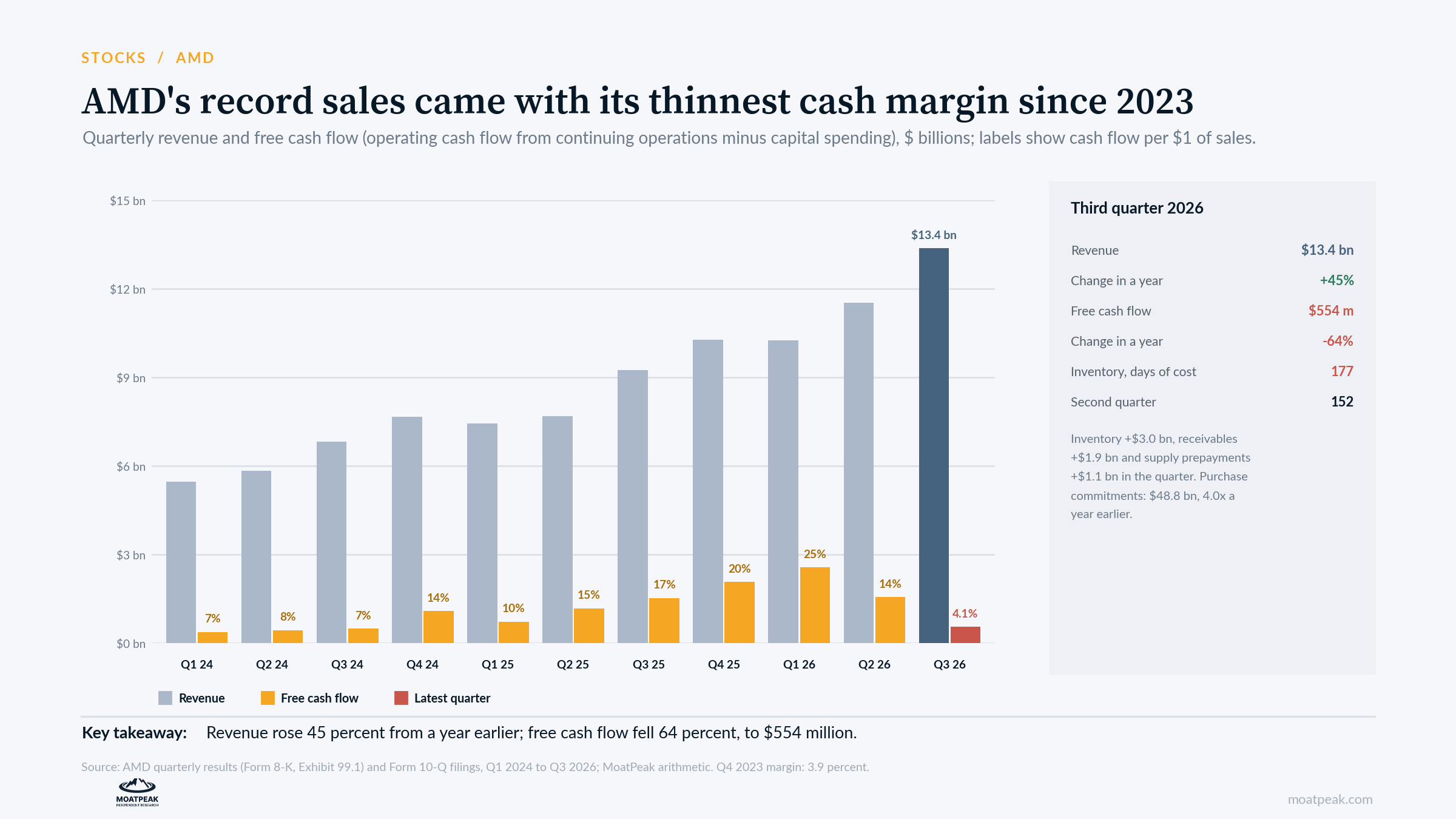
By the usual yardsticks, AMD’s third quarter was its best ever. Revenue rose 45 percent from a year earlier to $13.4 billion, data center sales nearly doubled to $8.5 billion and the company guided fourth-quarter revenue to about $17 billion, 66 percent above a year earlier.
The cash flow statement tells a second story. Free cash flow, operating cash flow from continuing operations minus capital spending, fell 64 percent to $554 million. That is 4.1 cents per dollar of sales, the thinnest margin since the fourth quarter of 2023 and down from 25 cents in the first quarter of this year.
We think that gap matters more than the beat. AMD is funding the AI build-out in two ways: with its own working capital now, and with up to a fifth of its share count later.
Where the cash went
Three items absorbed $6.0 billion in the quarter. Inventory rose $3.0 billion to $11.5 billion, up 35 percent in three months. Receivables rose $1.9 billion to $9.2 billion. Prepaid expenses and other assets rose $1.1 billion; over nine months, AMD attributes that line’s increase mainly to prepayments under supply agreements. Suppliers carried part of the load. Accounts payable rose $2.3 billion and, at $7.8 billion, are 2.6 times their level at the end of December.
Measured in days, inventory now covers 177 days of cost of sales, up from 152 in the second quarter and 158 a year earlier. Customers take 63 days to pay, up from 57.
The commitments behind the inventory grew faster still. AMD’s purchase commitments reached $48.8 billion at the end of September, up $18.5 billion in one quarter and four times their level a year earlier. Of that, $22.2 billion falls due in 2027.
Debt has filled part of the gap. AMD raised $4.7 billion of debt and commercial paper this year, and total debt rose to $7.1 billion from $3.2 billion in December. The balance sheet remains strong, with $15.8 billion in cash and short-term investments, or $8.7 billion in net cash.
The share bill
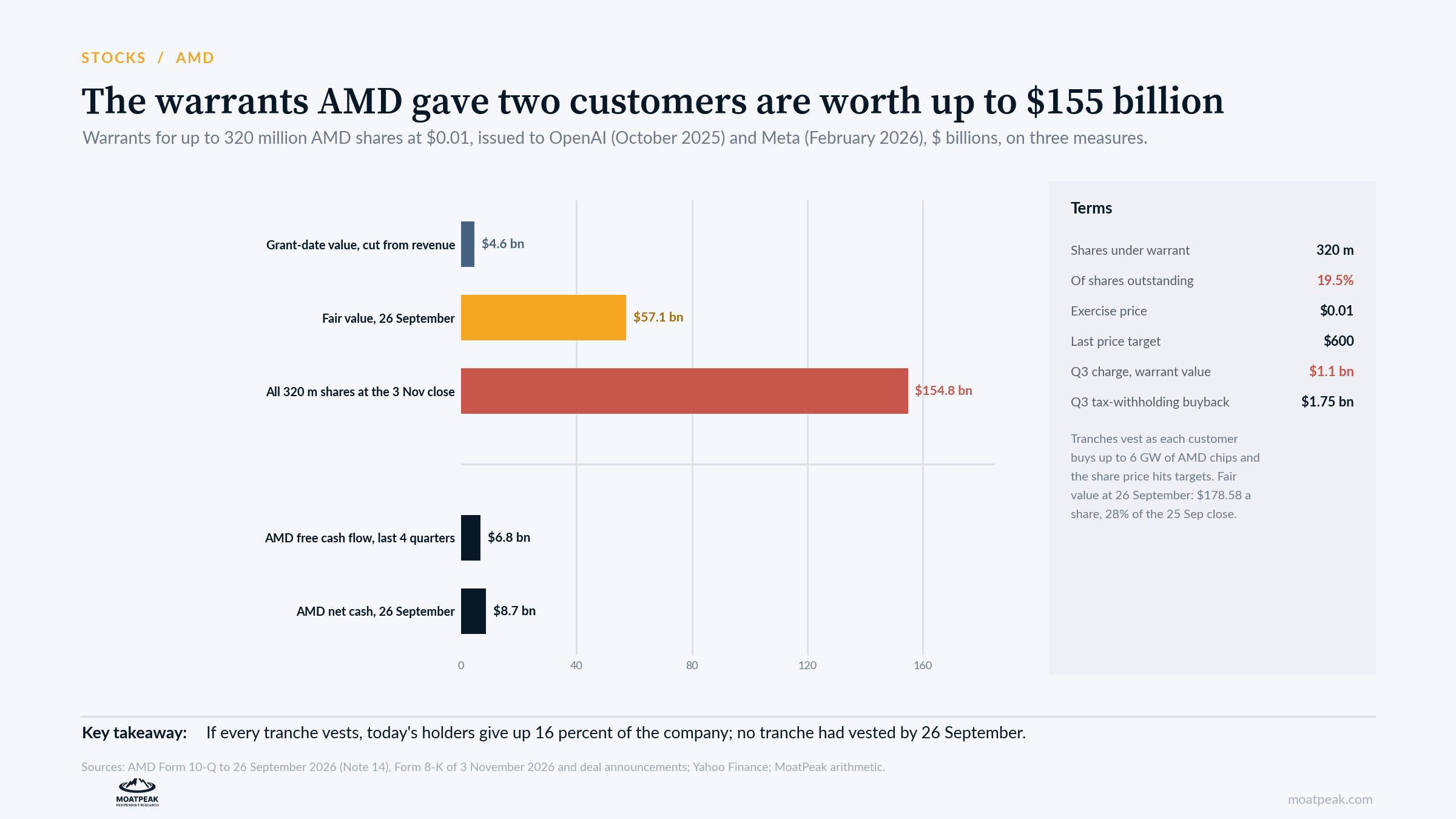
The second cost does not show up in the cash flow statement. In October 2025, AMD gave OpenAI warrants to buy up to 160 million AMD shares at one cent each, and in February 2026 it gave Meta the same. Tranches vest as each customer deploys up to 6 gigawatts of AMD chips and as AMD’s share price reaches set targets, the last of them $600. No tranche had vested by 26 September.
Together the warrants cover 320 million shares, 19.5 percent of the 1.64 billion outstanding. If all of them vest, current holders will own 84 percent of the enlarged company.
In our view, the accounting understates the cost. AMD deducts only the grant-date value, $14.25 a share or about $4.6 billion in total, from revenue as the customers buy. The quarterly filing puts the fair value as of 26 September at $178.58 a share, or $57.1 billion, based mainly on the share price and AMD’s estimate of the odds that the customers meet the purchase milestones. That value was 28 percent of the 25 September close. At the 3 November close of $483.90, the full 320 million shares are worth $155 billion, 23 times the free cash flow AMD generated over the past four quarters.
The change in value since the grant runs through other income. In the third quarter, it produced a $1.1 billion noncash charge, one reason GAAP earnings of $1.46 a share trailed the adjusted $2.09. Employee stock has a cash cost too: AMD spent $1.75 billion in the quarter withholding shares to pay employees’ taxes on vesting stock, more than three times its free cash flow.
Our read
AMD is winning the AI business it wanted, and paying for it the way a company buys market share. The 45 percent growth is real, but this quarter it turned into almost no free cash. Inventory, prepayments and purchase commitments are bets that the fourth quarter and 2027 will be as big as guided. If they are, the cash comes back. If orders slip, the balance sheet that funded the growth becomes the risk: $11.5 billion of inventory, $48.8 billion of commitments and $7.8 billion owed to suppliers.
The warrants change how we value the company. Anyone valuing AMD on the OpenAI and Meta revenue should also count the shares that come with it, 1.96 billion rather than 1.64 billion. At the 3 November close, that lifts the market value to about $950 billion from $794 billion, or 140 times free cash flow over the past four quarters.
The case against us
The inventory has a purpose. AMD is ramping its Helios rack systems and MI450 chips for the customers behind the warrants, with first deployments scheduled for the second half of 2026. Building stock ahead of a guided $17 billion quarter is what a supplier should do, and if fourth-quarter sales land as guided, inventory days should fall quickly.
Prepayments secure scarce capacity. Advanced chip and memory supply is tight, and paying in advance can lock in volumes that competitors cannot get.
The warrants pay for themselves if they vest. Full vesting requires 12 gigawatts of purchases and a $600 share price for the last tranches. In that world, AMD’s revenue and market value would be far higher, and holders would accept the dilution. Without the warrants, AMD might not have won either contract.
What it means for your money
Count the warrant shares. If you value AMD on the OpenAI and Meta contracts, use about 1.96 billion shares. The revenue and the dilution come together.
Watch cash conversion, not just revenue. The fourth quarter is the test. If revenue reaches about $17 billion and inventory days fall toward 150, the inventory build was a timing issue. Rising inventory with slowing growth would be the warning.
Expect noisy GAAP earnings. The warrant liability is marked to AMD’s share price each quarter, so a falling share price adds to GAAP profit and a rising one subtracts from it.
What we are watching
Early February: fourth-quarter results, with free cash flow, inventory days and whether the first warrant tranches vest.
The 2026 annual report: purchase commitments by year and any change in supply prepayments.
First gigawatt deployments: the milestones that trigger the first tranche for each customer.
Educational research only. Not personalized investment advice. MB “MoatPeak Group”.
Excellent analysis that goes beyond what has been said (a lot, perhaps too much) about AMD in recent days. Looking at growth without evaluating its financial sustainability over the investment time horizon can be misleading. And giving others options on your stock look doesn’t seems so.