


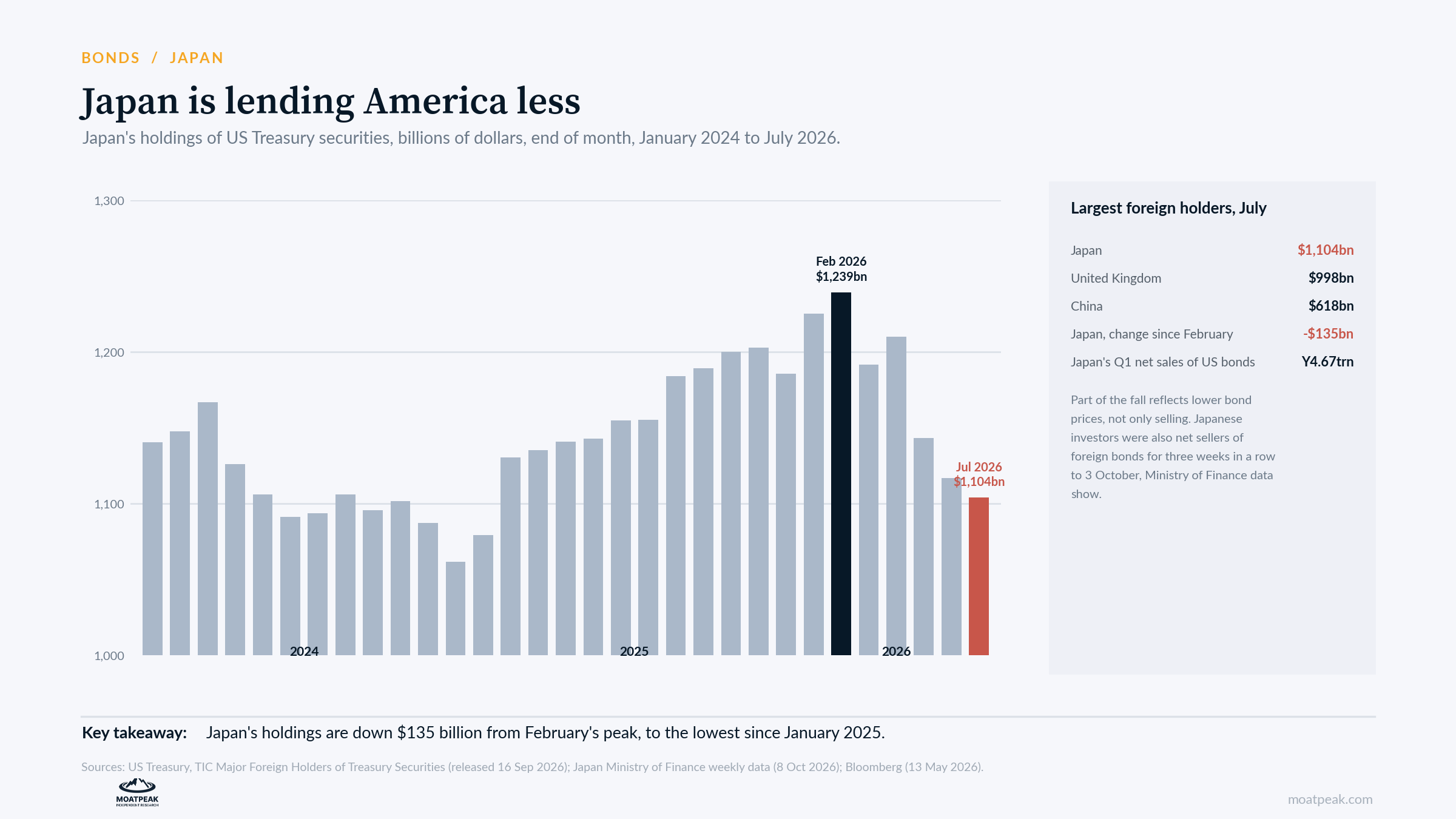
Japan is the largest foreign owner of US government debt. At the end of July, Japanese investors held $1.10 trillion of Treasury securities, according to US Treasury data. The UK was second with $998 billion, and China was third with $618 billion.
That pile is shrinking. In February, Japan held $1.24 trillion, the most since February 2022. By July, it had fallen by $135 billion, or 11 percent, to the lowest level since January 2025.
Some of that drop is about prices, not selling. When yields rise, the bonds investors already own lose value, and the holdings data reflect that. But there is real selling too. Japanese investors sold a net 4.67 trillion yen, about $29.6 billion, of US government and related bonds in the first quarter, the most for any quarter since 2022, Bloomberg reported. Japan’s Ministry of Finance data also show that its investors were net sellers of foreign bonds for three weeks in a row through 3 October.
The math behind it
For decades, Japanese investors had a simple reason to buy Treasuries: bonds at home paid almost nothing. That reason is gone.
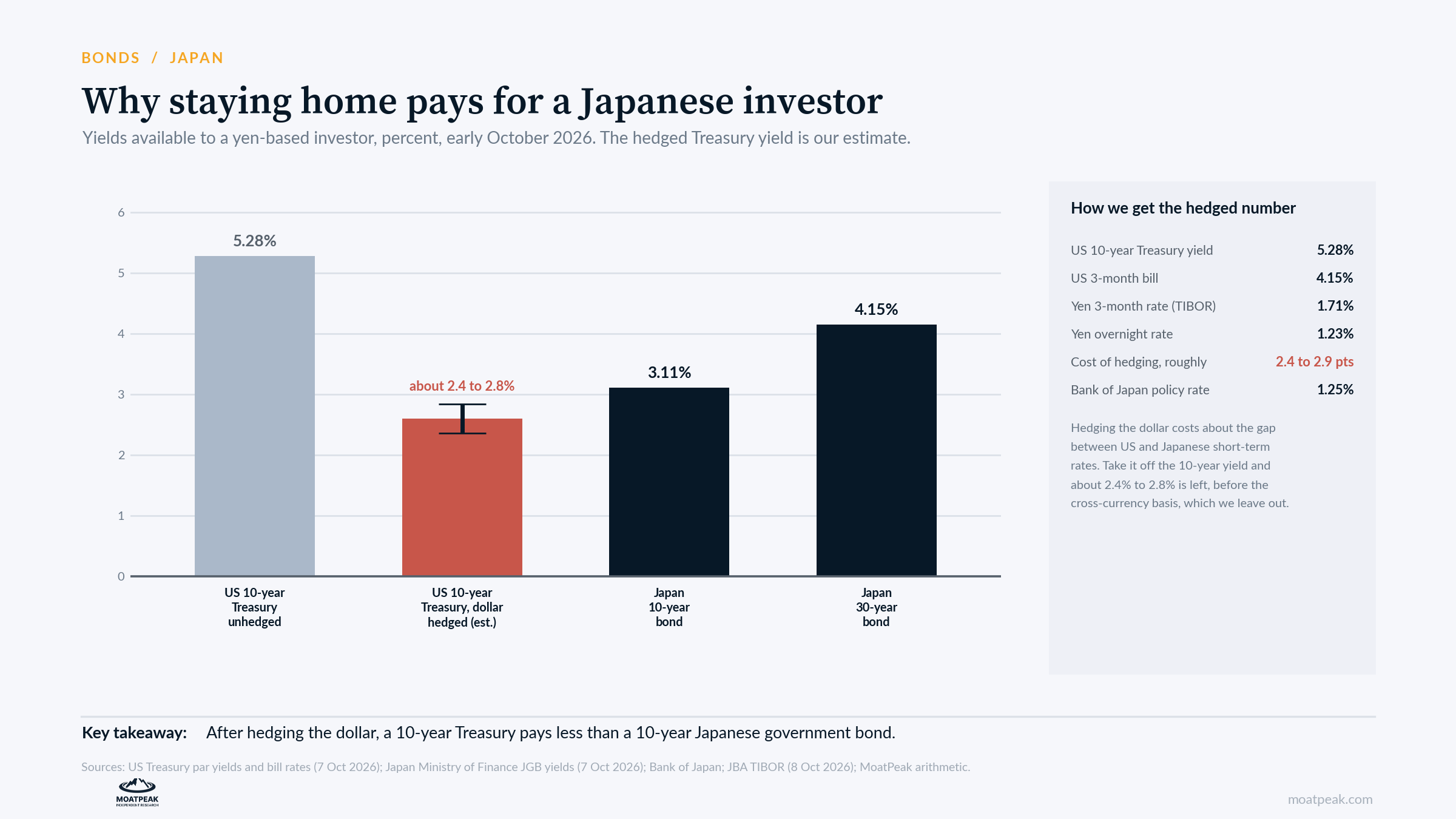
On 7 October, a 10-year Japanese government bond paid 3.11 percent, and a 30-year paid 4.15 percent. A 10-year Treasury paid 5.28 percent. That looks like an easy win for the Treasury. But many large Japanese investors, such as life insurers, hedge their dollars so that a swing in the exchange rate does not wipe out their returns.
Hedging is not free. Its cost is roughly the gap between short-term interest rates in the two countries. A 3-month US Treasury bill yields about 4.15 percent. Short-term yen rates are about 1.2 to 1.7 percent. So hedging costs about 2.4 to 2.9 percentage points a year, and that comes straight off the Treasury’s yield.
Take it off, and a hedged 10-year Treasury pays about 2.4 to 2.8 percent. A 10-year Japanese bond pays 3.11 percent with no currency risk at all. This is our own arithmetic, and it leaves out a smaller technical factor in hedging called the cross-currency basis.
The investment firm PIMCO made the same point in August: “With 10-year Japanese government bond (JGB) yields comparing favorably with U.S. Treasury yields on a currency-hedged basis, Japanese investors have become net sellers of long-term U.S. debt.”
Why it matters now
The timing is awkward for Washington. On Thursday, the Treasury sold $22 billion of 30-year bonds at 5.618 percent, the highest yield at a 30-year auction since 2000. CNBC called the demand solid, but the Treasury had to pay a high yield. When the biggest foreign buyer steps back, someone else has to take its place, and new buyers usually want a higher yield.
Japan is also changing at home. The Bank of Japan raised its policy rate to 1.25 percent in September, and it is buying fewer of its own government’s bonds: about 2.3 trillion yen a month this quarter, falling to about 2 trillion yen a month from next April. With the central bank buying less, private investors have to absorb more Japanese bonds. That tends to keep Japanese yields high and makes home even more attractive.
The case against us
Japan is not dumping Treasuries in a panic. It is still the largest foreign holder by a wide margin, and part of the decline reflects lower prices, not sales.
Some Japanese investors buy Treasuries without hedging. For them, a 5.28 percent yield is attractive, and if the yen weakens further, they gain on the currency as well.
And the math can flip. If the Fed stops raising rates while the Bank of Japan keeps going, the gap between short-term rates will narrow. Hedging will get cheaper, and hedged Treasuries will look better again.
What it means for your money
Who buys matters as much as how much. Long-term Treasury yields depend on who is willing to hold the bonds. When the largest foreign holder has a better deal at home, the US has to pay more to attract other buyers.
A headline yield is not what every buyer earns. After hedging, a 5.28 percent Treasury pays a Japanese investor less than a Japanese bond does.
Long-term bonds carry this risk most. Long-dated Treasuries and the funds that hold them are the most exposed if foreign demand keeps fading.
What we are watching
Every Thursday: Japan’s Ministry of Finance data on its investors’ purchases of foreign bonds.
16 October: US Treasury data on foreign holdings for August.
29 and 30 October: the Bank of Japan’s next policy meeting, with new forecasts.
Educational research only. Not personalized investment advice. MB “MoatPeak Group”.