

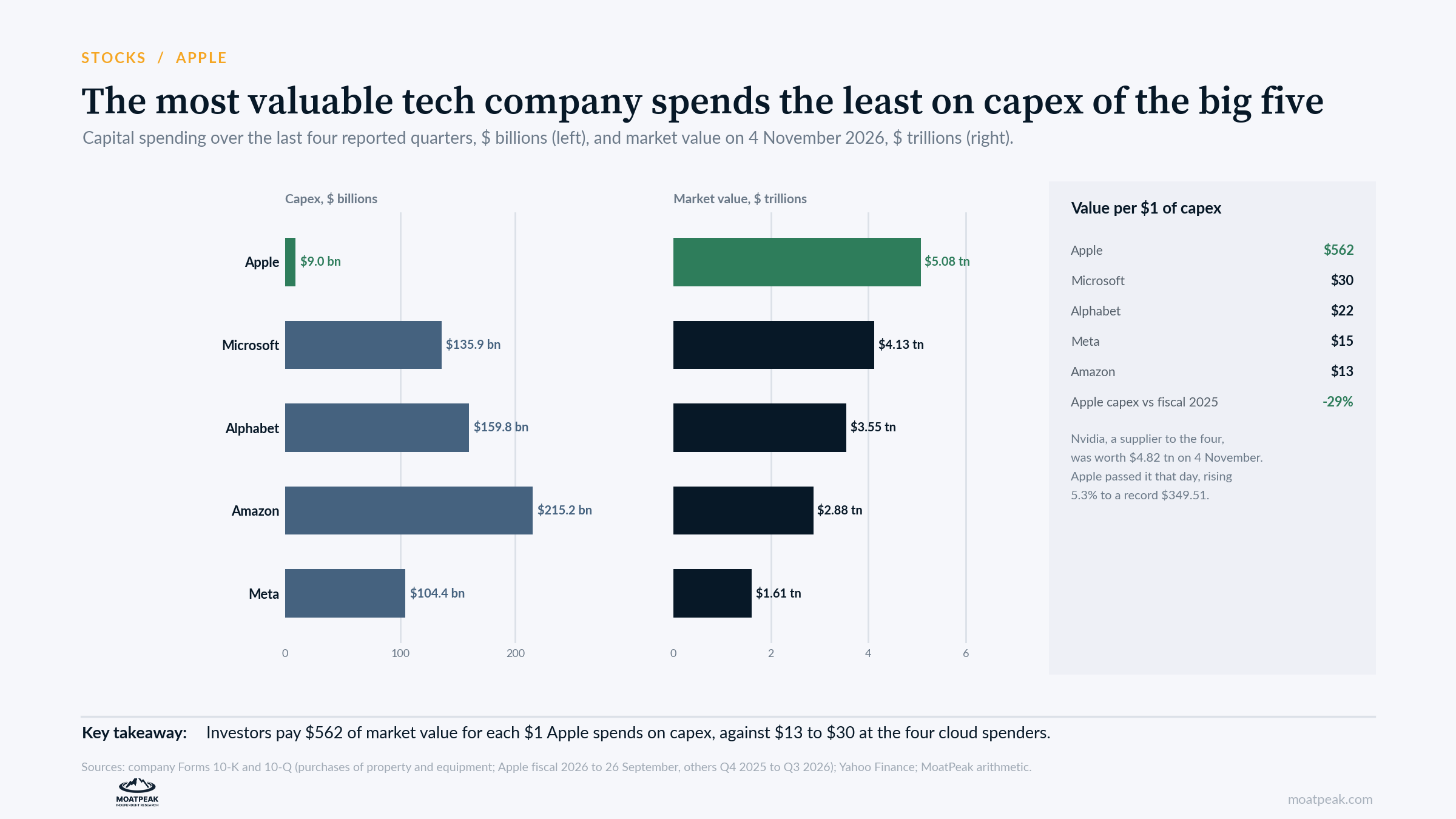
On 4 November, Apple rose 5.3 percent to a record $349.51 and became the world’s most valuable company, worth $5.08 trillion against Nvidia’s $4.82 trillion. Investors worried about the cost of the AI build-out have turned to the one giant that is barely taking part in it.
The business deserves much of the praise. The price now asks a lot of it.
Paid for spending less
Apple spent $9.0 billion on property and equipment in its fiscal year to 26 September, down 29 percent from a year earlier. Over their last four quarters, Microsoft spent $135.9 billion, Alphabet $159.8 billion, Amazon $215.2 billion and Meta $104.4 billion, mostly on data centers. Investors pay $562 of market value for each dollar Apple spends on capex, and $13 to $30 at the other four.
The cash engine is real. Revenue rose 15.1 percent in fiscal 2026, to $478.8 billion, and diluted earnings per share rose 20.4 percent, to $8.98. Free cash flow was about $136 billion, and Apple returned $102 billion of it through buybacks and dividends.
The multiple did much of the work
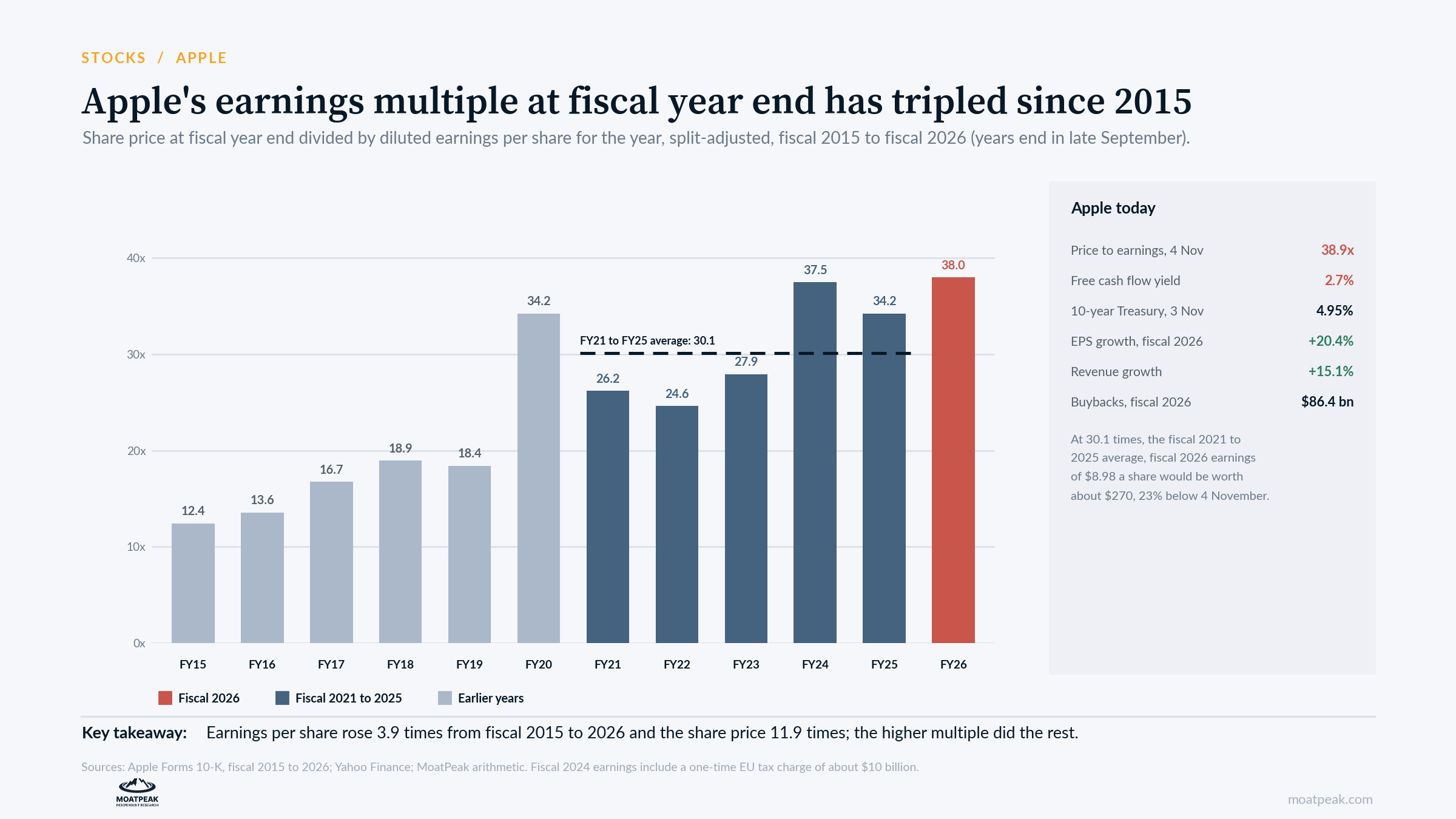
At $349.51, the shares trade at 38.9 times trailing earnings. At the end of fiscal 2015, the multiple was 12.4. Since then, earnings per share have risen 3.9 times and the share price 11.9 times; a multiple that tripled explains the rest.
That leaves a thin cash return. Apple’s free cash flow yield is 2.7 percent, against 4.95 percent on a 10-year Treasury on 3 November. Investors accept a lower cash return because they expect growth and safety.
Our read
Apple has earned a premium this year: faster growth, lower capital needs and no dependence on the payback from AI data centers. A haven at 39 times earnings still carries its own valuation risk. At the fiscal 2021 to 2025 average year-end multiple of 30.1, this year’s earnings would be worth about $270 a share, 23 percent below the 4 November close.
Keeping the premium requires growth near this year’s pace. We would treat Apple as a quality company at a full price, and size it as an equity that can fall, however defensive it looks.
The case against us
Growth may hold. If earnings per share rise 20 percent a year for two more years, the multiple at the 4 November price drops to about 27, below the fiscal 2021 to 2025 average.
Low capex may be the moat. If the AI build-out overshoots, Apple can buy capacity and models from others at lower prices and avoid write-downs.
Buybacks help. Apple’s diluted share count fell 2 percent in fiscal 2026, which lifts per-share growth every year it continues.
What it means for your money
Separate the company from the price. Apple’s results are strong; at 39 times earnings, the price already assumes they stay strong.
Compare cash yields. A 2.7 percent free cash flow yield against a 4.95 percent Treasury yield is the price investors pay for Apple’s perceived safety.
Check your concentration. At $5.08 trillion, Apple is a large weight in most US index funds, so many investors may own more of it than they realize.
What we are watching
17 November: Nvidia’s results, the next read on AI spending and on the rotation toward Apple.
Late January: Apple’s December-quarter results, the first test of whether 20 percent earnings growth carries into fiscal 2027.
Buybacks: the pace in the December quarter, after $86.4 billion in fiscal 2026. A slower pace would remove a steady lift to earnings per share.
Educational research only. Not personalized investment advice. MB “MoatPeak Group”.
This is the part that sticks with me. Apple is spending $9 billion on capex while the cloud giants are spending $100 billion plus, and the market is still paying it 39 times earnings. That only works if you believe the AI spend by the others does not pay off as fast as they hope, or that Apple can rent the capability later without building it. The 2.7 percent free cash flow yield against a 4.95 percent Treasury is the hard bit for me. I am not shorting it, the buybacks and the cash flow are real, but I would rather own the names doing the spending at a cheaper multiple than pay a safe haven price for a company that is sitting this buildout out.