


For most of the past two years, the story about Apple was that it had fallen behind in AI. It did not race to build giant AI data centers the way its peers did. Over the last four reported quarters, Apple spent $10.0 billion on capital projects. Microsoft spent $115.9 billion, Alphabet $132.4 billion and Amazon $173.0 billion.
In 2026, that restraint looks like a strategy. Apple’s shares are up 24.9 percent this year through 20 October, the best of the nine big tech companies we track here, and they sit 1.2 percent below their record. At about $4.95 trillion, Apple’s market value is within about 5 percent of Nvidia’s.
Cash is the scoreboard now
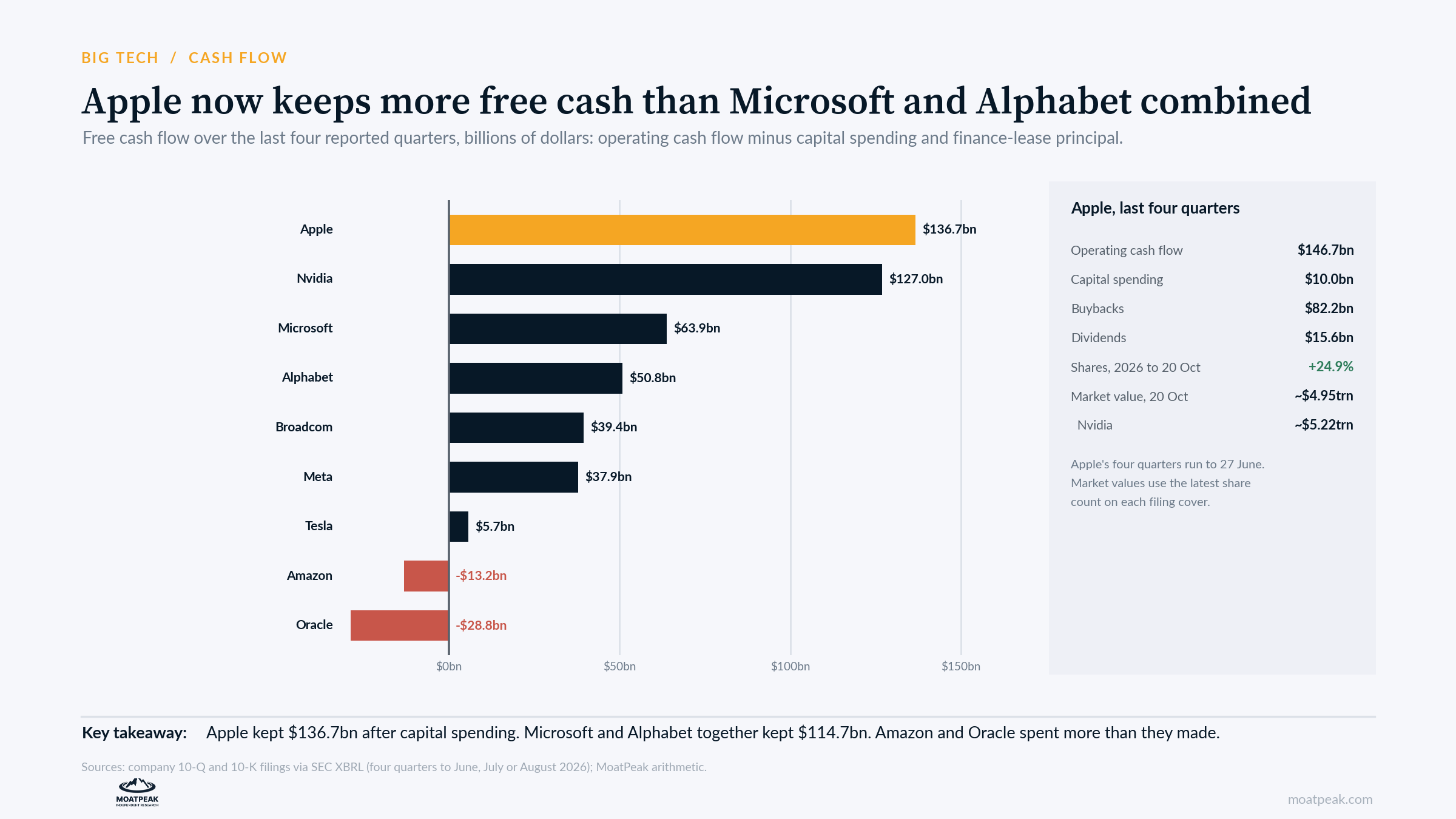
Free cash flow is what a company keeps after paying for its buildings and machines. Over the last four reported quarters, Apple generated $146.7 billion of operating cash and spent $10.0 billion on capital projects, leaving $136.7 billion. Microsoft kept $63.9 billion and Alphabet $50.8 billion, for a combined $114.7 billion. Amazon and Oracle spent more on capital projects than their operations brought in.
Apple returned $97.8 billion to shareholders over the same period: $82.2 billion in buybacks and $15.6 billion in dividends.
This matters more now than it did two years ago. The 10-year Treasury yield is above 5 percent, and bonds from the weakest AI borrowers yield around 15 percent. Investors have started asking which companies can fund their plans from their own cash. A company that does not need to borrow has a cost-of-capital advantage that compounds over time.
The market’s verdict so far
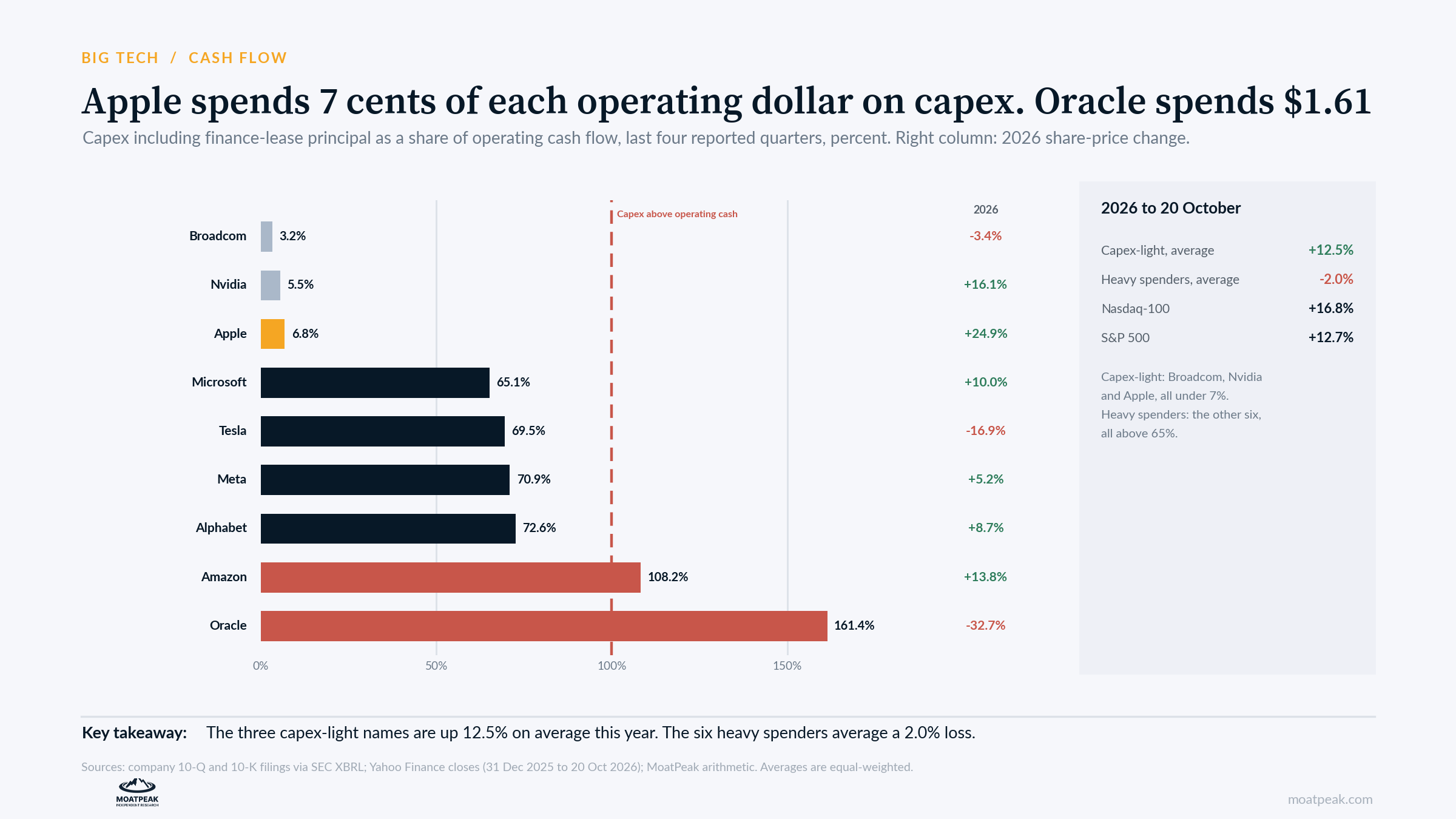
Rank the nine by the share of operating cash that goes into capex, and a pattern shows up. The three capex-light companies, Broadcom, Nvidia and Apple, are up 12.5 percent on average this year. The six heavy spenders, Microsoft, Tesla, Meta, Alphabet, Amazon and Oracle, average a 2.0 percent loss, dragged down by Oracle’s 32.7 percent fall.
The pattern is not clean. Amazon spends more than its operating cash and is up 13.8 percent. Broadcom spends almost nothing and is down 3.4 percent. Nvidia and Broadcom also sell the equipment the others buy, so their low capex is a different story. But the extremes are telling. Oracle, the heaviest spender relative to its cash, is down the most. Apple, which reaches users through its devices rather than its data centers, is up the most.
Our read: distribution is the moat
Apple reported more than 2.35 billion active devices in January 2025. Whoever builds the best AI model still has to reach those users, and much of that path runs through Apple’s phones and App Store. We think that lets Apple rent AI capability rather than own the data centers that produce it, and keep its cash for its shareholders.
The case against us
The shares already reflect much of this after a 25 percent rise this year. If the value of AI shifts to whoever owns the best models, Apple may have to pay more for access or lose some control over how users reach those models. And the heavy spenders could be right. If AI demand pays off, today’s data centers become tomorrow’s moat, and the capex-light companies become their customers.
Apple’s own growth still depends on its device cycle. Its next results, on 2 November, will show whether the cash machine is still growing.
What it means for your money
Look at free cash flow, not AI headlines. In a market that charges more for capital, the cash a company keeps after investing is the cleaner measure.
Notice who funds AI from cash and who borrows. Amazon and Oracle now spend more on capital projects than they generate.
Do not confuse capex-light with risk-free. Apple’s valuation leaves less room for error than it did a year ago.
What we are watching
21 October, after the close: Meta’s third-quarter results, and its capex compared with its operating cash.
Late October: capex plans from Alphabet, Microsoft and Amazon.
2 November: Apple’s fiscal fourth-quarter results.
Educational research only. Not personalized investment advice. MB “MoatPeak Group”.