


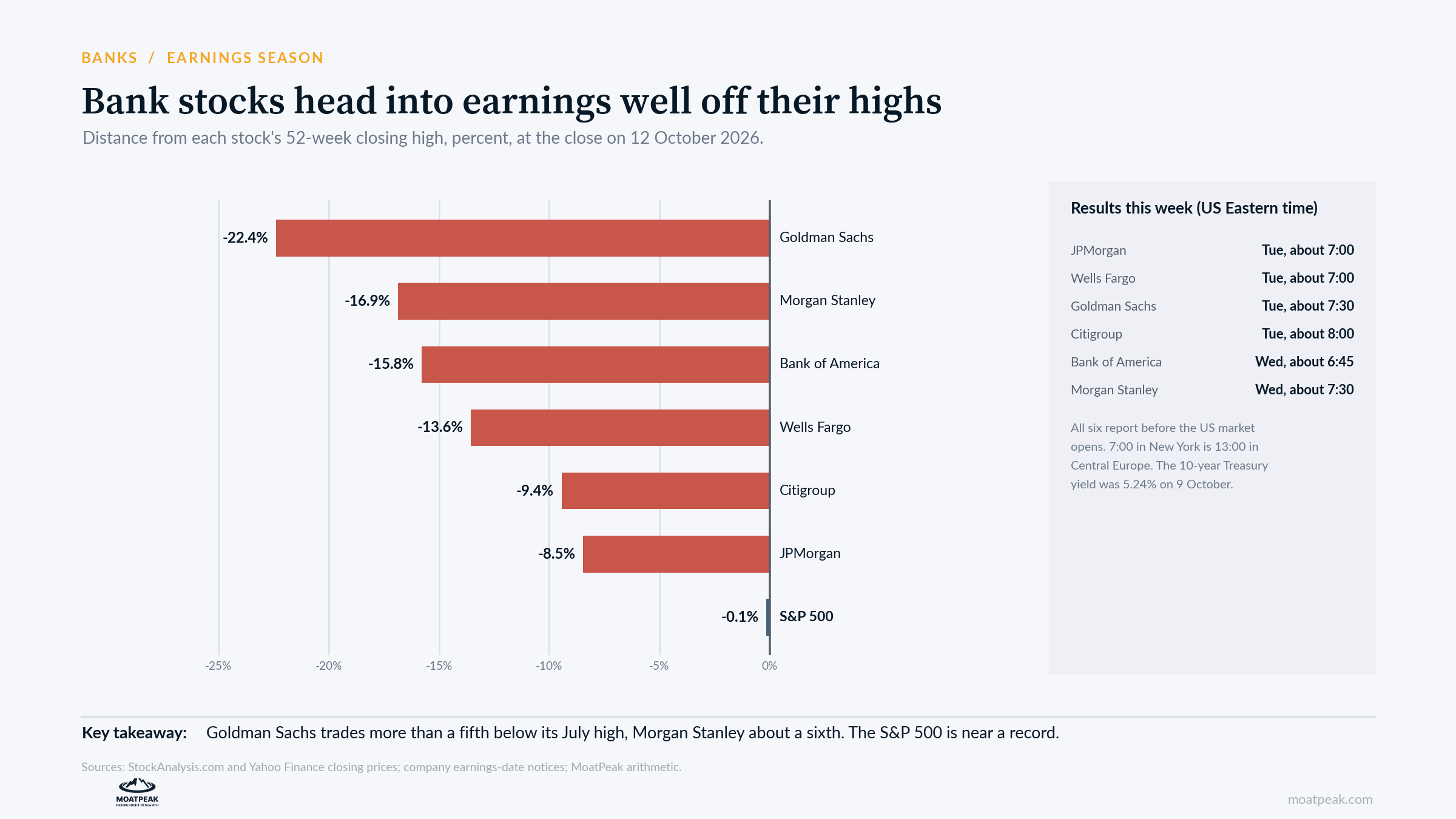
Earnings season kicks off with the banks this week. JPMorgan Chase, Wells Fargo, Goldman Sachs and Citigroup report on Tuesday 13 October, before the US market opens. Bank of America and Morgan Stanley follow on Wednesday.
They come in bruised. At Monday’s close, Goldman Sachs was 22.4 percent below its 52-week closing high, Morgan Stanley 16.9 percent and Bank of America 15.8 percent. Wells Fargo was down 13.6 percent from its high, Citigroup 9.4 percent and JPMorgan 8.5 percent. The S&P 500, by contrast, closed just 0.1 percent below its record.
Why bank stocks fell
Interest rates are the first reason. On 16 September, the Federal Reserve raised its policy rate to a range of 3.75 to 4 percent and said inflation remains elevated. The 10-year Treasury yield was 5.24 percent on Friday, near its highest level in decades. Higher rates can help banks earn more on new loans, but they also reduce the value of the bonds banks already own and make it harder for some borrowers to keep up with payments.
The second reason is the deal calendar. Some companies, including Oura and SB Energy, put planned stock market listings on hold in late September, Reuters reported. The KBW Nasdaq Bank Index fell 6 percent in the third quarter and was about 13 percent below its August peak last week.
The comparison problem
The second quarter was exceptional. SpaceX’s listing in June raised about $85.7 billion, counting the extra shares sold under the underwriters’ option, making it the largest IPO on record. Investment banking fees rose 55 percent from a year earlier at Goldman Sachs, 58 percent at Morgan Stanley, 50 percent at Bank of America and 28 percent at JPMorgan. Trading was strong too. JPMorgan’s markets revenue rose 35 percent, and Goldman’s equities revenue rose 72 percent.
“Clearly, the large deals contributed meaningfully to this quarter’s results,” JPMorgan’s Jamie Dimon said in July.
So the third quarter will look weak next to the second, even if it beats the same period last year. In September, Goldman’s chief executive, David Solomon, told investors to expect a “muted” quarter, according to Reuters. FactSet expects the financial sector as a whole to grow earnings by just 3.0 percent from a year earlier, against 29.6 percent for the S&P 500.
Here is what analysts polled by LSEG expect per share, against a year ago and the second quarter:
JPMorgan: $5.94, against $5.07 a year ago and $6.14 in the second quarter excluding one-off gains.
Goldman Sachs: $12.44, against $12.25 and $20.98.
Citigroup: $2.41, against an adjusted $2.24 and $3.15.
Wells Fargo: $1.85, against $1.66 and $2.00.
Bank of America: $1.10, against $1.06 and $1.21.
Morgan Stanley: $2.94, against $2.80 and $3.46.
Four things we will watch
1. Credit. Loan losses are one of the first places an economy shows strain. In the second quarter, JPMorgan’s credit card charge-off rate was 3.34 percent, above its full-year guidance of about 3.2 percent. Bank of America’s was 3.55 percent, down from 3.82 percent a year earlier. Across the industry, late payments and charge-offs fell in the second quarter from the first, the FDIC says. But the Fed’s July survey of loan officers showed banks tightening their credit card standards. We will keep a close eye on how much banks set aside for future losses, particularly for credit card and commercial property loans.
2. Net interest income. This is what a bank earns on its loans and securities after paying depositors. In July, JPMorgan guided to about $105.5 billion for 2026. Any change to that number will show whether higher rates are helping banks more than they hurt.
3. Fees after the SpaceX quarter. Goldman Sachs and Morgan Stanley depend most on deals and trading. In September, JPMorgan’s Doug Petno said he expected investment banking fees and markets revenue to rise by “mid-to-high teens,” Reuters reported. We want to see whether deal activity held up after some listings were put off in late September.
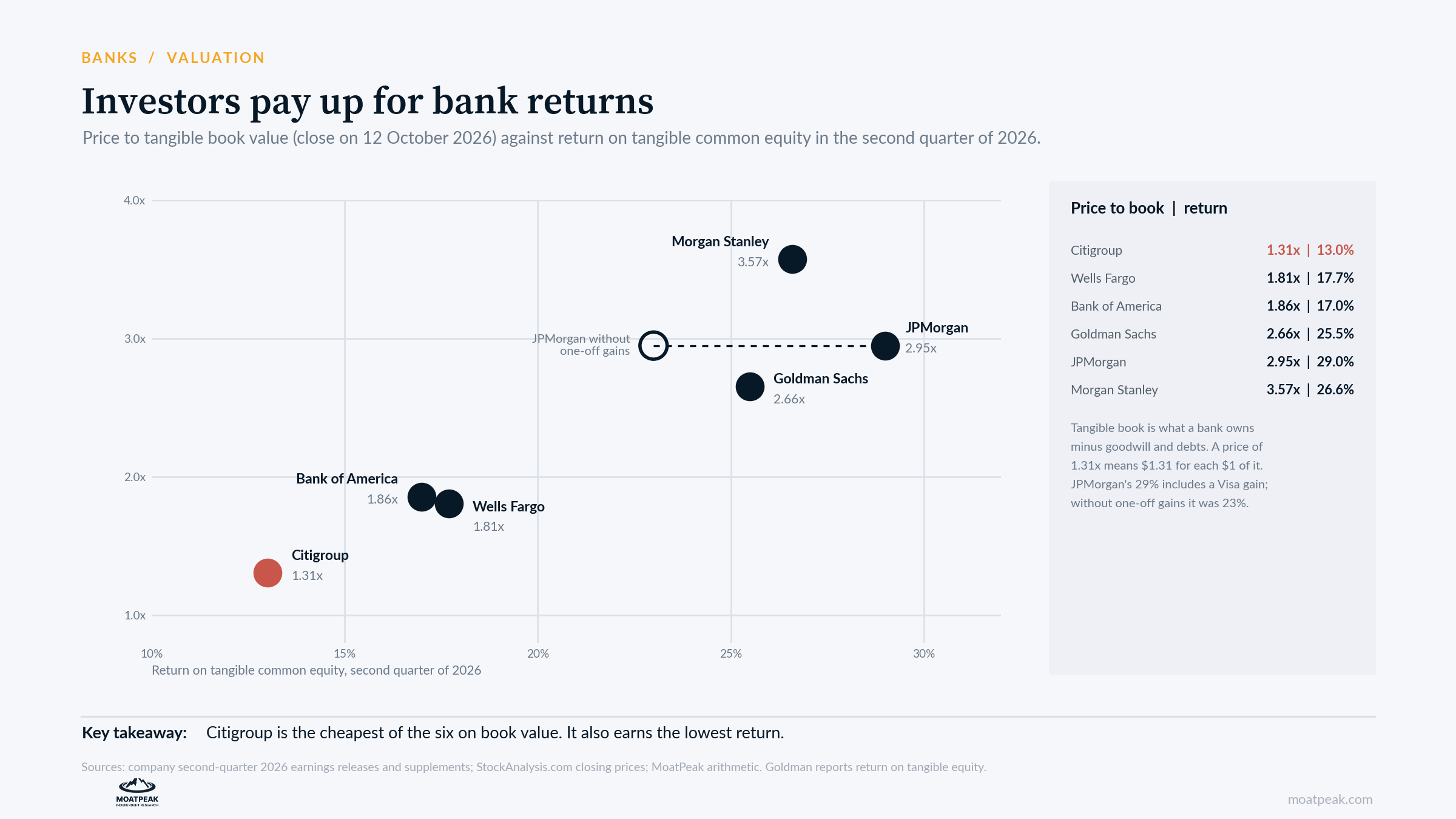
4. What investors pay for returns. Citigroup is the cheapest of the six at 1.31 times tangible book value, but it earned only 13.0 percent on tangible equity in the second quarter, the lowest return. Morgan Stanley trades at 3.57 times and earned 26.6 percent. JPMorgan trades at 2.95 times and earned 29 percent, or 23 percent without one-off gains on its Visa shares and other investments. A low multiple is a bargain only if the returns come through.
How we will read the reaction
How share prices respond could tell us more than the earnings themselves. These stocks are already well below their highs, so expectations are modest. If strong results trigger selling, that may be a sign the market is more worried than the results suggest. That matters beyond banks, because banks are often the first to pick up on changes in the economy. If weak results lead to buying, much of the bad news is probably already priced in.
The case against us
Bank results look backward, since they cover July to September. Credit problems can show up later, and a quiet quarter for losses says little about 2027 if long-term yields stay above 5 percent. And with the S&P 500 near its record, a broad sell-off could drag bank stocks down regardless of their results.
What it means for your money
Watch the market reaction as well as the beat or miss. It shows what was already priced in.
When comparing banks, look at two numbers together: price to tangible book value and return on tangible equity.
Watch losses on credit cards and commercial property loans. They tend to rise early in a downturn.
What we are watching
Tuesday 13 October: JPMorgan, Wells Fargo, Goldman Sachs and Citigroup results, before the US open.
Wednesday 14 October: Bank of America and Morgan Stanley results, September consumer prices and the Fed’s Beige Book.
Guidance for 2027: what banks say about loan demand and credit costs in the year ahead.
Educational research only. Not personalized investment advice. MB “MoatPeak Group”.