


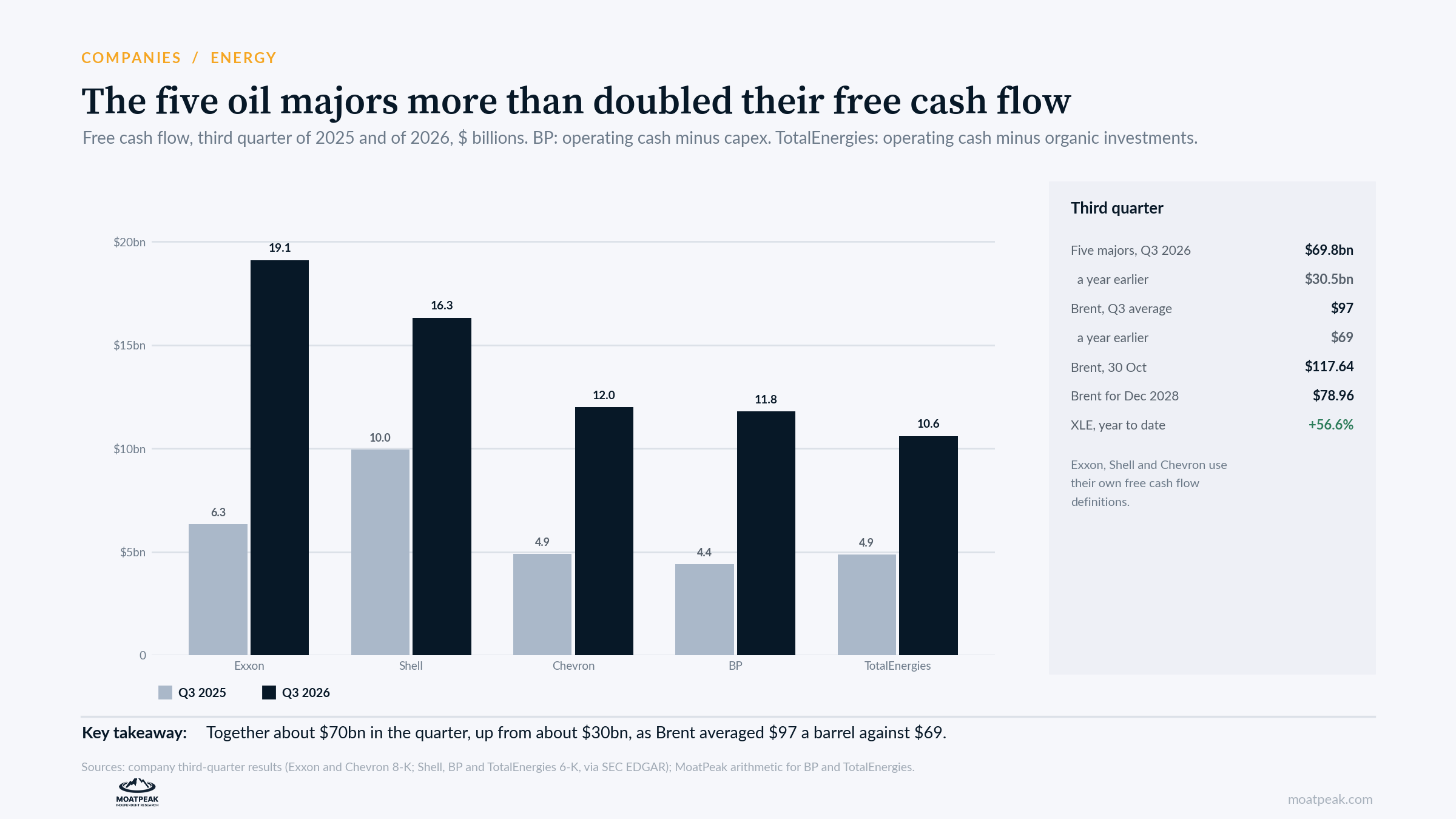
The five largest Western oil companies reported on Thursday and Friday, and the numbers were enormous. With Brent averaging $97 a barrel in the quarter, against $69 a year earlier, Exxon’s free cash flow tripled to $19.1 billion. Shell’s rose to $16.3 billion from $10.0 billion and Chevron’s to $12.0 billion from $4.9 billion. By our count, BP generated $11.8 billion and TotalEnergies $10.6 billion.
Together, that is about $70 billion in a single quarter, against about $30 billion a year earlier.
What they did with it
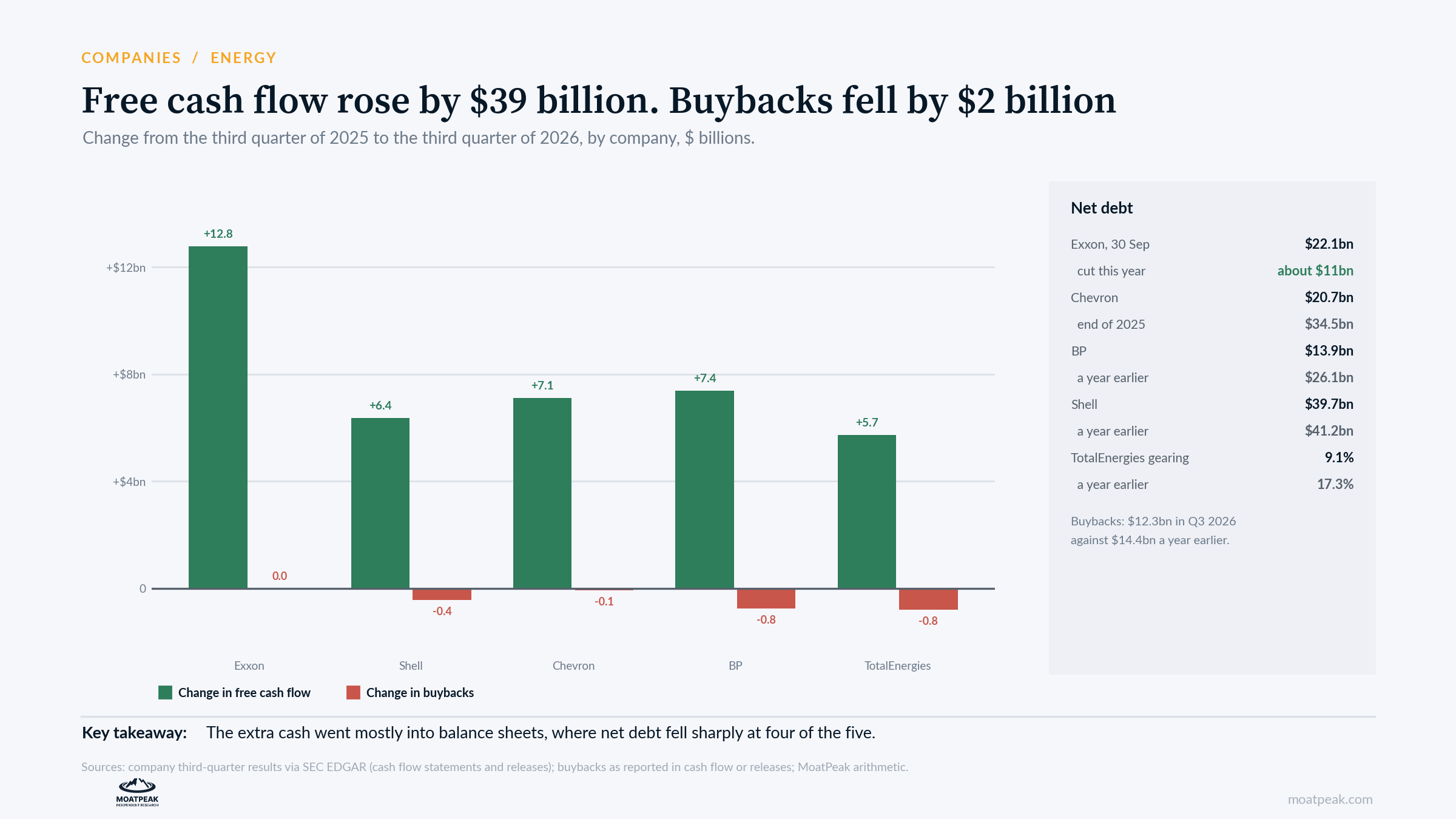
Start with what they did not do. The five bought back $12.3 billion of their own shares, down from $14.4 billion a year earlier. Exxon kept its buyback at $5.1 billion and its total payout at $9.4 billion, exactly where both stood when its free cash flow was a third as large, and it set next year’s buybacks at $20 billion, about this year’s pace. Chevron bought back $2.5 billion, against $2.6 billion. TotalEnergies cut its buyback to $1.5 billion from $2.3 billion, and BP bought back nothing, against $750 million a year earlier. Shell is the one exception so far: its next buyback program is $5.0 billion, up from $4.2 billion.
They are not drilling much more either. Exxon’s spending on property and equipment fell to $7.2 billion from $8.7 billion, Chevron’s capital spending to $4.0 billion from $4.4 billion and BP’s to $3.0 billion from $3.4 billion. TotalEnergies spent more, and Shell’s increase reflects its purchase of ARC Resources.
Most of the money went to the balance sheet. Chevron’s net debt fell to $20.7 billion from $34.5 billion at the end of 2025. BP’s fell to $13.9 billion from $26.1 billion a year earlier, and BP now plans to use its spare cash to settle what remains of its Deepwater Horizon liabilities in full. Exxon has cut net debt by nearly $11 billion this year, to $22.1 billion. TotalEnergies’ gearing, its main debt measure, fell to 9.1 percent from 17.3 percent.
Our read
What management does with a windfall tells you what it expects. These five are acting as though today’s prices will not last. Debt repaid keeps its value whatever happens to oil. Bigger buybacks and new projects would lock in commitments that look reckless at lower prices, so they are mostly avoiding both.
The futures market agrees with them. On Friday, the expiring December Brent contract settled at $117.64 a barrel. Brent for delivery in December 2028 traded at $78.96.
Investors are less cautious. The energy sector has returned 57 percent this year, and the five companies’ shares are up between 45 and 56 percent. Their share prices assume more of this windfall will last than the companies themselves are willing to bet on.
The case against us
Paying down debt is a return to shareholders in another form. Less debt means lower interest costs and more room for payouts later, and it beats buying back stock at the top of a price spike.
Disruptions can outlast what markets expect. If supply stays tight, today’s prices could hold far longer than the futures curve implies, and these companies would be well rewarded for their caution with even larger balance sheets to deploy.
Being cautious also makes sense politically. In past price spikes, record profits invited windfall taxes, especially in Europe. Quiet debt reduction draws less attention than record buybacks, so some of this restraint may be about optics rather than oil.
What it means for your money
Value the cash at mid-cycle prices. A quarter at $97 Brent says little about what these businesses earn at the $79 the market expects for 2028. Use that lower number to test any valuation.
Give credit to the balance sheets. The debt reduction is the part of the windfall that will last. It makes these companies safer whatever oil does next.
Know what kind of hedge you own. Energy stocks returned 13.9 percent in October while technology lost 8.3 percent. That hedge depends on oil staying high, which is exactly what the companies are not counting on.
What we are watching
15 December: BP’s strategy update, its first chance to say what comes after debt reduction.
Fourth-quarter results in early 2027: whether buybacks rise once debt targets are met.
The Brent curve: whether the gap between near-term Brent and the December 2028 contract, nearly $40 on Friday, closes from the top or the bottom.
Educational research only. Not personalized investment advice. MB “MoatPeak Group”.
The buyback detail deserves more attention than it gets here. These companies made about $70 billion in free cash in the quarter, up from about $30 billion a year earlier, yet bought back only $12.3 billion of shares and Exxon suspended its buyback entirely. That is management voting with its own money: the cash is real, but they would rather de-risk the balance sheet than defend the share price. In my view, that makes the mid-cycle valuation case you describe stronger, not weaker. What I am watching is the December 15 BP strategy update you flagged. If debt targets are declared met and buybacks rise, that is the tell that management thinks current Brent prices are closer to normal than the futures curve does.