


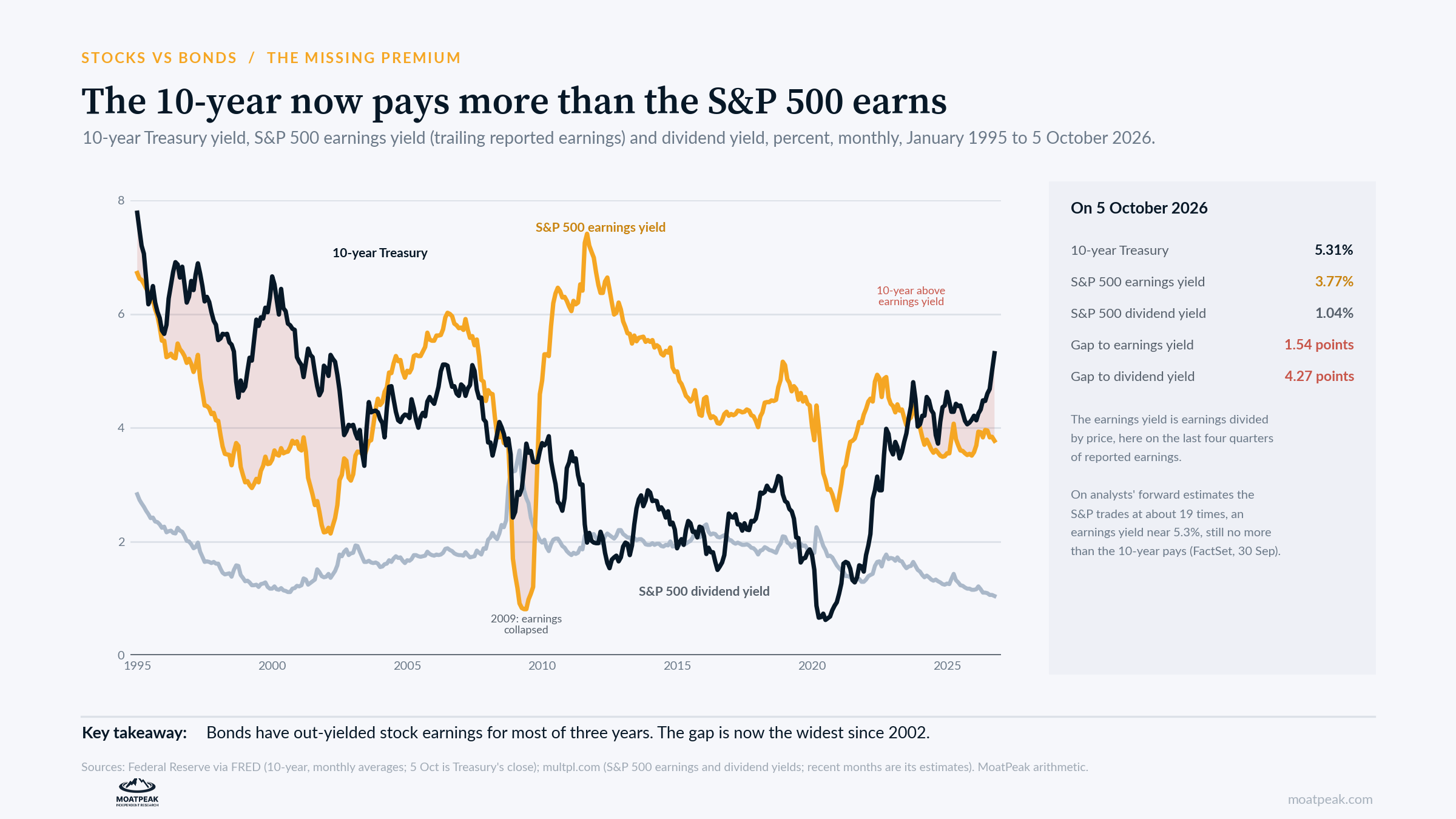
On the profits reported over the last four quarters, a share of the S&P 500 earns 3.77 percent of its price. At Monday’s close, a 10-year US Treasury paid 5.31 percent. The bond pays 1.54 percentage points more.
For most of the last 30 years, it was the other way around. Stocks earned more than safe bonds paid, and that extra was the reward for taking on more risk. Economists call it the equity risk premium. On these numbers, it is gone.
How unusual this is
The bond has paid more than the S&P 500’s earnings yield in all but one month since August 2023, so this is not new. What is new is the size. At 1.54 points, the gap is the widest since July 2002, leaving aside 2009, when profits collapsed and briefly pushed the earnings yield below 1 percent.
Dividends show an even bigger gap. The S&P 500’s dividend yield is only 1.04 percent, so the 10-year pays 4.27 percentage points more. That is the widest gap since November 2000. The widest on our chart, which starts in 1995, was 5.49 points in January 2000.
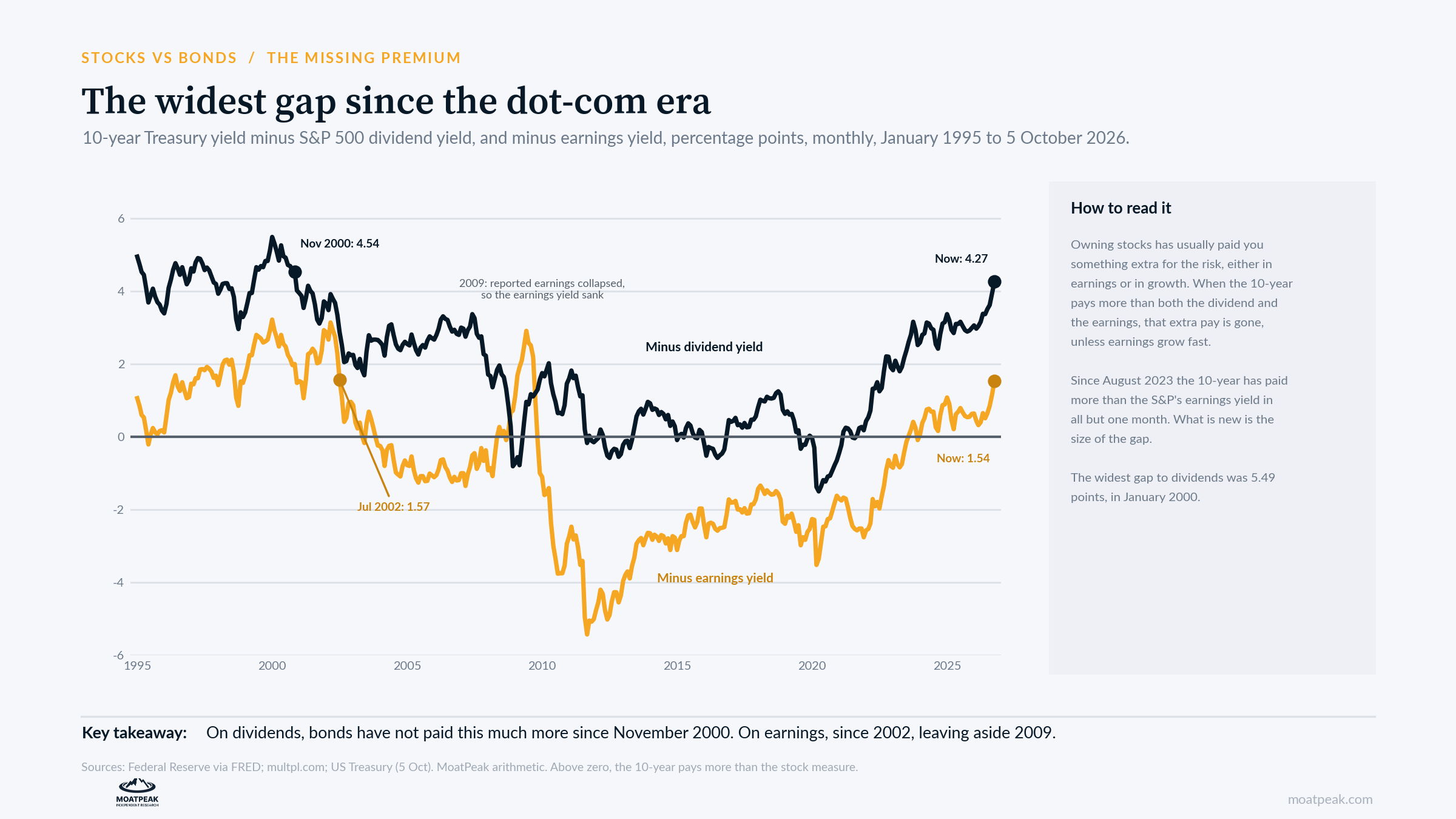
Those dates matter. The last time bonds paid this much more than stocks, investors were betting on growth that took years to arrive. The S&P 500 fell in 2000, 2001 and 2002.
The case for stocks anyway
There is a good case on the other side, and it rests on profits.
The 3.77 percent is based on profits already reported. Analysts expect more. On FactSet’s figures, the S&P 500 traded at 19.0 times expected earnings for the next 12 months at the end of September, a little below its five-year average of 19.8 and close to its ten-year average of 19.1. Turned around, that is an earnings yield of about 5.3 percent, roughly what the 10-year pays.
So on expected profits, stocks and bonds are about level. On reported profits, bonds come out ahead. The gap between those two numbers is the earnings growth investors are counting on.
Earnings can also rise with prices, something a bond coupon cannot do. Against the 10-year inflation-protected Treasury, which yielded 2.93 percent on 30 September, its highest since November 2008, stocks still earn a little more. And demand in the economy is strong: S&P Global’s survey of US service companies came in at 58.8 in September, its highest since July 2021.
Why we are cautious
When the safest asset in the world pays more than 5 percent for ten years, every dollar of future profit is worth less today. That hits hardest at companies whose profits are furthest away.
Forward figures are only a promise. If profits fall short, the forward earnings yield moves back toward the reported one, and the gap with bonds widens. The economy under the index is also uneven: the Conference Board’s consumer confidence index fell to 81.9 in September, its lowest since 2014, even as service companies boomed.
The index itself is narrow. From 5 August to Monday, the Dow fell 5.7 percent while the Nasdaq rose 4.2 percent, and Nvidia closed at a record $238.90 on Monday. A few large companies carry the index’s valuation, which means they also carry much of its risk.
What it means for your money
Know what you are being paid for. On reported profits, owning the S&P 500 now earns you less than lending to the US government for ten years. You come out ahead only if earnings growth arrives.
Safe yields are real competition. On Monday, Treasury bills and notes out to two years paid between about 4.0 and 4.8 percent.
Check your concentration. If you own a broad index fund, a large share of it sits in a handful of the most expensive companies.
What would prove us wrong
Fast profit growth would narrow the gap from the stock side. Third-quarter results begin in mid-October, and a strong season would lift the earnings yield. Falling bond yields would close it from the other side. A weak consumer price report on 14 October, or signs that the Fed is less likely to raise rates, could do that quickly.
What we are watching
7 October: the Fed minutes and the 10-year auction.
14 October: the September consumer price index.
From mid-October: third-quarter earnings, and whether forward estimates hold.
Educational research only. Not personalized investment advice. MB “MoatPeak Group”.