


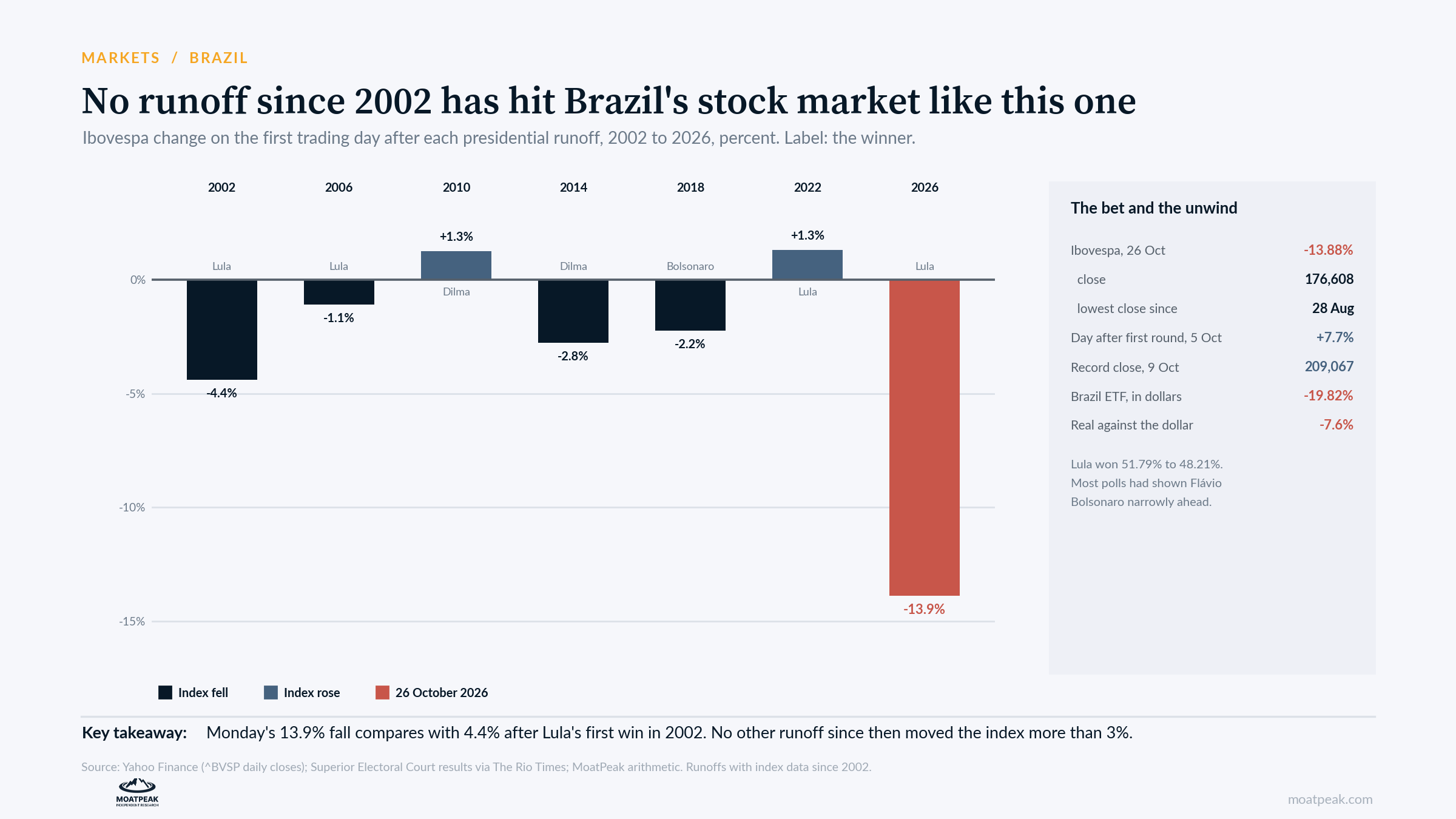
On Monday, the first trading day after Sunday’s presidential runoff, Brazil’s Ibovespa fell 13.88 percent to 176,608. It was the index’s worst day since March 2020 and its fifth worst since 1993. For dollar investors, it was worse. The real lost about 7.6 percent against the dollar, and the iShares MSCI Brazil ETF fell 19.8 percent, its second-worst day since 2000.
President Luiz Inácio Lula da Silva won a fourth term with 51.79 percent of the vote, ahead of Flávio Bolsonaro at 48.21 percent. Investors had positioned for the other result. Flávio won the first round on 4 October, and most polls showed him narrowly ahead.
The market’s path shows the bet. The day after the first round, the Ibovespa jumped 7.7 percent. It set a record close of 209,067 on 9 October and was still within 2 percent of it on Friday. Monday wiped out the entire rally. The index closed at its lowest level since 28 August, about 8 percent below its close on 2 October, the last session before the first round. It is still up 9.6 percent this year.
Nothing like it in recent runoffs
No runoff since 2002 has shaken the market this much. The previous worst reaction came after Lula’s first victory in 2002, when the index fell 4.4 percent. Since then, the day-after moves have ranged from a 2.8 percent fall in 2014 to a 1.3 percent gain in 2010 and 2022. Monday’s drop was three times the 2002 move.
The 2002 example offers another lesson. That year, investors sold before the vote. The Ibovespa fell 42 percent between March and mid-October, so the market had largely priced in the result by the time it came. A year after the runoff, the index was up 87.8 percent. This year, investors bought before the vote and sold after it.
What history says
Looking back, the Ibovespa’s worst days have often turned out to be buying opportunities. Of its 11 worst days since 1995, 10 were followed by gains over the next 12 months, with a median rise of 69 percent in reais. The pattern is similar in dollars. The iShares Brazil ETF’s five worst days before Monday were followed by total returns of 19 to 129 percent over the next year.
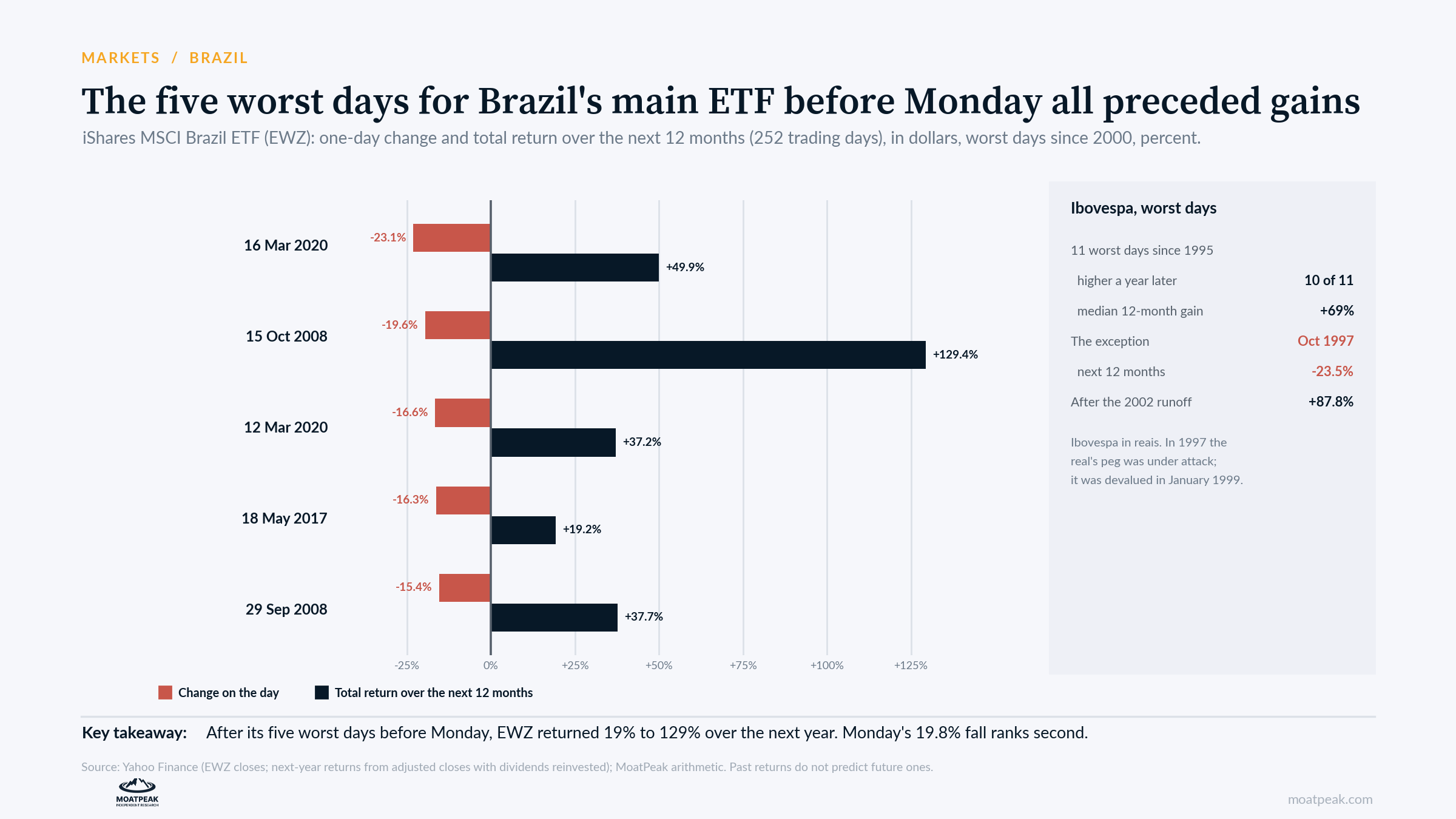
The one exception is the one that matters most now. After the Ibovespa fell 15.0 percent on 27 October 1997, it lost another 23.5 percent over the next 12 months. Brazil was then defending a managed exchange rate with very high interest rates, and the real was eventually devalued in January 1999.
Our read
Monday’s fall says more about positioning than about a new forecast for Brazil. Investors had priced the outcome most polls pointed to, and they repriced it in one session.
History favors patience after days like this, but most of those days came during global crises, when central banks around the world were cutting rates. This selloff is domestic, so any rebound depends on confidence in Brazil’s own policy. The real is the best gauge of that confidence. The currency has floated since 1999, so pressure now shows up in the exchange rate and in the central bank’s response. A steady real would make the historical pattern more relevant. A sliding real would make 1997 the better guide.
The case against us
The sample is small and clustered. Four of the 11 worst days came in March 2020 alone.
Gains measured in reais can flatter a recovery when the currency is weak, and a weaker real feeds inflation. That could keep interest rates high and weigh on stocks.
Political risk can take more than one session to be reflected in prices. Investors may keep selling until the new term’s fiscal plans are clear.
What it means for your money
Watch the currency. For dollar investors, the real explains much of Monday’s loss and will explain much of any recovery.
Consider the base rate, but don’t rely on it blindly. Brazil’s worst days have usually been followed by gains, yet the main exception came when the currency gave way.
Size for volatility. Keep positions small enough to ride out further swings in both the index and the real.
What we are watching
Wednesday 4 November: Brazil’s central bank interest rate decision, at the end of its 3 and 4 November meeting.
Tuesday 5 January 2027: Lula’s fourth term begins.
The real: it ended Monday near 5.37 per dollar after touching 5.52.
Educational research only. Not personalized investment advice. MB “MoatPeak Group”.