


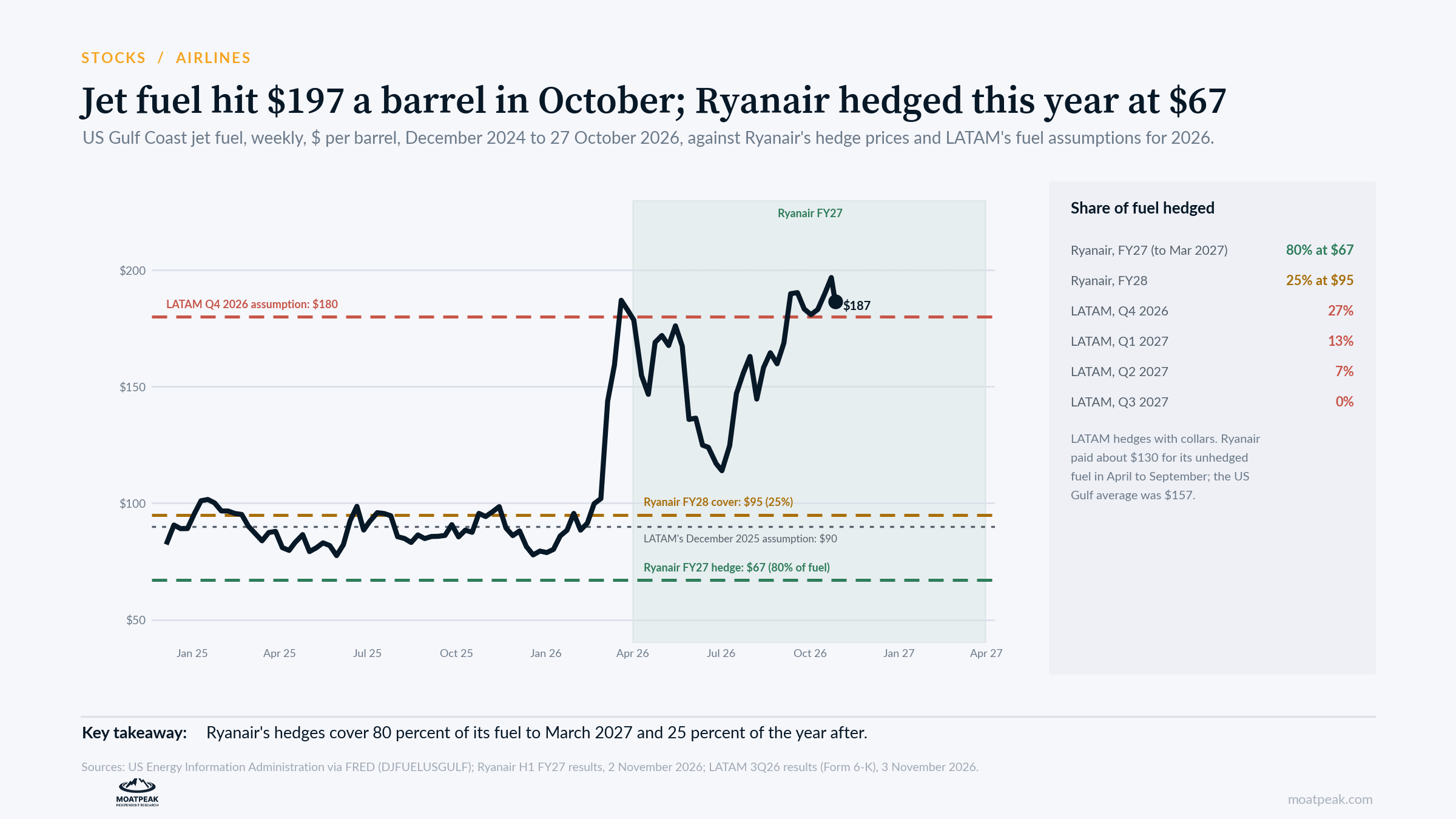
Ryanair’s profit fell 15 percent in the half-year to September, but its shares rose 5.2 percent on the day of the results, 2 November. Investors focused on what went right. Traffic grew 6 percent to 125.8 million passengers, and 80 percent of the airline’s jet fuel is locked in at about $67 a barrel until March 2027.
The bigger number came later in the statement. For the year to March 2028, Ryanair has covered only 25 percent of its fuel, at about $95 a barrel, and at current forward prices it expects its fuel bill to rise by about €2 billion. That is close to the €2.26 billion it earned before exceptional items in the year to March 2026. Management expects fares to rise but says that is “unlikely to provide a full offset”.
So the question for investors is how much of that €2 billion the airline can pass on. LATAM, which reported on 3 November with little hedging, gives a live answer.
A hedge buys time
US Gulf Coast jet fuel averaged $157 a barrel from April to September, up 81 percent from a year earlier, and $189 in October. Ryanair says the price of its unhedged fuel doubled to about $130. Even with 80 percent hedged, its fuel bill rose 15 percent in the half, while passengers grew 6 percent and average fares fell 4 percent.
That protection ends with the financial year. Ryanair has cut its winter schedule to burn less unhedged fuel, so traffic from November to March will be broadly flat on a year earlier. In the year to March 2028, it plans to fly more than 220 million passengers, up 3 percent, with three-quarters of its fuel bought at market prices.
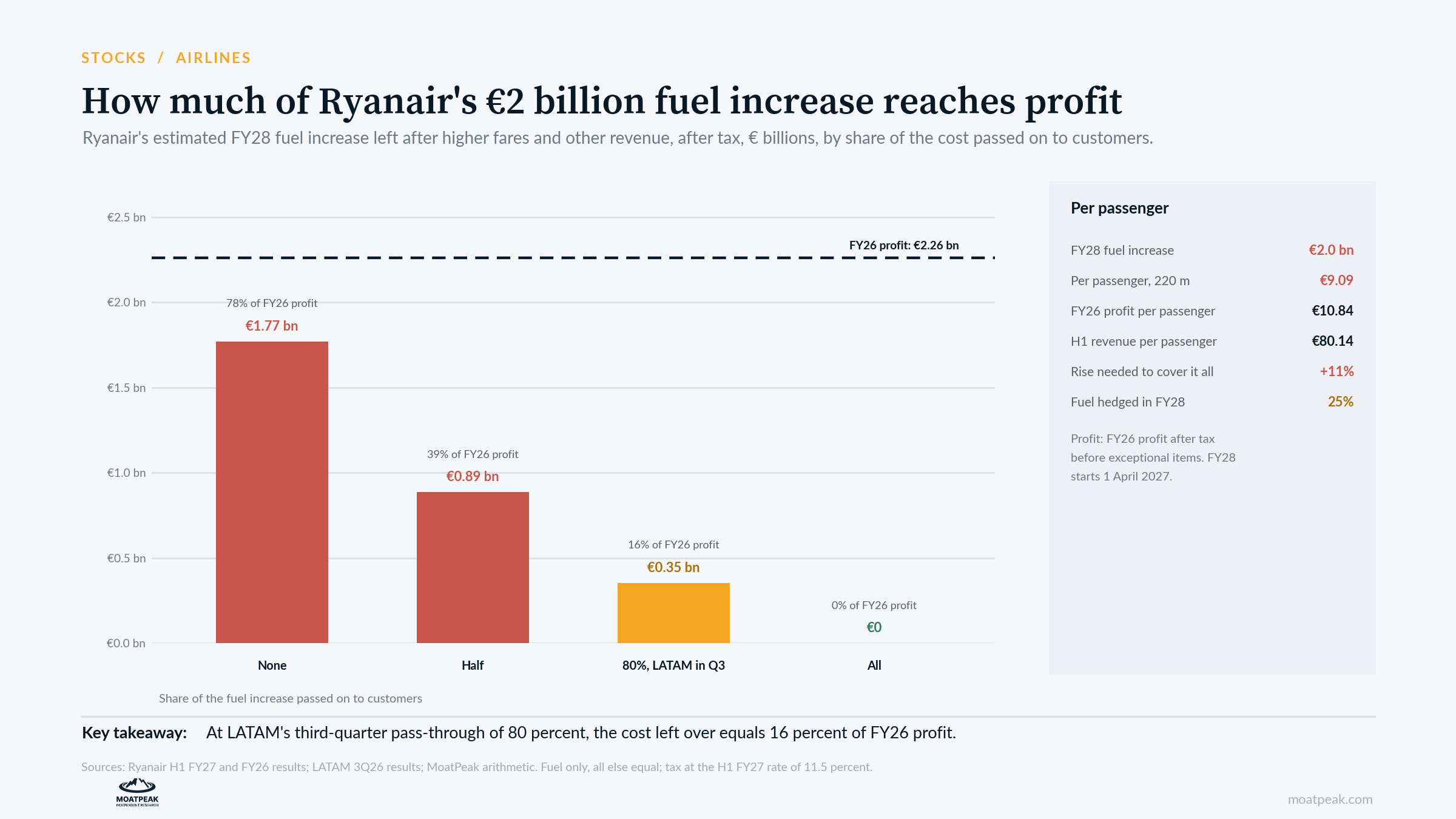
Per passenger, the estimated increase is about €9.09. Ryanair earned €10.84 per passenger after tax, before exceptional items, in the year to March 2026, and took in €80.14 of revenue per passenger in the latest half. To pass on the whole increase, revenue per passenger would have to rise about 11 percent.
LATAM is living it now
LATAM shows what happens when an airline has little hedging. Its fuel cost was $167 a barrel in the third quarter, including hedges, up from $110 a year earlier. The company put the price impact at about $520 million and said higher revenue recovered about 80 percent of it. Revenue rose 18.4 percent.
It still lost margin. The adjusted operating margin fell to 12.5 percent from 18.1 percent, and adjusted EBITDA fell 4.7 percent. The full-year guidance shows a company chasing the fuel price. In December, LATAM expected adjusted EBITDA of $4.2 billion to $4.6 billion, with jet fuel at $90 a barrel. It now expects $3.9 billion to $4.05 billion, with fuel at $155 for the year and $180 in the fourth quarter. Only 27 percent of its fourth-quarter fuel is hedged, and none for the third quarter of 2027.
Our read
Hedging delays a fuel shock; it does not cancel it. If Ryanair matches LATAM’s 80 percent pass-through, about €0.35 billion of the increase would reach profit after tax, roughly 16 percent of last year’s earnings. At half, it would be €0.89 billion, or 39 percent. If Ryanair passes on nothing, the figure rises to €1.77 billion, or 78 percent.
We think something near the 80 percent case is plausible, because the whole European industry faces the same roll-off. Ryanair says all EU airlines’ cheap hedges expire before summer 2027 and that some rivals are already in Chapter 11, while capacity stays short because aircraft makers are behind schedule. When every competitor’s costs rise together, fares tend to follow. Ryanair’s own record this year argues for caution, though: fares fell 4 percent in the half as demand turned hesitant.
At about 12 times last year’s earnings, the shares look cheap on a hedged year. The test is pricing for the year to March 2028, and the first evidence will be summer 2027 bookings.
The case against us
Fuel could fall. Brent crude dropped 12 percent in the two sessions to 3 November, to $103.60 from $117.64, and Ryanair’s €2 billion estimate rests on forward prices that move daily. The airline also adds cover on dips, which is how it reached 25 percent for the year to March 2028.
The cost gap may widen. Ryanair says its hedges widened its cost advantage over EU rivals this year, and the first 16 Boeing MAX-10s, due from spring 2027, carry 20 percent more seats on 20 percent less fuel, by its figures.
Management has other levers. It plans airport negotiations, possible temporary pay freezes, leaner crewing and more automation to offset part of the bill.
What it means for your money
Price airlines on the unhedged year. For any airline, find the share of next year’s fuel that is hedged and at what price. A low multiple on a hedged year can overstate normal earnings.
Treat pass-through as the key number. Each 10 points of pass-through on Ryanair’s estimate is worth about €0.18 billion after tax, or 8 percent of last year’s profit. Fares in the next quarterly updates are the best early signal.
Use LATAM’s guidance as a gauge. Its fuel assumption moved from $90 to $155 in 11 months. Airline forecasts can change faster than fares.
What we are watching
Late January: Ryanair’s third-quarter results, with fares for October to December and any update to hedging for the year to March 2028.
LATAM’s fourth quarter: whether it keeps passing on 80 percent with only 27 percent of its fuel hedged.
Jet fuel forward prices into spring 2027: the input behind Ryanair’s €2 billion estimate.
Educational research only. Not personalized investment advice. MB “MoatPeak Group”.