


“China is exporting deflation” has become one of this autumn’s favorite market stories: a wave of cheap Chinese goods pushing down prices and profit margins around the world. For buyers in the United States, the data no longer show it.
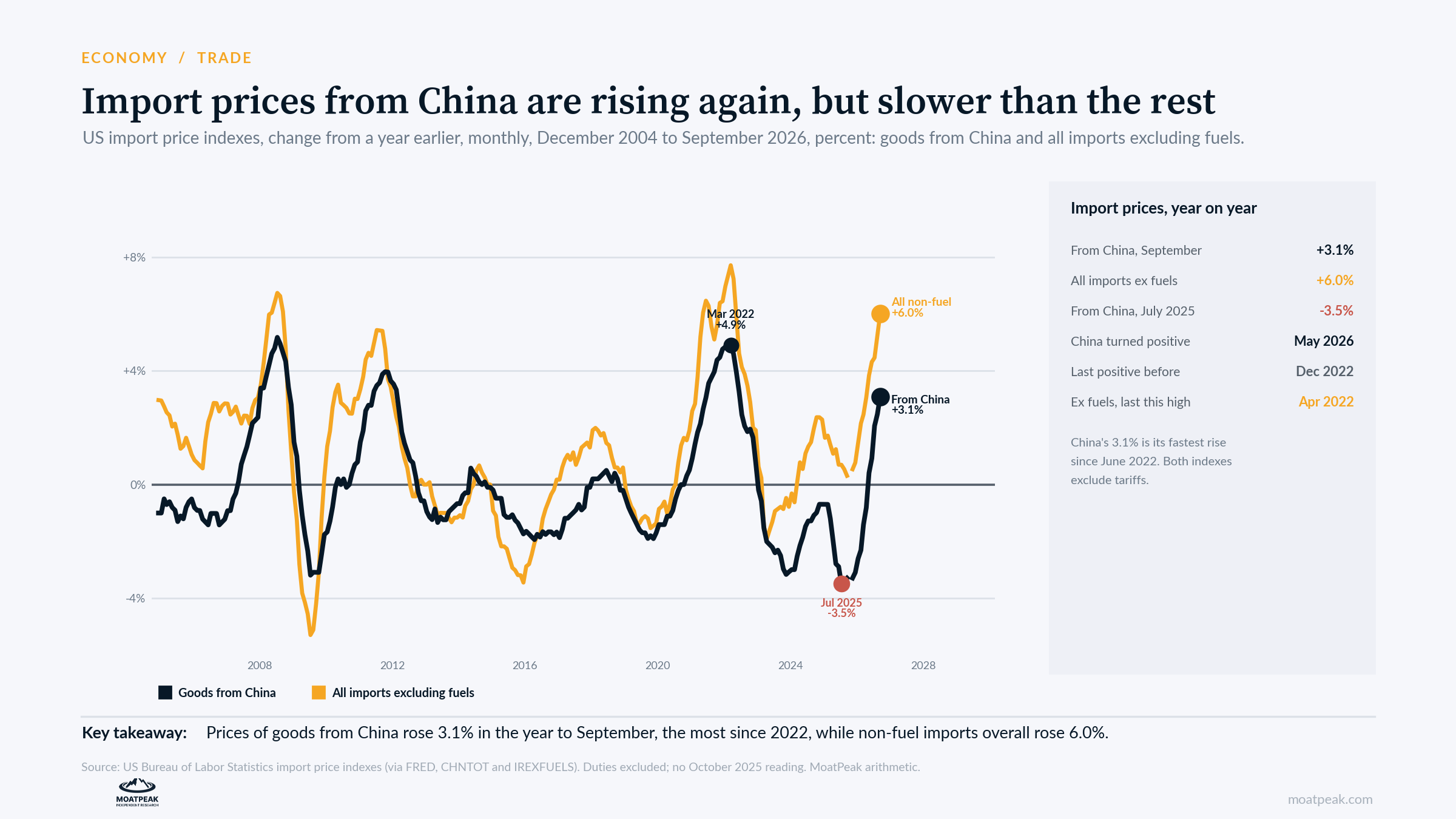
Prices of goods imported from China rose 3.1 percent in the 12 months to September, according to the Bureau of Labor Statistics. That is the fastest increase since June 2022. As recently as July 2025, those prices were 3.5 percent lower than a year earlier. They turned positive in May for the first time since December 2022.
China is still not the main source of imported inflation. Import prices excluding fuels rose 6.0 percent over the same 12 months, the most since April 2022. Goods from China are rising at about half that pace.
The yuan did the work
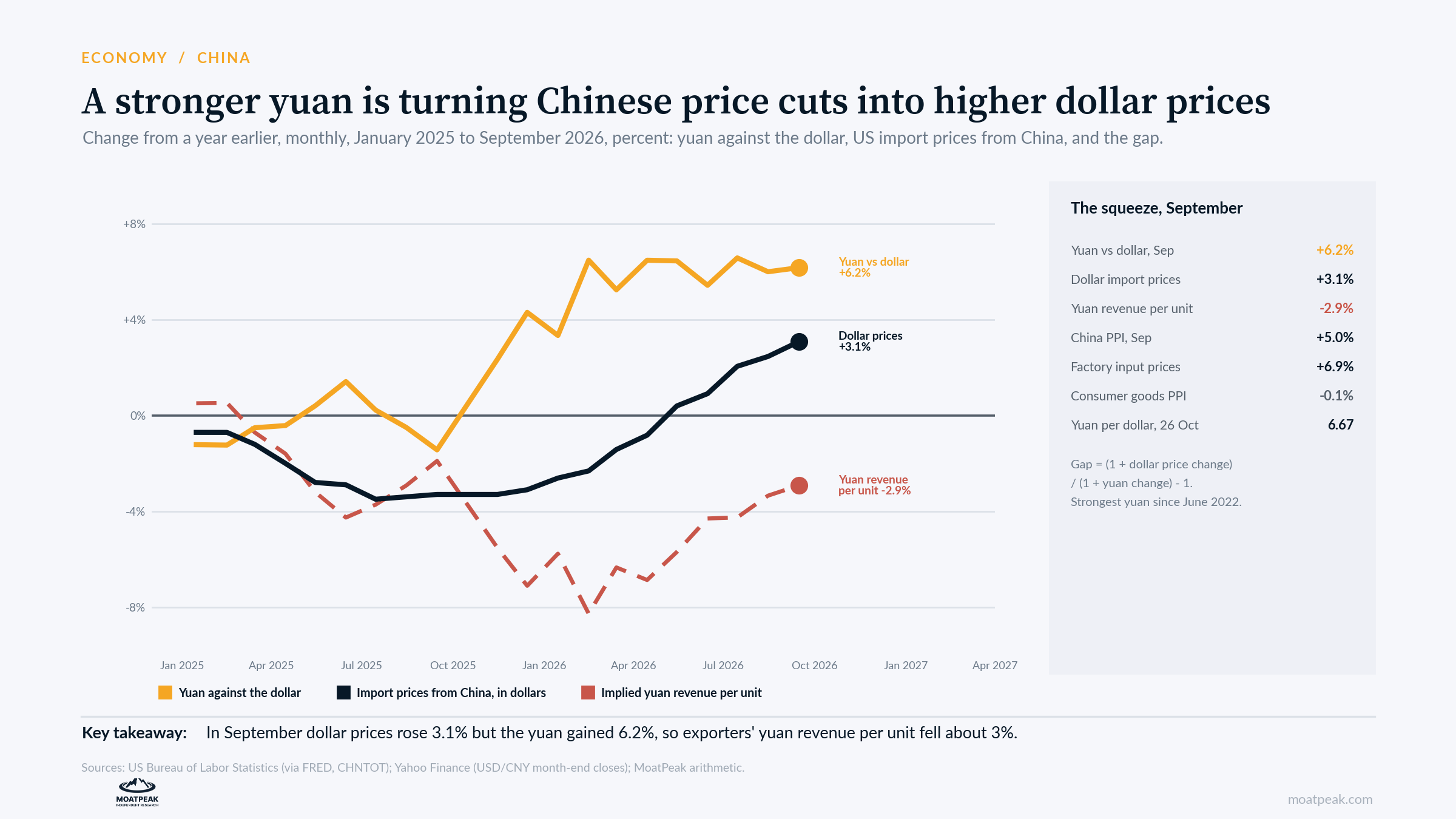
The main driver is the currency. The yuan gained 6.2 percent against the dollar in the 12 months to the end of September, moving from 7.12 per dollar to 6.70. On Monday it traded at 6.67, its strongest level since June 2022.
Chinese exporters passed on only about half of that move. If a factory’s dollar price rose 3.1 percent while each dollar now converts into about 5.8 percent fewer yuan, its revenue per unit in yuan fell about 2.9 percent. In yuan, China is still cutting prices. In dollars, those cuts have turned into increases.
The squeeze inside China
That would be easier to bear if costs were falling. They are rising. China’s purchasing price index for industrial producers, which tracks what factories pay for materials and fuel, rose 6.9 percent in September from a year earlier. Producer prices rose 5.0 percent, driven by mining (up 25.4 percent) and raw materials (up 9.4 percent). Prices of consumer goods leaving Chinese factories fell 0.1 percent, and carmakers’ factory prices fell 2.0 percent.
Chinese exporters are paying more for inputs and receiving fewer yuan for each unit they sell to American buyers. That is a margin squeeze, the opposite of the picture of Chinese factories flooding the world with ever-cheaper goods at no cost to themselves.
Our read
China is still the brake on US import prices, but the brake is wearing thin. Its goods are rising half as fast as other non-fuel imports only because its exporters are absorbing much of the yuan’s rise. If they keep absorbing it, their margins shrink further. If they stop, dollar prices of Chinese goods would likely move toward the 6 percent pace of everything else.
Either way, the deflation the market fears is not reaching American buyers. For the Fed, which meets on Wednesday after raising rates in September, imported goods are adding to inflation pressure, and China is no longer offsetting it.
The case against us
The index covers US imports only. Buyers paying in euros or other currencies face different math, so Chinese goods can still be getting cheaper elsewhere.
The yuan could weaken again. If it moves back above 7 per dollar, China would regain much of its price advantage.
These prices also exclude tariffs. What US companies pay after duties depends on tariff policy, so shelf prices can move differently.
What it means for your money
Importers lose an advantage. Companies that buy heavily from China, such as retailers and consumer brands, no longer get the cost reductions they used to.
Competitors get some relief. Makers that compete with Chinese goods face less price pressure when Chinese dollar prices rise.
Watch the yuan. Near 6.7 per dollar, Chinese exporters must either raise prices further or accept thinner margins.
What we are watching
Wednesday 28 October: the Fed’s rate decision.
Monday 9 November: China’s October consumer and producer prices.
Tuesday 17 November: US import prices for October.
Educational research only. Not personalized investment advice. MB “MoatPeak Group”.