


Is China in a depression? Ask two investors, and you will often get two confident answers. The data published in October suggest both are describing something real. They are describing different halves of the same economy.
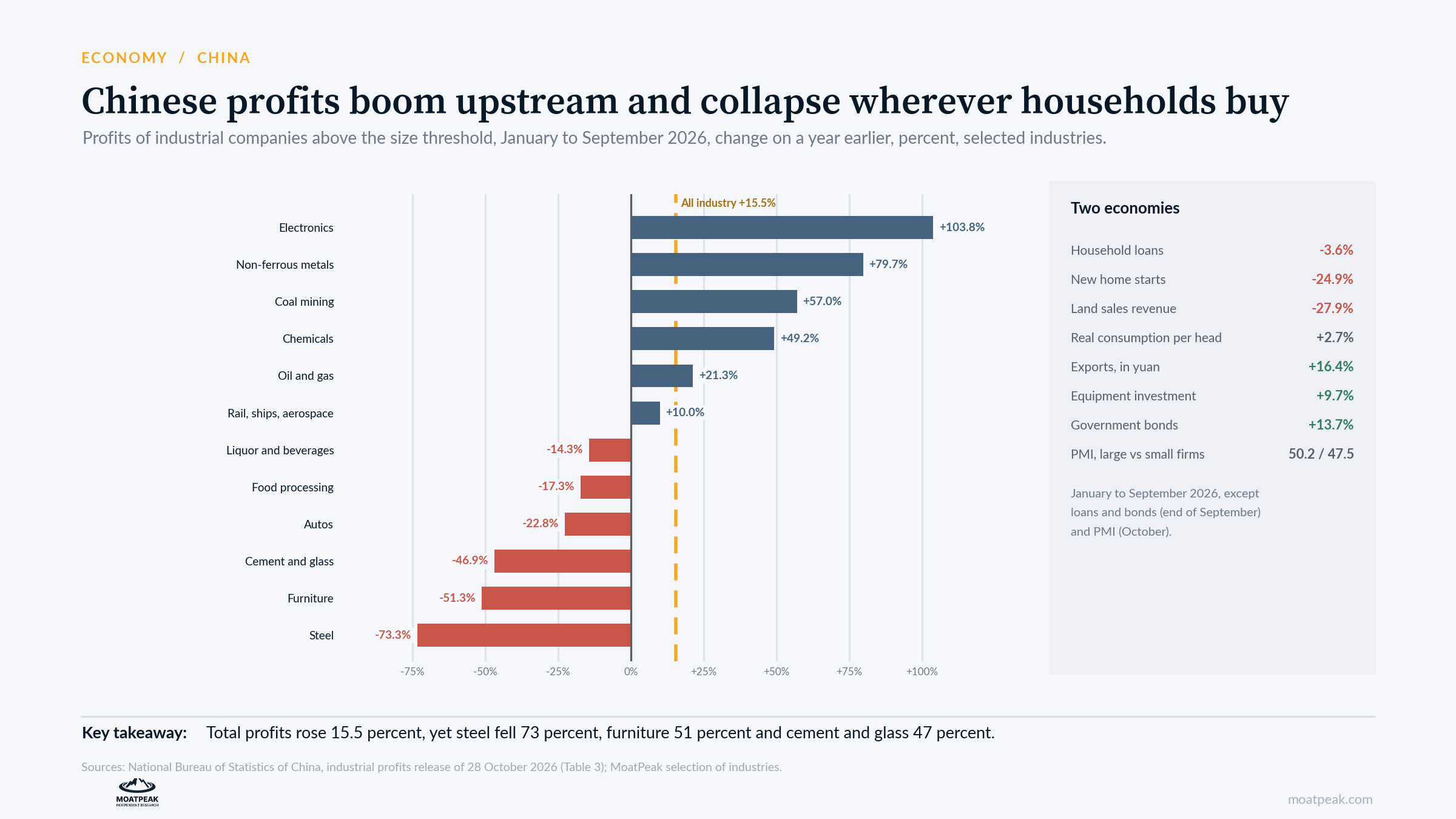
The household half is in a long slump. Investment in property development fell 20.6 percent in the first nine months of 2026, and new construction starts fell 24.9 percent. Local governments made 27.9 percent less from land sales. Household loans shrank 3.6 percent in the year through September. Real consumer spending per person rose 2.7 percent, well behind real income growth of 4.4 percent, so families are saving more. Car sales fell about 20 percent in September. In October’s survey of manufacturers, small companies reported shrinking activity while large ones still reported growth.
The other half is booming. Exports rose 16.4 percent in yuan in the first nine months, and by about 36 percent in dollars in September alone. Spending on equipment rose 9.7 percent even as total fixed investment fell 7.2 percent, and investment in information transmission jumped 30.8 percent. Government bonds outstanding grew 13.7 percent.
Industrial profits show the split most clearly. Total profits rose 15.5 percent. Electronics makers more than doubled their profits, up 103.8 percent, and non-ferrous metal producers gained 79.7 percent as metal prices rose. Steelmakers’ profits fell 73.3 percent, furniture makers’ 51.3 percent and cement and glass producers’ 46.9 percent. Carmakers lost 22.8 percent and liquor and beverage makers 14.3 percent.
The market drew a different line
If investors were simply trading those two economies, technology hardware stocks would have soared, and property stocks would have sunk. The stock market split along another line: who stands behind the balance sheet.
From the end of 2025 to 30 October, with dividends included, China Construction Bank returned 37.8 percent, China Shenhua Energy 34.2 percent, China Resources Land 16.3 percent, ICBC 14.9 percent and China Yangtze Power 13.4 percent. All five are state-controlled. Over the same period, Tencent lost 35.2 percent, Alibaba 32.0 percent, Meituan 30.4 percent, BYD 27.9 percent and Longfor 46.4 percent. All five are private.
The cleanest comparison is within property. China Resources Land and Longfor both build and sell homes in the same falling market. The state-backed developer is up 16 percent this year, and the private one has lost almost half its value.
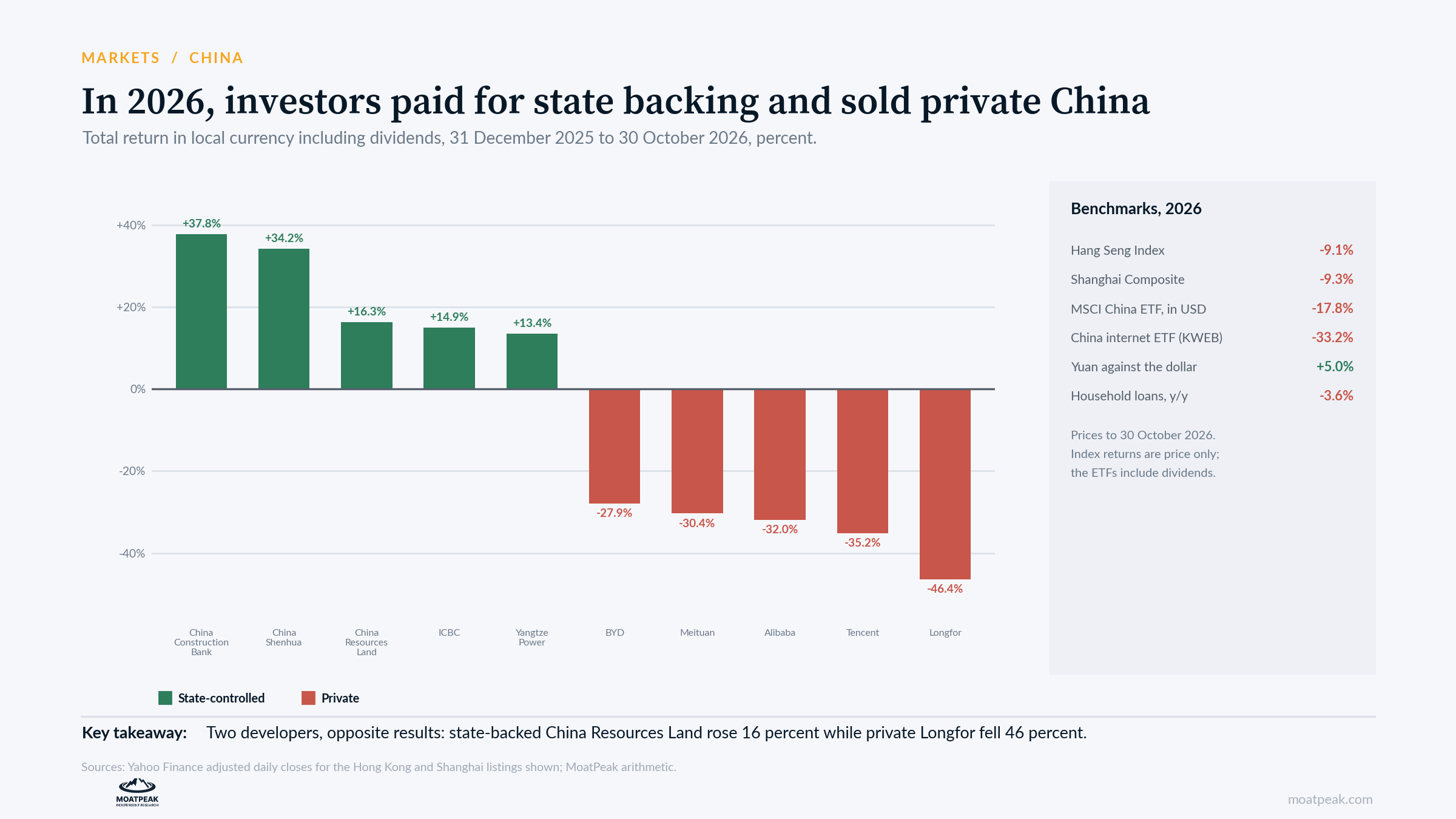
The broad market has followed the private side. The Hang Seng Index is down 9.1 percent this year and the MSCI China ETF 17.8 percent in dollars, even though the yuan has gained 5.0 percent against the dollar.
Our read
The market has stopped arguing about whether China is in a depression and started pricing how the slump ends. It is paying for balance sheets the state will stand behind and for cash dividends, and it is selling companies that need Chinese households to borrow and spend again. With household loans still shrinking, that is a rational bet on a long, slow repair.
Two things follow. First, China’s headline growth and profit figures are a poor guide to the Chinese stocks most foreign investors own. The internet platforms live off household spending, the weak half.
Second, the safe side is getting crowded, and it is where the state sends the bill. Beijing injected 500 billion yuan of capital into its largest state banks last year and plans another 300 billion in the fourth quarter. In Japan, the losses from the property bust ended up in the banks, and public capital injections began in 1998, eight years after the bubble burst.
The case against us
State backing can keep paying for years. The state controls the banks, sets their dividends and has shown it will recapitalize them quickly, which is more than Japan managed in the 1990s.
The private platforms may already price in the household slump. After falls of around 30 percent this year, any lasting support for household incomes could lift them quickly. Beijing began subsidizing one percentage point of interest on qualifying first-home mortgages on 1 October.
The boom half is real. Electronics profits doubled and exports are growing fast. Companies tied to them could recover with global technology shares.
What it means for your money
Know which China you own. A broad China fund has behaved like the household half: it fell 17.8 percent this year while the state banks rose.
Watch household credit, not GDP. The household half turns when household loans start growing again. Until then, recoveries in consumer and property stocks are likely to disappoint.
Treat state backing as a policy bet. Dividends from state banks and utilities depend on decisions made in Beijing, including who absorbs the losses from property and local government debt.
What we are watching
Mid-November: October credit data, and whether household loans keep shrinking.
The fourth quarter: the 300 billion yuan capital injection into the big banks, and its terms for existing shareholders.
Monthly property data: new home sales and land sales, where a real turn would show first.
Educational research only. Not personalized investment advice. MB “MoatPeak Group”.