


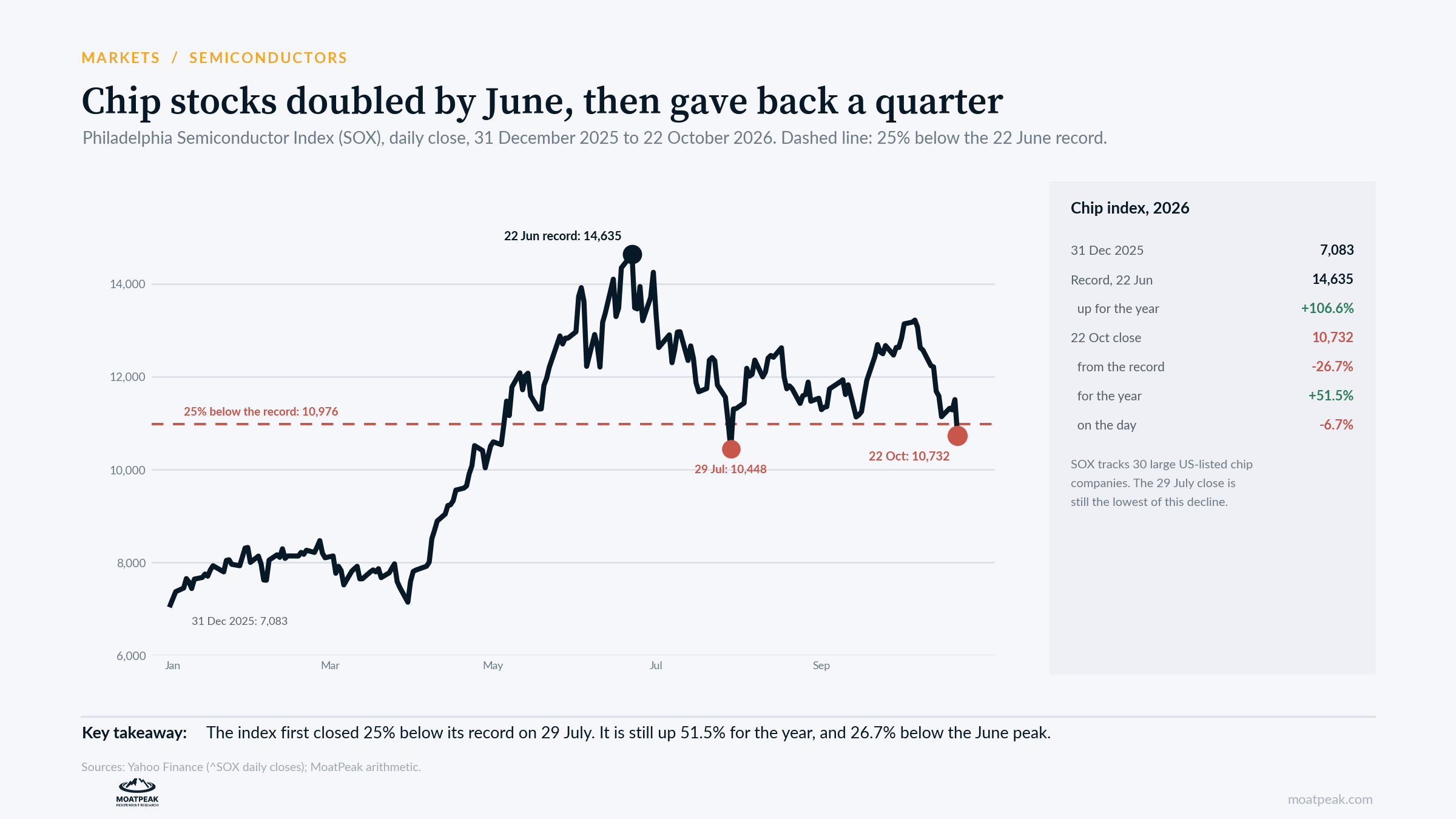
The chip index has had two years in one. The Philadelphia Semiconductor Index (SOX), which tracks 30 large US-listed chip companies, more than doubled between the end of 2025 and 22 June, when it closed at a record 14,635. By 29 July, it was down 28.6 percent. It bounced, then fell 6.7 percent on Thursday alone, to 10,732. That leaves it 26.7 percent below the record and still up 51.5 percent for the year.
A 25 percent drop from a record usually splits investors into two camps. One says the correction is done. The other says the cycle has turned. We went back through every decline in the index’s history to see what usually came next.
After the first 25 percent drop
Since 1994, seven earlier declines in the index reached 25 percent from a record close. In five of the seven, the fall went past 35 percent. The median drop from peak to low was 46.5 percent. Only once, in 2018, did the fall stop near 25 percent.
From the first close 25 percent below the record, the index fell a median 28.6 percent further before it bottomed. The low came a median 244 days later.
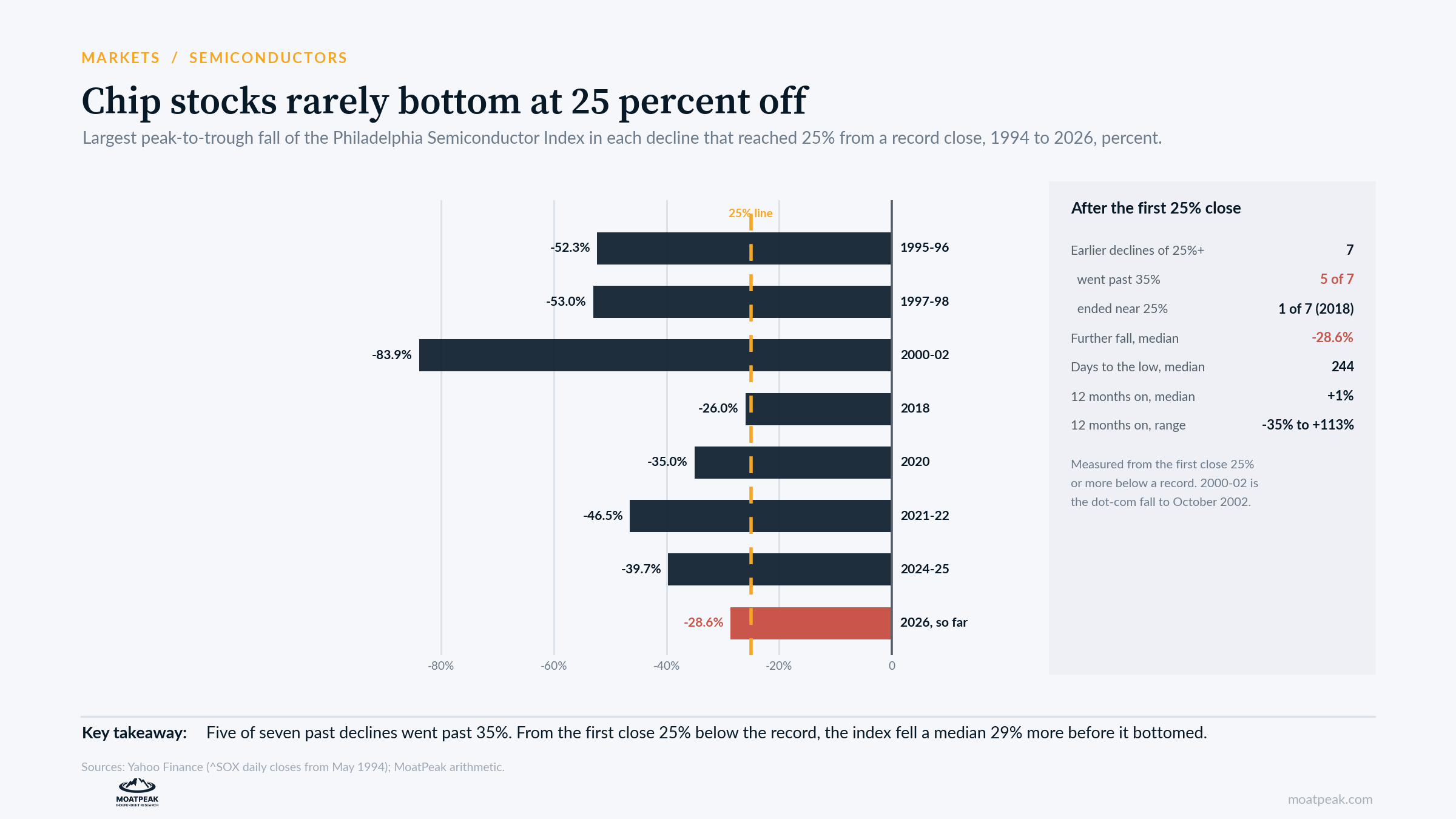
The other half of the story matters as much. Twelve months after that first 25 percent close, the median return was about 1 percent, and individual returns ran from minus 35 percent to plus 113 percent. Buying at 25 percent off was neither a reliable bargain nor a reliable trap. It was a coin toss with very big swings.
The path to the bottom was rarely smooth. In the last decline, the index rallied 23.6 percent between its first 25 percent close in August 2024 and January 2025, and then fell to a low in April 2025, almost 40 percent below its 2024 record.
What could make this one different
The current decline first closed 25 percent below the record on 29 July, and that close is still its low. The case for a shallower fall rests on profits, which are still rising. Micron, the largest US memory maker, expects about $61.5 billion in revenue this quarter, a record. Lam Research, which makes chip-making equipment, expects revenue to grow again this quarter, to about $8.6 billion.
The case for a deeper fall is that growth is slowing at the edges. Lam’s guidance implies about 5 percent growth, after 22 percent last quarter, and its shares fell 11.8 percent on Thursday. Tesla has cut its 2026 capital spending plan to about $20 billion, from more than $25 billion. And at Micron, inventory grew 21 percent last quarter while cost of sales grew 12 percent, an early sign worth watching. The Fed, meanwhile, raised rates in September.
Our read: history says a 25 percent fall in chip stocks is more often a midpoint than a bottom. Whether this one turns out differently depends more on profits than on the chart. As long as chip earnings keep rising, the index could see a shorter decline, like 2018 or 2020. If earnings forecasts start to fall, the past suggests the drop can run much further.
The case against us
Seven declines is a small sample, and the industry has changed. The chip index is now led by a handful of very large AI companies, and the 2000 to 2002 crash, the deepest in the sample, may not be a fair comparison.
Profits also argue against us. Record guidance from Micron and continued growth at Lam don’t suggest a cycle that has turned. Declines without an earnings downturn can end quickly.
What it means for your money
Size positions for a deeper fall. Past declines that reached 25 percent went on to a median of about 46 percent. If you own chip stocks, ask whether you could hold through that.
Watch profits, not just prices. Earnings forecasts, inventories and the spending plans of the largest buyers will say more than the next bounce.
Don’t treat a rally as proof of a bottom. The last decline included a 24 percent rally before its final low.
What we are watching
Wednesday 28 October, after the close: Microsoft’s results and its plans for AI spending, one of the biggest sources of chip demand.
Micron’s next quarterly report: whether inventory keeps growing faster than cost of sales.
Earnings revisions for chip companies: the first broad cuts would be the clearest sign of a turn.
Educational research only. Not personalized investment advice. MB “MoatPeak Group”.