


For two years, the main limit on the artificial intelligence build-out was a shortage of chips. Companies struggled to get enough, so chip supply set the pace for everything else.
Over the past three weeks, new limits have shown up: a regulator’s docket in Wisconsin, a forest in northern Finland, and the rules of the largest power grid in the United States. None of these has anything to do with chips, but all of them decide when a data center can actually start operating.
A power line back at the start
Project Lighthouse in Port Washington, Wisconsin, is one of the largest campuses in the build-out. It needs 1.3 gigawatts of power, according to utility records, and Vantage Data Centers is building it with Oracle as the tenant, as part of OpenAI’s Stargate program. Oracle’s website says customer delivery is expected in the second half of 2027.
Work on the buildings is going ahead. The hard part is the power. The campus needs new high-voltage lines from American Transmission Co., and those lines still need approval from the Wisconsin Public Service Commission.
The commission found ATC’s application complete in December 2025. Over the next eight months, ATC filed or refiled 564 documents, according to Aterio, a data-center research firm. On 6 August the commission voted unanimously to withdraw its finding that the application was complete. “The magnitude and volume of changes have created a barrier to parties and the public’s participation in this proceeding,” said Chair Summer Strand. On 10 September the commission closed the case without ruling on its merits, and on 18 September ATC filed again.
That reset the legal clock. Under Wisconsin law, the commission has 30 days to decide whether an application is complete, so its next decision is due around 19 October. After that, it has 180 days to rule, and the chair can extend that by up to 180 more.
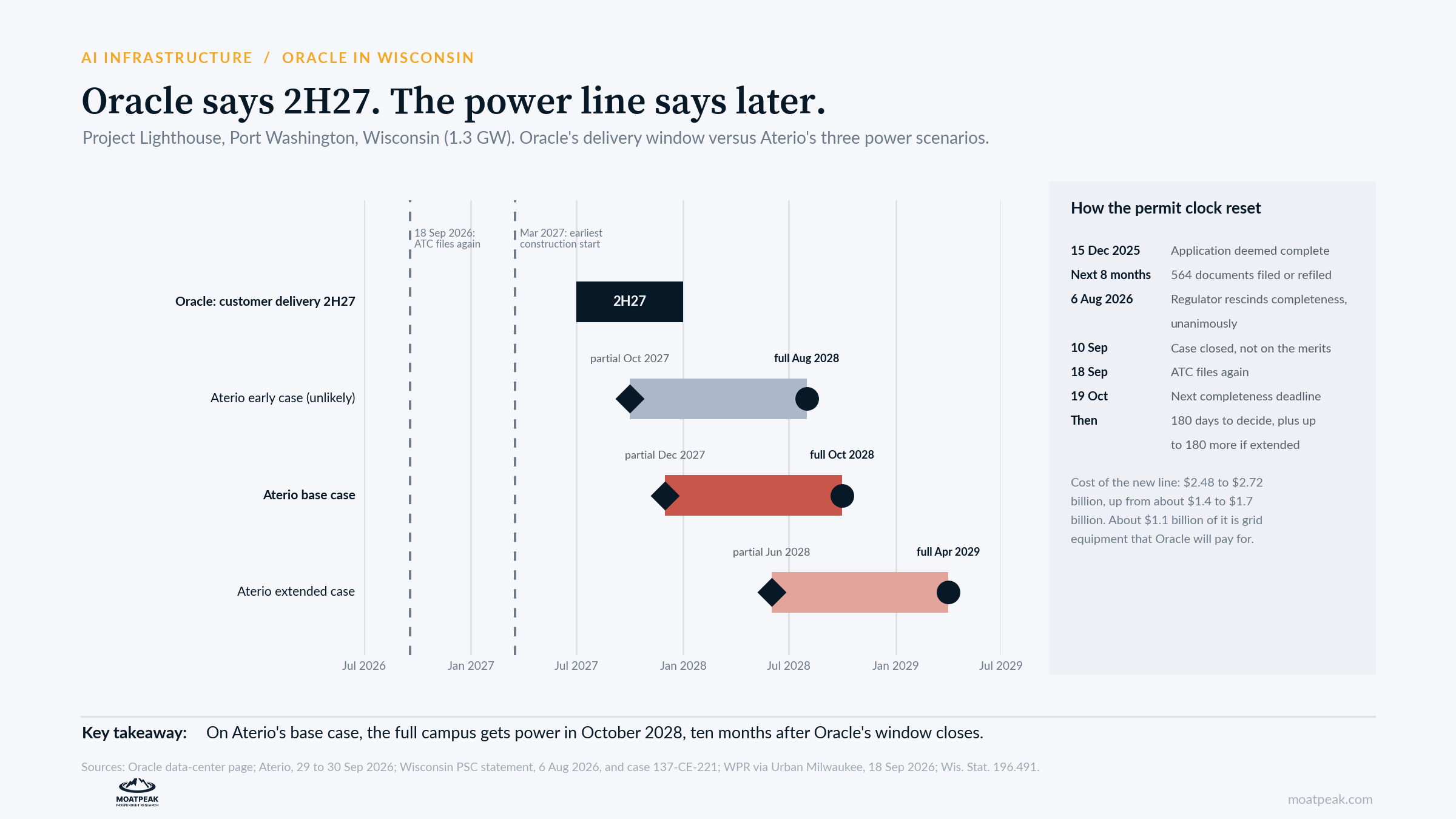
According to Aterio’s report from late September, work on the new lines cannot begin before about March 2027. In its base case, the first part of the campus gets power in December 2027 and the full 1.3 GW in October 2028. In its extended case, full power slips to April 2029. Aterio notes that the commission used the extra 180 days in every comparable large transmission case, and that four 345-kilovolt lines received decisions 355 to 358 days after their applications were complete. These are Aterio’s estimates from public filings, not commitments from Oracle, ATC or the regulator.
The line is also getting more expensive. The current estimate is $2.48 billion to $2.72 billion, up from about $1.4 billion to $1.7 billion in the first application. About $1.1 billion of that is grid-stabilizing equipment that Oracle has agreed to pay for. “We Energies’ largest customer today is less than 100 megawatts, and, at the max, this could be 3,500,” Tom Content of the Citizens Utility Board told Wisconsin Public Radio.
A forest in Finland
On 9 September, Google announced that it would invest at least 13 billion euros in Finland over two years, its largest single investment in Europe. The plan included new data centers in Kajaani, Vaala and Muhos, and a 22-year agreement to buy up to half the output of Fortum’s Loviisa nuclear plant. In other words, Google had brought its own power.
On 6 October, Finland’s Permit and Supervision Agency told Google’s project company, Tuike Finland, to stop preparatory work at Muhos and Kajaani immediately, and by 23 October at the latest. Google has confirmed that about 330 hectares were cleared at Muhos and just under 200 at Kajaani without the environmental impact assessment that the agency says should have come first. Tuike has until 14 October to respond.
In September, Google told the Finnish news agency STT that the trees were felled “in full compliance with the Forest Act.” On 6 October, the company said it had “fallen short of our own high standards” and would plant trees on 130 hectares at Muhos. A citizens’ initiative calling for stricter rules on data centers gathered 50,000 signatures in three days.
The Finnish dispute could be sorted out. The point is what it shows: a company can solve its power problem and still be held up by a different permit.
Paying for power that already exists
On 6 October, Google and Constellation Energy announced agreements covering 3,590 megawatts in PJM, the largest power grid in the United States. Of that, 890 megawatts will be new nuclear capacity from upgrades at 11 existing reactors in Illinois, Pennsylvania and New Jersey, under a 20-year contract. Constellation will invest more than $4.3 billion, with the first upgrade due by 2028. The other 2,700 megawatts will come from Constellation’s existing PJM fleet under a 15-year agreement. Constellation’s shares rose 12.25 percent that day.
For perspective, Constellation’s nuclear deals with Microsoft, Meta and Amazon add up to 2,646 megawatts.
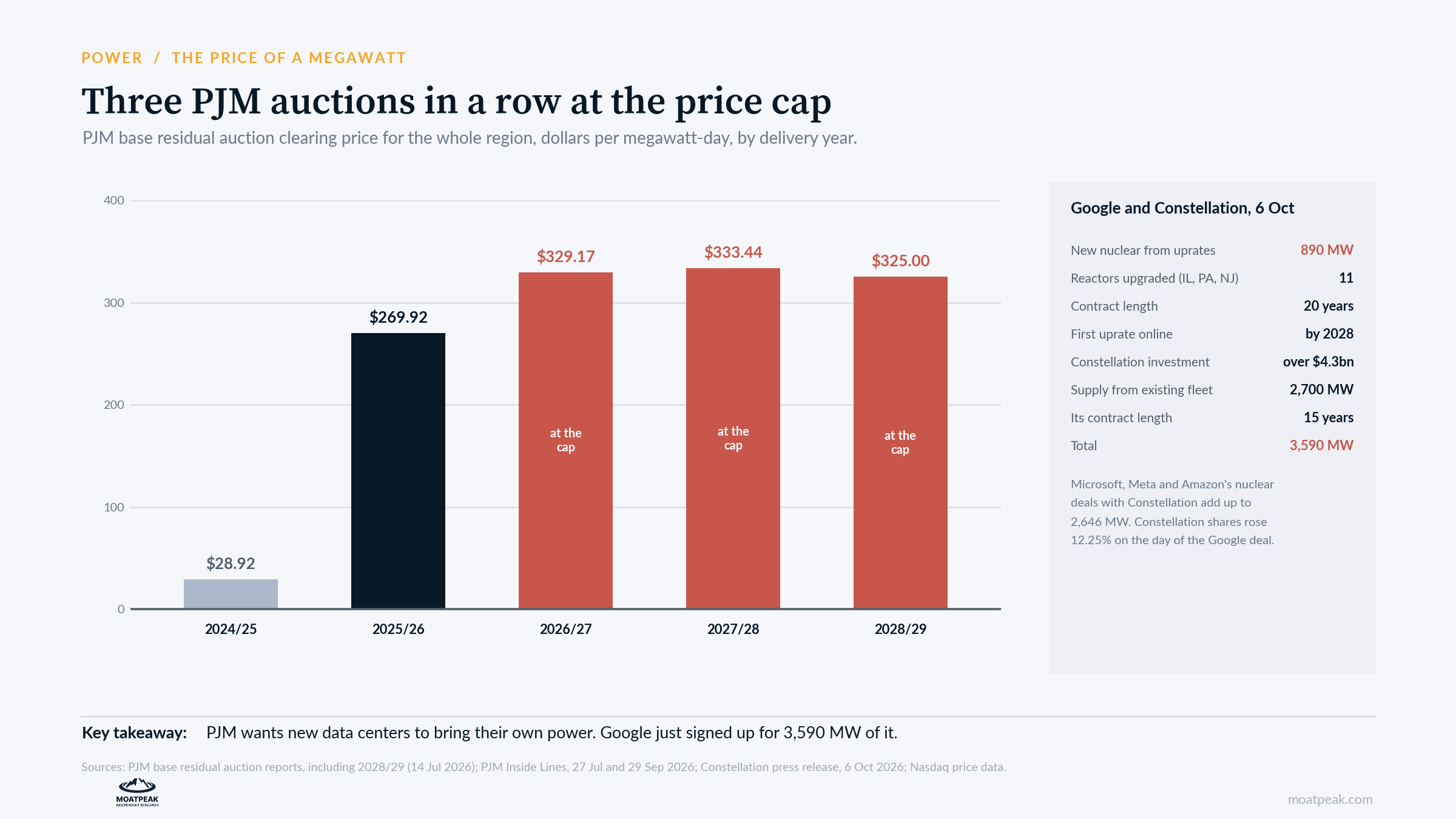
The timing is no accident. PJM’s board has put forward a proposal that Constellation’s release calls “Bring Your Own Power”: new loads of 50 megawatts or more that do not bring their own supply by 1 June 2027 would be among the first to be cut in a power emergency. PJM filed the plan with federal regulators on 13 August and asked them to decide within 60 days. Meanwhile, PJM’s auction price for capacity has risen from $28.92 per megawatt-day for 2024/25 to its cap in each of the last three auctions, and on 29 September federal regulators put PJM’s emergency procurement plan on hold for five months.
Upgrading an existing reactor avoids most of what is slowing down everything else: finding new land, building new lines, getting permits and waiting in the queue to connect to the grid.
Why a delay costs more than time
A campus that is built but not yet powered still has to pay for its buildings, its equipment and its debt. Revenue starts only when the power does.
That matters most for companies that borrowed against a promised delivery date. Oracle has guided to capital spending of $90 billion to $95 billion in fiscal 2027, up from $55.7 billion in fiscal 2026, and S&P rates it BBB-, the lowest investment grade rating. In late September, Oracle sent a force majeure notice on its Project Jupiter campus in New Mexico, Bloomberg reported, and the cost of insuring its debt against default hit a record. Lighthouse is a different site with a different problem, but the result is the same kind of delay.
Delays also create winners. Every month a new campus waits, computing capacity that is already running gets scarcer, and so does power generation that already exists. That is what investors paid for in Constellation on Tuesday.
The case against us
Most of these problems can be solved. Google could file its explanation by 14 October, carry out the assessment and still keep its 2027 and 2028 schedule. The Wisconsin commission may decide faster than Aterio expects, and Oracle has other campuses that do not depend on this line. Demand for computing power is still running ahead of supply, so a late campus could still fill up quickly at good prices.
If Lighthouse gets its approval soon and Finland settles within weeks, this was a difficult month, not the start of a new trend.
What it means for your money
Treat delivery dates as estimates. When a company says 2027, the permit calendar now matters as much as the chip supply.
Power that already exists has scarcity value. Owners of running plants, especially nuclear, are being paid for the capacity they bring.
Know who carries the time risk. Borrowers that promised capacity by a set date carry more of it than owners of computing power that is already running.
What we are watching
Around 12 October: the end of the 60 days PJM asked federal regulators to take on its plan.
14 October: Tuike Finland’s explanation is due.
About 19 October: the Wisconsin commission’s decision on whether ATC’s new application is complete.
23 October: Finland’s deadline for the work to stop.
Educational research only. Not personalized investment advice. MB “MoatPeak Group”.