


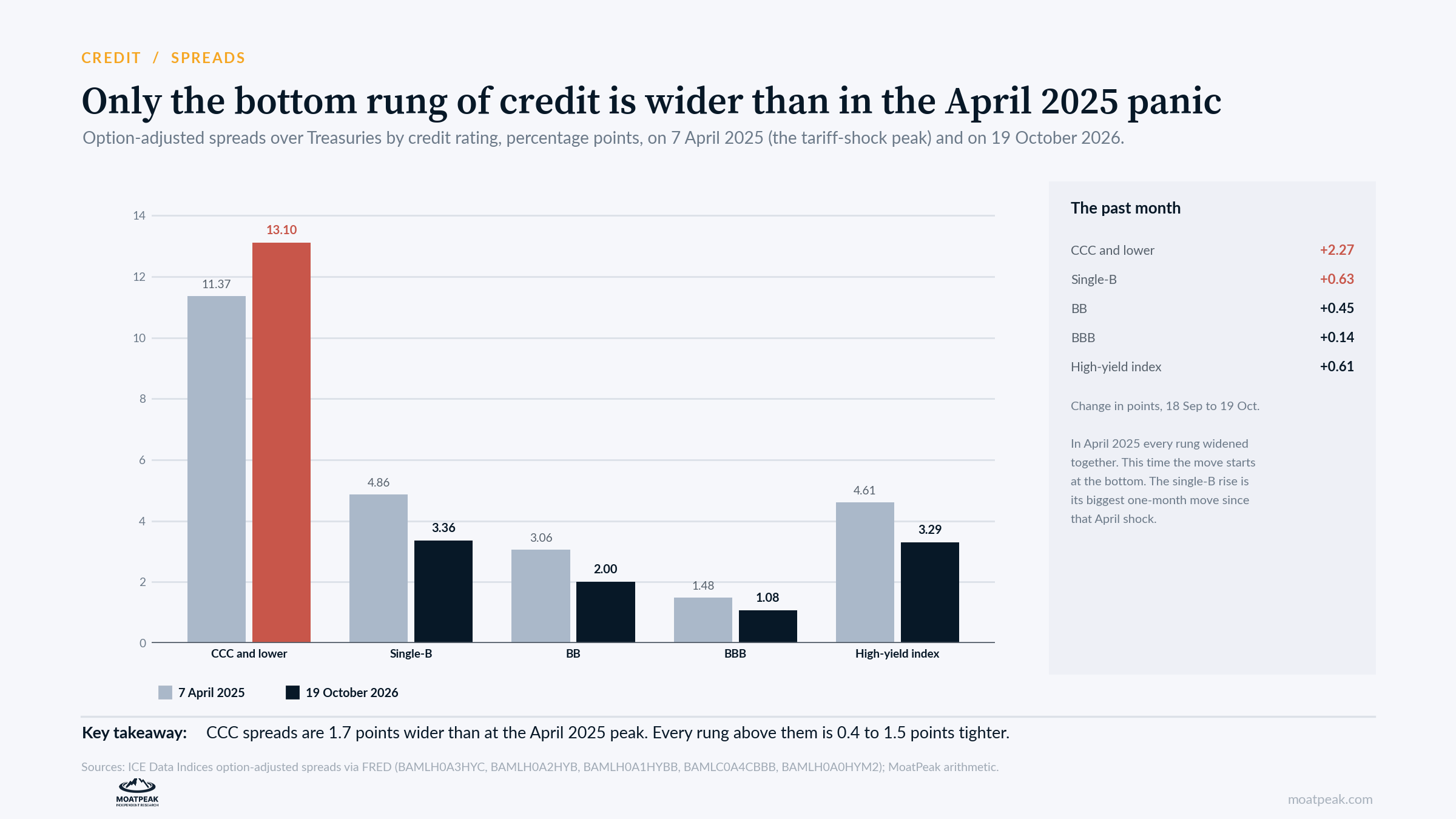
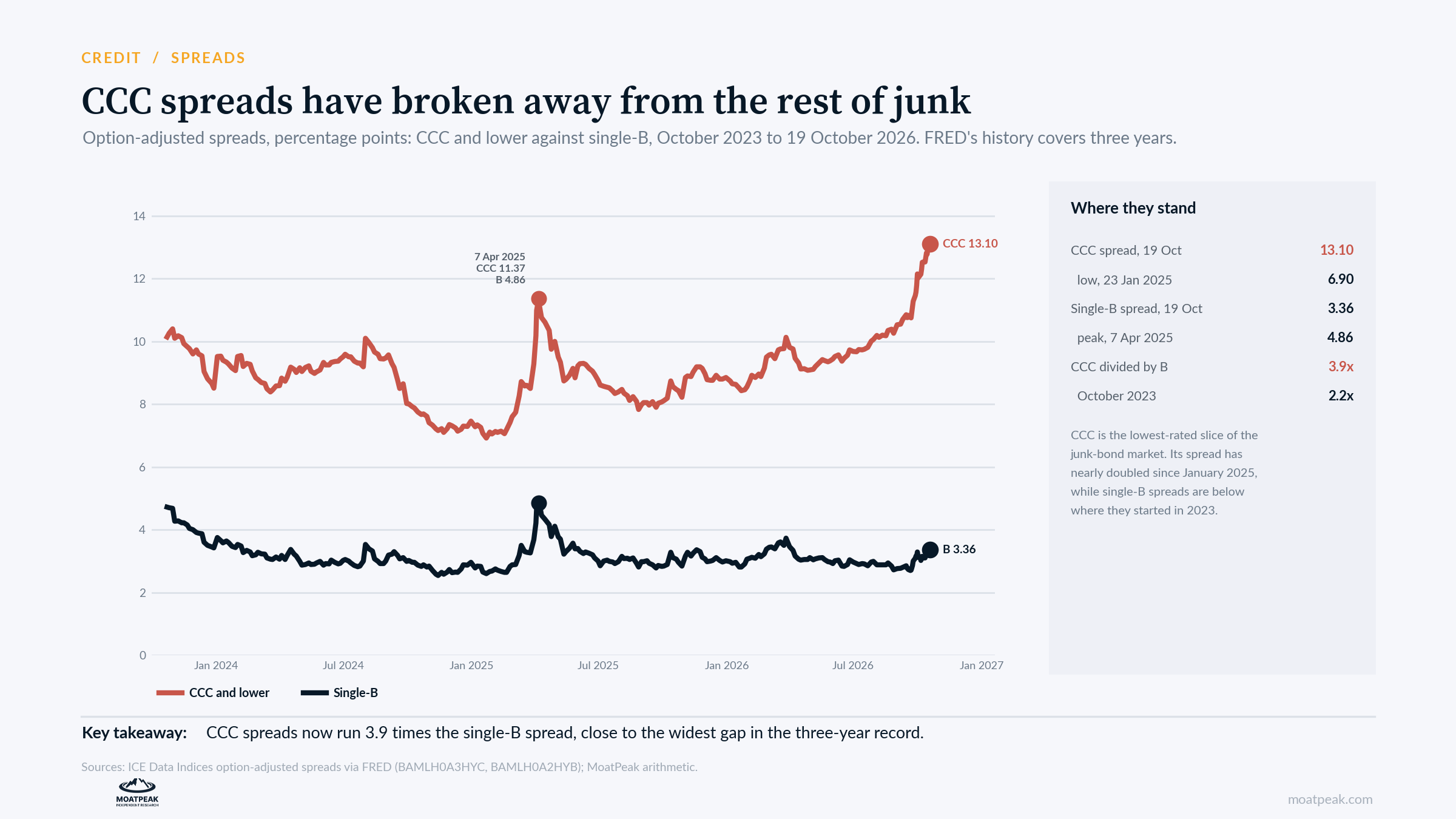
On 19 October, the extra yield investors demanded to hold CCC-rated bonds, the junk market’s lowest tier, reached 13.10 percentage points over Treasuries. That is the widest in the three years of daily history on FRED. It is also wider than on 7 April 2025, the worst day of the tariff shock, when it hit 11.37 points.
Everything above that rung looks calmer than it did then. Single-B spreads are 3.36 points, against 4.86 in April 2025. BB spreads are 2.00, against 3.06. BBB, the lowest investment-grade rating, is at 1.08, against 1.48. The high-yield index as a whole is at 3.29, against 4.61.
It is tempting to read the CCC move as the start of a broad credit crisis. We read the same numbers differently. In April 2025, every rung widened at once, which is what a market-wide shock looks like. This time, the stress falls on the borrowers least able to refinance at today’s rates. That is a narrower problem, and it tells us where losses are likely to land first.
Why the bottom breaks first
CCC borrowers are the companies with the least room for error: heavy debt, thin cash flow and maturities that need new money. With the 10-year Treasury yield above 5 percent, every refinancing costs more, and the weakest balance sheets feel it first. The CCC spread has nearly doubled from its January 2025 low of 6.90 points.
The gap between CCC and the next rung shows how concentrated the move is. CCC spreads are now 3.9 times single-B spreads, close to the widest in the three-year record and up from 2.2 times in October 2023.
The rung to watch
Single-B is the next step up, and it has started to move. Its spread rose 0.63 points in the month to 19 October, its biggest one-month rise since the April 2025 shock. BB rose 0.45 points and BBB 0.14. If the stress spreads up the ladder, it should show up there first.
Another place to look is private credit, where many similar borrowers get their loans. Business development companies, the listed funds that lend to midsize firms, report their loan values quarterly but trade daily. On 20 October, FS KKR traded at 0.55 times its June net asset value, Blue Owl Capital Corp at 0.70 and Golub Capital BDC at 0.84. Ares Capital, the largest, was at 0.96. The market appears to be pricing losses or lower payouts that the June values do not yet show.
The case against us
CCC is a small, lumpy corner of the market. A handful of large troubled issuers can move its spread, so part of the widening may reflect a few names rather than a broad trend. The calm above it is real information too: if lenders feared a recession, BB and BBB spreads would be rising faster.
Spreads can also reverse quickly. After April 2025, the CCC spread fell from 11.37 points to below 9 within six weeks. And for buyers who can tell the survivors apart, 13 points over Treasuries is a large cushion.
What it means for your money
Read the ladder, not the headline index. The high-yield index blends the rungs and looks calm. The stress is at the bottom.
Watch single-B spreads. A sustained rise there would mean the problem is moving from the weakest borrowers into the middle of the market.
Treat the discounts on listed lenders as a signal. Their third-quarter results will come out in the coming weeks and will show whether the market or the June marks were closer.
What we are watching
Single-B spreads, published daily on FRED, now 3.36 points.
Third-quarter results from the listed lenders, starting in late October, for new loan values and payouts.
27 and 28 October: the Fed’s rate decision.
Educational research only. Not personalized investment advice. MB “MoatPeak Group”.