


US construction spending fell 1.9 percent in September, the Census Bureau reported on 2 November. It was the largest monthly drop since April 2020, and spending was 2.7 percent lower than a year earlier. Read as one number, that is a soft patch.
Split in two, it looks different. One building type is growing at 90 percent a year, and almost everything else is contracting.
One building type
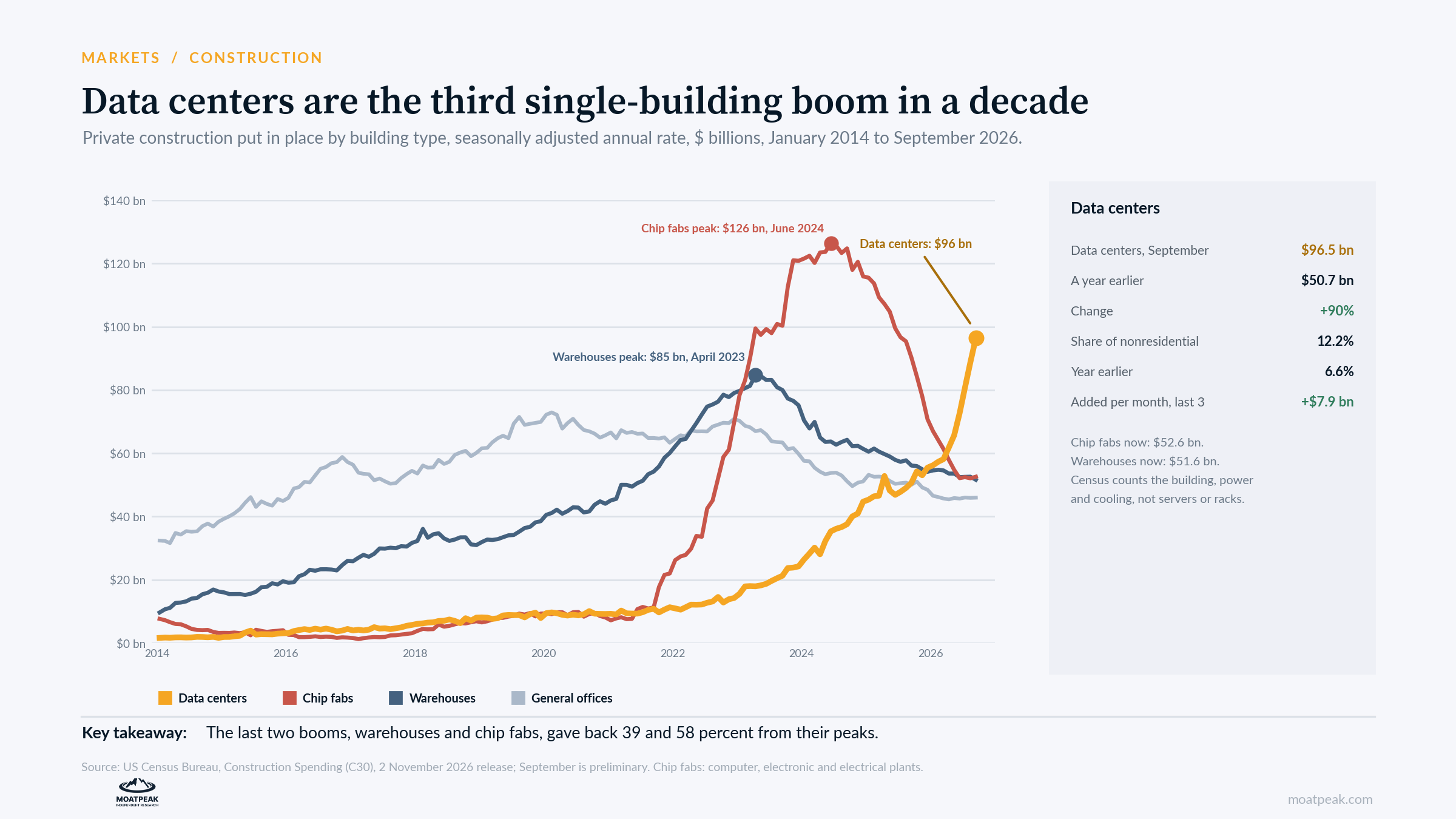
Private spending on data centers ran at a seasonally adjusted annual rate of $96.5 billion in September. That is up 8.6 percent from August, 72 percent since January and 90 percent from a year earlier. In each of the past three months, the annual rate rose by about $8 billion.
Data centers now account for 12.2 percent of private nonresidential construction, up from 6.6 percent a year ago. The category passed general offices for good in September 2025, warehouses in December and chip fabs in April. It is now 1.8 times the size of chip fab construction and 2.1 times that of general offices. When the Census Bureau began tracking it separately in 2014, it was a $1.6 billion line.
The definition matters. The survey counts the building, its power systems and its cooling. It excludes the servers and racks inside. So the $96.5 billion is the part of AI spending that pours concrete and pulls cable, a fraction of what the builders spend on chips.
Everything else
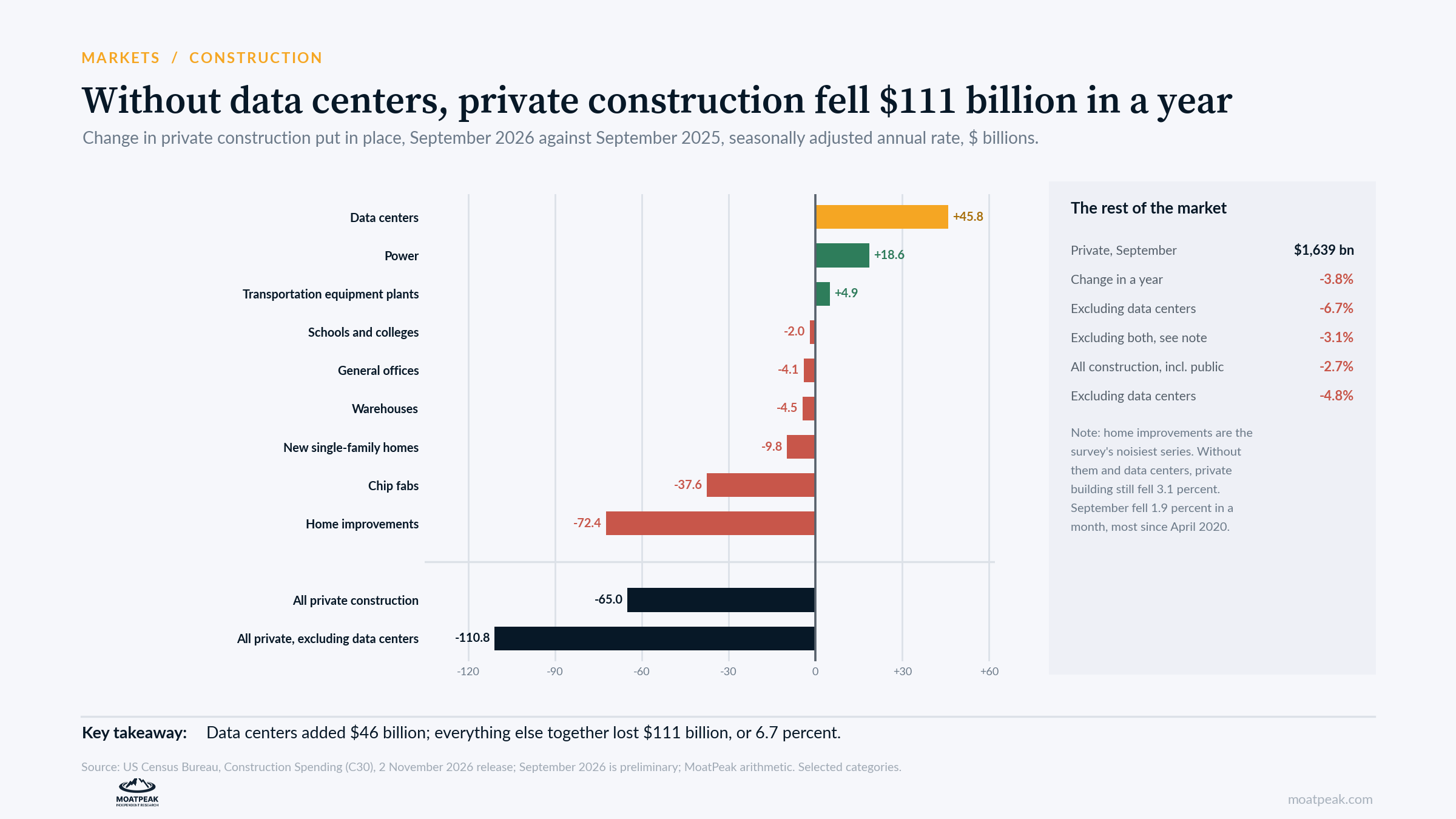
Take data centers out and private construction fell 6.7 percent over the year, a drop of $111 billion at an annual rate. Since January alone, data centers added $40 billion while everything else lost $62 billion.
The decline is broad. Residential spending is down 8.9 percent from a year ago. New single-family homes are down 2.4 percent, and home improvements are down 18 percent. Chip fabs, the boom of 2023 and 2024, are down 42 percent from a year ago and 58 percent from their June 2024 peak. Warehouses are down 8 percent on the year and 39 percent from their April 2023 peak. General offices are down 8 percent.
The one other bright spot is related. Power construction rose 12.1 percent, and electric power 14 percent, as utilities add generation and grid capacity for new demand, including data centers.
Home improvements are the noisiest series in the survey, so we checked the result without them. Excluding both improvements and data centers, private construction still fell 3.1 percent. Including public projects, total construction excluding data centers fell 4.8 percent.
Our read
Data centers and power projects together added $64 billion over the year, while every other category combined lost $129 billion. Growth in US construction now rests on one theme, and that matters beyond builders. Contractors, equipment makers and materials suppliers that look diversified may now depend on one customer group for most of their growth.
History is a warning. Warehouses boomed on e-commerce and chip fabs on subsidies. Both grew for years and peaked when buyers changed their plans, then gave back 39 and 58 percent. The fab boom took 33 months to multiply elevenfold, from $11 billion in September 2021 to $126 billion in June 2024, and the next 27 months to lose 58 percent. Data centers have more than quadrupled in three years. Spending put in place lags decisions by a year or more, so the reported series kept rising after the plans changed.
Data centers have a stronger buyer base. The five largest builders added $577 billion of signed purchase and lease commitments last quarter, by our count from their filings, and much of that is locked in for years. That supports the line into 2027. What it cannot do is keep adding $8 billion a month indefinitely. Growth at this pace depends on power hookups, permits and financing, and those are already the bottlenecks.
The stock market has priced the split. This year to 2 November, Quanta Services rose 47 percent, Vertiv 39 percent and Comfort Systems 29 percent. The iShares US Home Construction ETF rose 1.9 percent, while residential construction fell 8.9 percent from a year earlier.
The case against us
This boom has different buyers. The companies behind it generate hundreds of billions of dollars of operating cash flow a year, unlike the developers and subsidized fabs of earlier cycles.
The data are early. September is preliminary, August was revised and the Census Bureau revises the series every year. A month showing $8 billion of growth could be revised down later.
Housing may turn. Residential spending is sensitive to mortgage rates, and lower rates would lift the largest part of the market and ease our concentration concern.
What it means for your money
Find the data center share. For any industrial or materials holding, check what part of backlog or orders comes from data centers. Growth from one source deserves a lower multiple than growth from many.
Watch the monthly increment. The level matters less than the change. If data centers stop adding several billion dollars a month, their contribution to construction growth shrinks quickly, even before spending falls.
Mind the housing gap. Homebuilder shares are up this year while residential spending is down 8.9 percent. That gap closes when either rates fall or earnings do.
What we are watching
1 December: October construction spending, and revisions to the August and September data center figures.
Late January and February: capital spending plans for 2027 from the largest builders.
Utility filings: large-load interconnection requests, the first place a slowdown in data center plans would show.
Educational research only. Not personalized investment advice. MB “MoatPeak Group”.