


Somebody announces a gigawatt of new data center capacity. The number goes round. A share price moves.
The problem is that ‘gigawatt’ can refer to seven different things, even though we use the same word for each one. The difference between the first and last is as big as the difference between an idea and a finished building.
We use a simple method to tell them apart. It was the most helpful part of our research last week, and you can use it for any headline you see this year.
What actually happens between an announcement and a machine
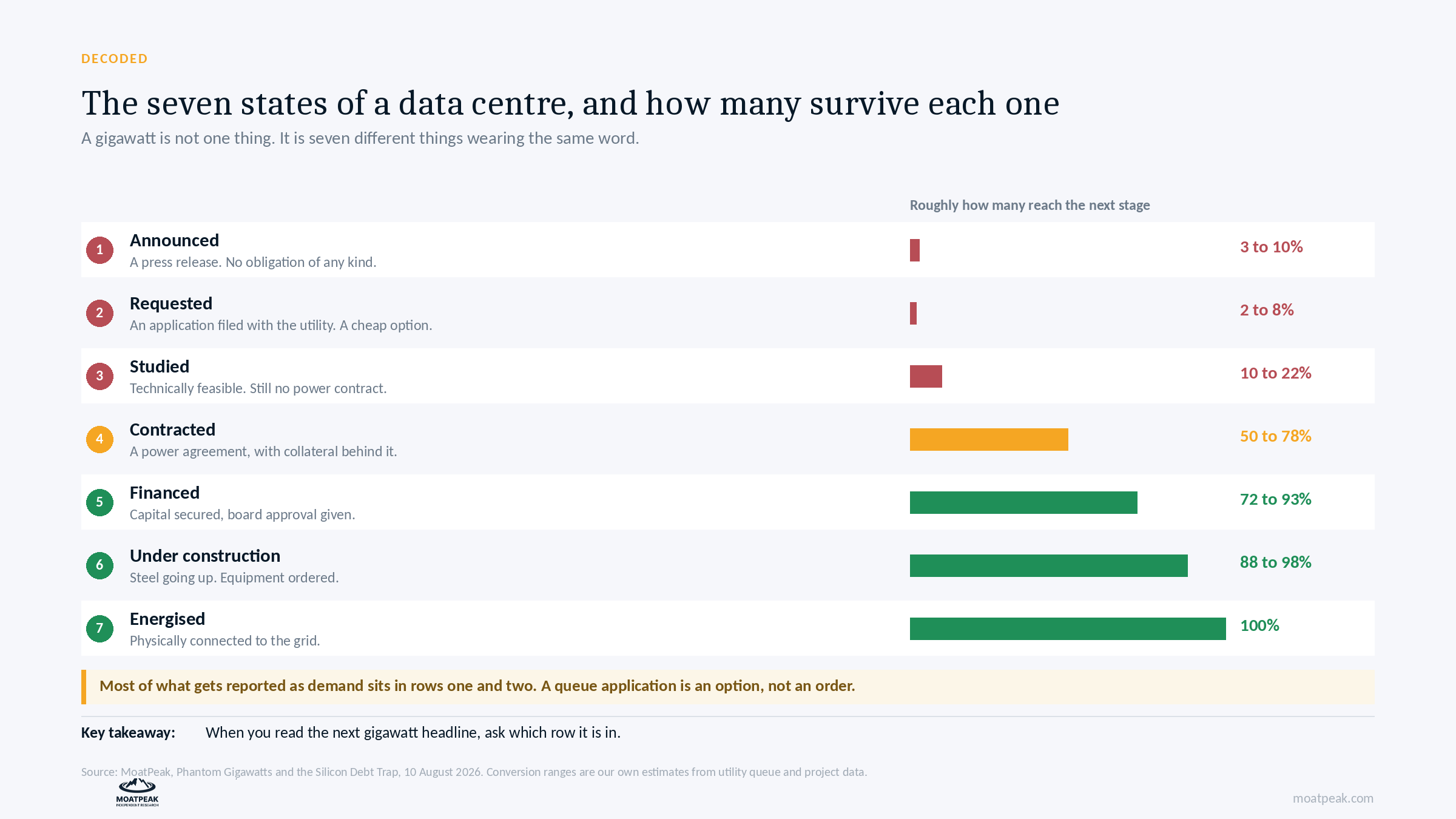
A data center project goes through seven stages before it produces anything. Each stage means something different legally, and the chances of moving to the next stage vary a lot.
1. Announced. A press release. Nobody has committed to anything, nothing has been signed, and no money has moved. By our estimates, 3 to 10% of capacity at this stage becomes real.
2. Requested. An application has been filed with the utility or grid operator. This might sound serious, but it is not. Filing is inexpensive, so it is just a way to hold a place in line, often without power, financing, equipment, or even a customer. 2 to 8%.
3. Studied. The engineering has been checked, and the connection is technically feasible. Still no power contract. 10 to 22%.
4. Contracted. There is now a power agreement with collateral. This is the first stage where someone would lose real money if they backed out, so the chances of moving forward increase. 50 to 78%.
5. Financed. Capital secured, board approval given – 72 to 93%.
6. Under construction. The steel is being put up, and equipment has been ordered. 88 to 98%.
7. Energized. The project is now physically connected. It only counts as a real gigawatt at this stage.
Notice where most projects drop out. It’s not at the end, but between stages three and four – right when someone has to sign a contract that would cost money to break.
Also, notice where the headlines focus. Most reported demand is in stages one and two.
The check that takes ten seconds
Next time you see a company announce, secure, plan, or request a gigawatt of capacity, don’t just look at the size. Ask which stage it’s in.
The wording usually gives you a clue. Phrases like announced, plans to, is exploring, has applied for, or is in talks mean stages one to three. Signed, agreed, has begun construction, or has energized mean stages four to seven.
Most news stories skip this detail because the distinction isn’t exciting, but the big number is.
Why does the same building get counted four times
There’s another problem, and it’s even more awkward than the first.
At a single campus in Shackelford County, Texas, four separate companies each announced the project. Nvidia, Oracle, Vantage, and OpenAI. One physical site, four press releases.
If you count announcements instead of actual locations, you will end up counting the same capacity four times.
This happens all the time because everyone involved in a project wants to announce it. The chip supplier, cloud tenant, developer, and end customer are all separate companies, each with its own investors.
When you add double counting to the queue effect, our estimate is that announced demand is four to twenty times higher than what can actually be financed.
Which brings us to the most useful outside confirmation we found.
The Lawrence Berkeley National Laboratory publishes a free annual study of connection queues. Its 2026 edition looked at all the capacity that entered American queues between 2000 and 2020 and found that only around 13% had actually reached commercial operation by the end of 2025. Roughly 75% were withdrawn.
That is a national lab using different data and asking a different question, but reaching the same conclusion as our framework. When two independent methods agree, the answer is probably close to correct.
Now for the part that changes the whole argument
Everyone is debating the grid – can it handle the load, where will the power come from, which utility will win, and when will the transformer arrive?
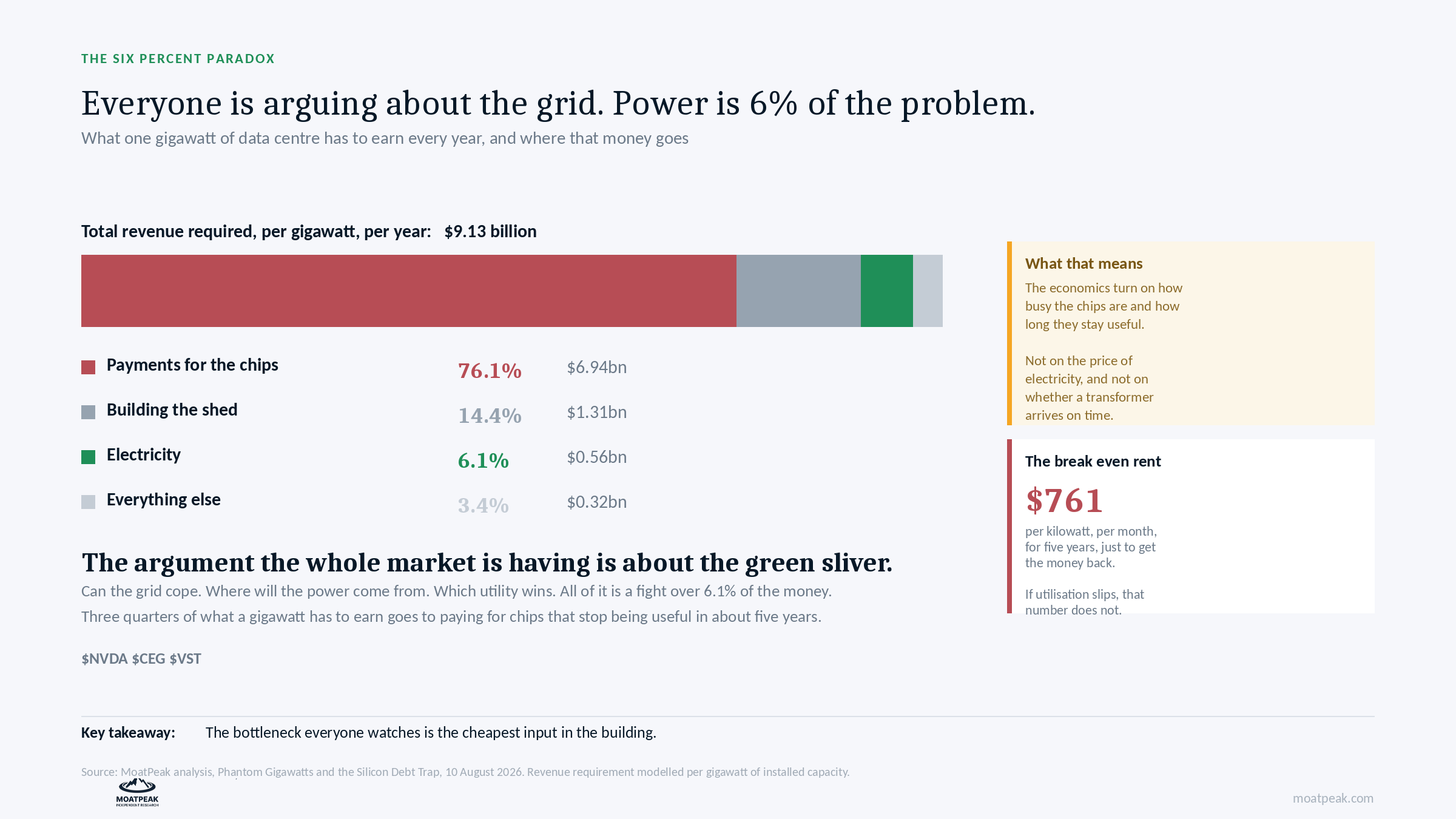
In our model, one gigawatt of data center capacity needs to generate about $9.13 billion per year.
Electricity is $0.56 billion of that – six percent.
Payments for the chips are 76%.
So, the biggest debate in the market is actually about the smallest cost. The economics are not really about electricity prices. They depend on how much the chips are used and how long they stay valuable, since three-quarters of a gigawatt’s earnings go to equipment that becomes outdated in about five years.
This means you need about $761 per kilowatt per month for five years to break even. If usage goes down, that number stays the same.
The four questions we would ask of anything in this theme
This is the whole framework, and you can use it on your own.
First, which row is it in? Not how many gigawatts, but which of the seven stages, and what would need to happen for it to reach the next one.
Second, who is doing the counting? If four companies announce one campus, that is still just one project. Count the actual sites.
Third, which part of the cost are you exposed to? The power debate is only 6% of the total. If your investment depends on electricity prices, you are exposed to a small part. If it depends on chip usage, you are exposed to the bulk of it.
Fourth, who takes the loss if the project fails? Few people ask this. Each participant in a data center project has a different capacity to absorb the loss. Some keep non-refundable deposits even if the servers never run, while others have to absorb the loss themselves. It is the same issue, but with very different results.
And the honest limits of all this
There are three important caveats to all of this, and we want you to hear them directly from us. The demand is real. None of this means the buildout is fake. Cloud backlogs are huge and still growing, and companies reporting in the last two weeks have shown real acceleration instead of a slowdown. Our point is about how to count capacity, not whether it is needed.
Low conversion is normal. Interconnection queues have always been full of projects that never happen. That is what a queue is for. A 13% historic conversion rate does not mean there is a bubble; it just shows that filing an application is cheap.
Transparency can be punished. Regions that publish all their early-stage requests look much worse than regions that only publish mature projects. If you compare two grids without adjusting for what each one discloses, you will almost always think the more honest one is in trouble.
What is in the full report
The framework above is yours. What we have kept for subscribers is the application of it: which regions are genuinely power-constrained once you adjust for the disclosure problem, our scoring of who can push stranded costs onto somebody else, the reverse valuation work showing how many gigawatts of future contracts particular share prices already assume, and the four names we think sit on the right and wrong sides of all of it.
The comprehensive research and more – at moatpeak.com.
Educational research only. Not personalized investment advice. MB “MoatPeak Group”.