


Unemployment sits at 4.1%, which seems healthy at first glance. But beneath the surface, the job market has stalled.
Since 2019, the rate at which unemployed people find jobs has dropped by about 14%. Hiring is down 12%. The quits rate has also fallen 14%, showing that people are staying in their jobs because they do not see better options, not because they are more satisfied. Long-term unemployment has grown from 21.2% to 25.5% of all unemployed people.
This is not a wave of layoffs. Instead, it is a kind of gridlock. Companies are neither firing nor hiring.
A similar pattern shows up in company accounts, pointing to the same conclusion.
We went looking for the savings
The main idea behind investing in AI is that it should make companies more efficient. If that is true, we should see lower costs in the financial reports of companies using AI.
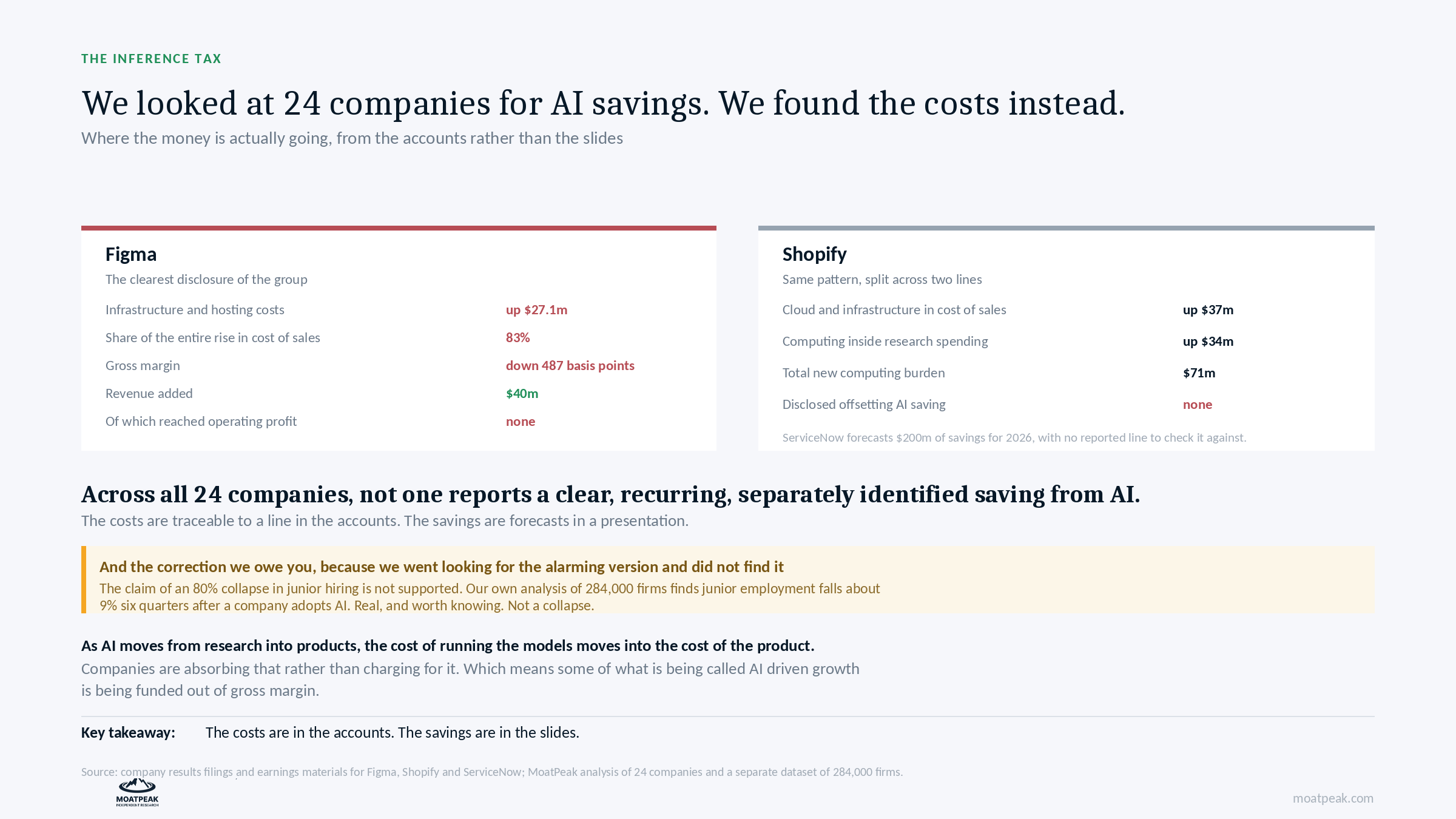
We reviewed 24 companies, and none of them reported a clear, ongoing, and separate cost saving that could be directly linked to AI.
What we found instead was the cost, and it is easy to trace.
Figma is the clearest example, and to its credit, it provides the most detail. Its infrastructure and hosting costs went up by $27.1 million, making up 83% of the total increase in its cost of goods sold. Management says this is due to paying for AI model costs on beta products that are not yet generating revenue. The company’s non-GAAP gross margin dropped by 487 basis points compared to last year. Figma added $40 million in revenue, but none of it became operating profit.
Shopify added $37 million in cloud and infrastructure costs to its subscription cost of sales, plus another $34 million in computing costs for research and development. That is $71 million in extra spending, with no reported AI savings to balance it out.
ServiceNow forecasts $200m of savings in 2026. It may well achieve it. But without a reported line, nobody outside the company can tell whether that is AI or ordinary cost control.
We refer to this as the inference tax. As AI shifts from research to real products, the cost of running these models moves from a flexible budget item to part of the product’s actual cost. Right now, companies are absorbing these costs instead of passing them on to customers.
This means that some so-called AI-driven growth is actually being paid for out of gross margin.
Two claims we checked and had to soften
We prefer to share what we actually found, not just what supports our argument.
The claim of an “80% collapse in junior hiring” is not supported by our data. Our analysis of 284,000 firms shows that junior employment drops by about 9% six quarters after adopting AI. This is real and important, but it is not a collapse. The often-cited 19% figure from another study actually measures a delay in hiring, not job losses. Also, the ratio of youth unemployment to overall unemployment is 2.08, which is better than the 2.25 seen in July 2019.9.
A productivity metric does not always mean real productivity. Shopify’s revenue per employee went up, but that is partly because it now counts only employees, not contractors, which makes the ratio look better automatically. Breaking it down, 80.5% of the improvement comes from higher sales, and only 19.5% is from better use of staff.
Block’s internal AI tool did increase code commits per engineer by 2.5 times. But at the same time, credit losses went up by $578.5 million and marketing costs rose by 21%. Real improvement in one area does not prove overall productivity if other numbers are getting worse.
Seven questions to ask of anything claiming AI efficiency
Here is the checklist. You can use it yourself.
Is the claimed productivity gain just sales growth wearing a new label?
If inference costs are permanent, can this company hold its gross margin?
Does the valuation require a terminal margin the business has never achieved?
Has the denominator moved? Watch for contractors quietly leaving the headcount base.
Is the tool changing the profit and loss account, or only an activity metric like code volume?
Could cheaper output simply pull demand and headcount up rather than down?
Is the claimed saving actually a price cut being handed to the customer?
The risk is duration, not magnitude
A sudden rise in unemployment would be easy to spot and would get attention. But when it becomes hard to change jobs for a long time, it is less visible and slowly weakens workers’ bargaining power, since people who cannot leave cannot negotiate.
We believe this is what is really happening, even though it does not make headlines.
You can see the costs in the financial accounts. The savings, however, are only shown in presentations. Until a company publishes a clear, checkable line, consider those savings as just forecasts.
Our full transparency scorecard, ranking companies on how clearly they disclose AI costs, plus the scenario work behind it, is at moatpeak.com.
Educational research only. Not personalized investment advice. MB “MoatPeak Group”.