


There’s a company that could be worth either $22.51 or $45.71, depending on how you answer one question. Its share price is $21.56. The question isn’t about growth, competition, or the economy.
It’s whether $130.1 million in credit losses should be counted as a regular business cost or treated as a one-time event.
What the business actually does
Pagaya works with other lenders. If a bank or car dealer turns down a loan application, Pagaya reviews it with its own models. Last quarter, it looked at over $307 billion in applications and approved about 1%. The approved loans are bundled into securities and sold to institutional investors, and Pagaya earns a fee from this process.
This might sound like a software business, and for a while, the market saw it that way.
But it’s not quite a software business, and here’s why.
The number that changes everything
To make these securitizations work, Pagaya has to keep some of the risk. As of June 30, it held $1.04 billion in retained loans and securities.
Its total shareholder equity is $594 million.
This means the retained credit book is 175% of the company’s net worth. These assets aren’t priced by the market; instead, management estimates their value.
That’s why this accounting question really matters. If the company had to write down that book by 20%, it would lose about $208 million, or roughly 35% of shareholders' equity.
The two presentations
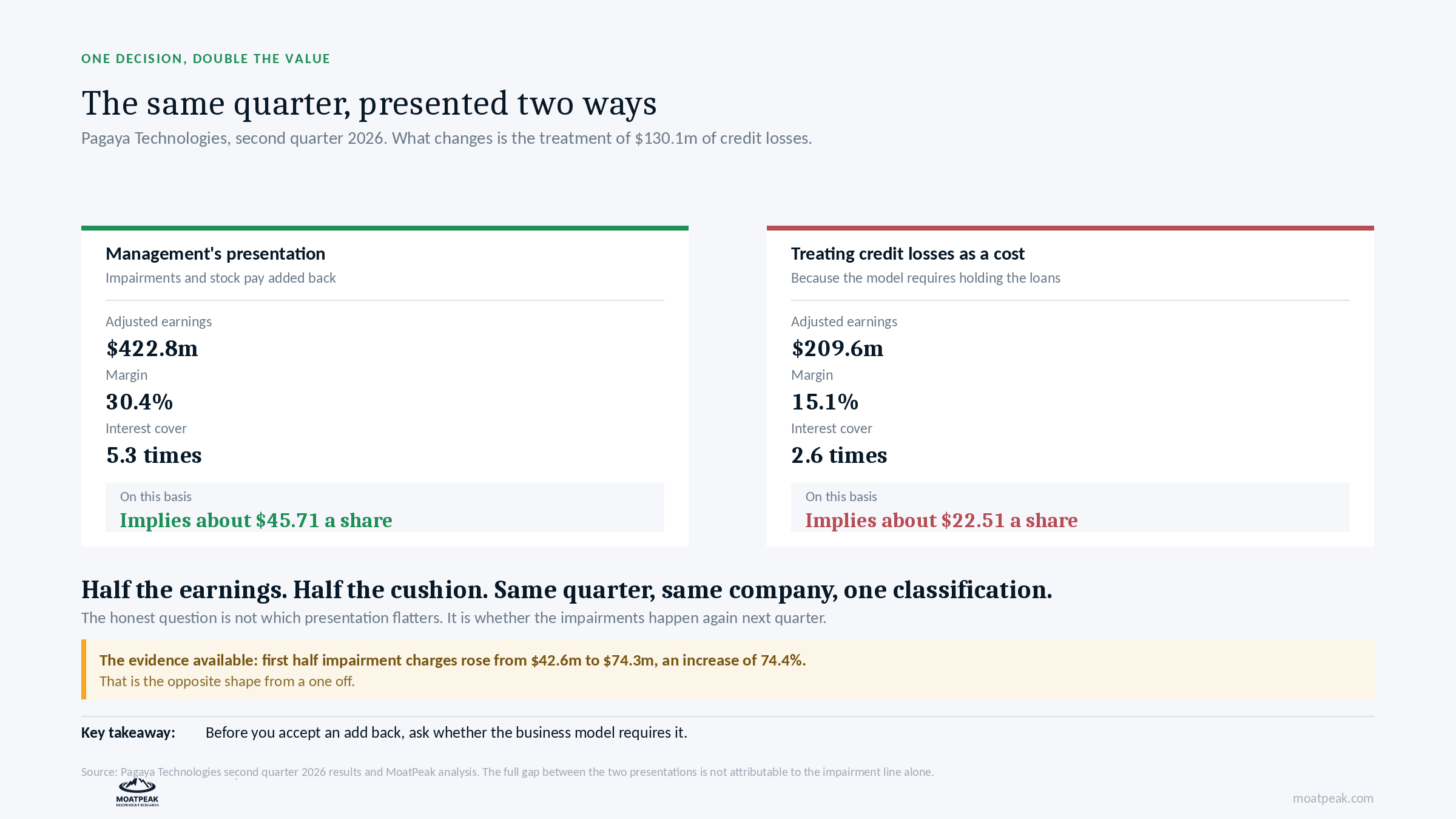
Here’s management’s version: If you add back the $130.1 million in impairments and stock compensation, adjusted earnings come to $422.8 million with a 30.4% margin. Interest cover is 5.3 times. By this measure, the company is worth about $45.71.
The other view is to treat credit losses as a regular operating cost, since keeping loans is a core part of this business. That approach gives you $209.6 million in earnings and a 15.1% margin. Interest cover falls to 2.6 times. By this measure, the company is worth about $22.51.
That’s a 50% drop in earnings, all from one accounting choice.
To be fair, we can’t fully account for the $213.2 million gap between the two versions using only the disclosed impairment figure. Some of the difference comes from other adjustments we can’t see. We mention this so it’s clear that the whole gap isn’t due to one line item.
The test that decides it
The real question isn’t which version looks better. It’s whether these impairments keep happening.
If this quarter’s credit losses were a one-time event, then management is right and the adjusted number is a better guide.
Here is the evidence available. First-half impairment charges rose from $42.6m to $74.3m, an increase of 74.4%. That is the opposite shape of a one-off.
Also, the reported quarterly profit of $45 million included a $20.1 million one-time tax reversal. That’s truly non-recurring, and no one adds it back in the other direction.
Two more things that are easy to miss
Monetization is slowing down. Network volume grew 33% year-over-year, but gross profit grew only 16%. This 17-point gap means the business is growing in size faster than in value. The fee take rate is 4.2%, just 20 basis points above what we’d consider a warning sign.
There’s also a dilution risk that’s often overlooked. There are 22.4 million latent shares outstanding, including 19.9 million founder options, and these aren’t included in the diluted share count. That’s about 23% potential dilution.
The transferable lesson
Every company that reports adjusted earnings is asking you to accept that something is not a real cost.
Sometimes they are right. A genuine one-off restructuring is not a cost of running the business next year.
The test is simple and comes down to one question: does the business model require this to happen?
If a company has to keep credit risk to operate, then credit losses are just as much a cost as salaries. If it needs to pay staff in shares to hire them, then stock compensation is a real cost. And if the add-back keeps growing instead of shrinking, calling it a “one-off” isn’t accurate.
Our full model, the three scenarios and the specific price at which we think the margin of safety becomes adequate are at moatpeak.com.
Educational research only. Not personalized investment advice. MB “MoatPeak Group”.
This is an important reminder that “adjusted earnings” are only as useful as the adjustments behind them.
A change in classification can materially change the earnings base, margins, and ultimately the valuation investors are willing to assign to the business.
The headline number matters less than understanding what sits underneath it.