


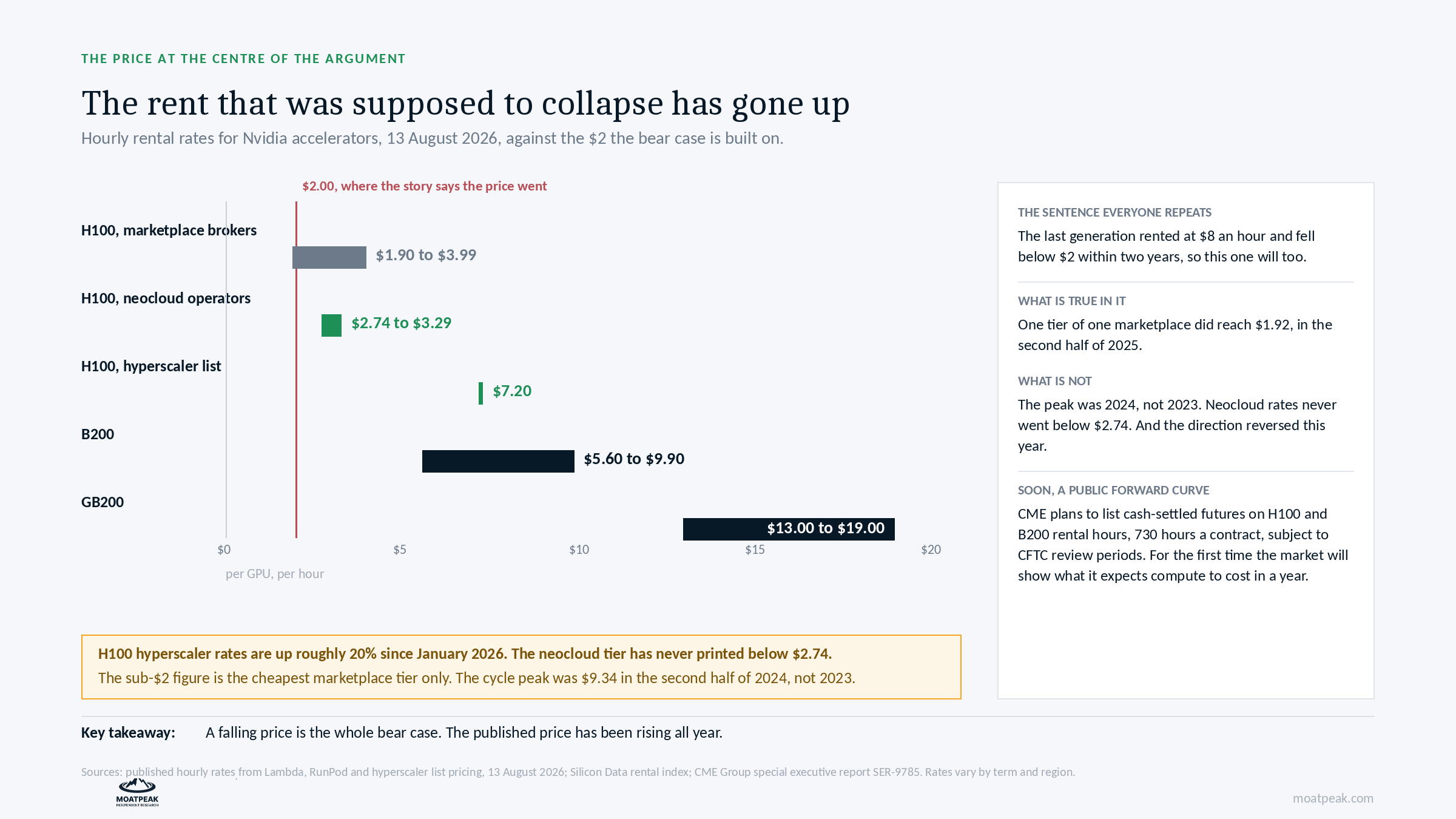
A common argument about artificial intelligence has spread widely in the past month. It says that renting a graphics processor used to cost about $8 an hour, but dropped below $2 within two years. The claim is that new chips will get cheaper in the same way, that companies that built the infrastructure will lose money, and that the whole system will fall apart.
This argument seems convincing and insightful, which explains why it has caught on so fast.
But the main claim behind this argument is not true at the moment.
What the published rates show
Here are the list and marketplace prices as of August 13, 2026. Anyone can look them up in a few minutes.
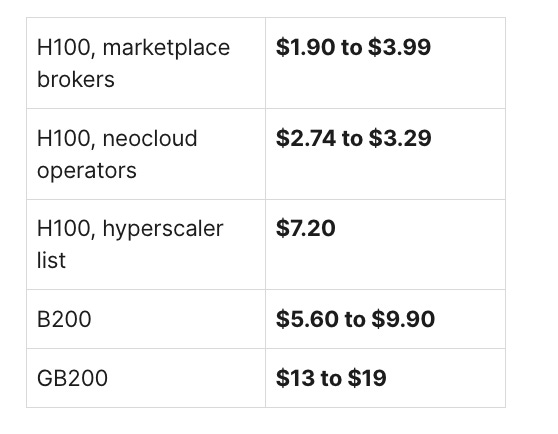
Three main points stand out from the table.
The price under $2 only applies to one tier. It comes from marketplace brokers, who are the cheapest and least reliable in the market. In this case, you are renting someone else’s extra capacity with no service guarantee or promise it will be available next week. Neocloud operators, where most serious work is done, have never offered prices below $2.74. Hyperscaler list prices have always been higher.
The highest price did not happen in 2023. It actually hit $9.34 in the second half of 2024. The $7.76 figure often mentioned for 2023 was just a median, and prices were going up then, not down.
The trend has changed direction. Hyperscaler H100 rates have gone up by about 20% since January.
Why this mistake keeps happening
This is a pattern worth learning, because once you can see it, you will find it everywhere.
People often take the lowest price in a market, present it as the standard price, and then build an argument around it.
This happens with rental rates, where the $2 marketplace price is treated as if it represents a market that usually trades between $2.74 and $7.20. It also happens with model output prices, where $1.75 per million tokens is shared as the standard, even though every top model charges at least $2.00 just for input, and output usually costs much more. It also happens with balance sheets, where a median across five companies is used to claim all are safe, even though the range goes from the best corporate credit to just above junk status.
Each time, a real number from the low end of a range is treated as ‘the price.’ Each time, the argument built on it sounds more dramatic than the facts really support.
That is not a reason to be careless. It’s a reason to check which number you are using.
The counter-argument, taken seriously
Here is the strongest argument against what I have said above, and it should be considered seriously, not ignored.
Rising rents today do not prove that rents will stay high. They could just mean supply is still tight and prices might drop later, once new construction is finished. Renting also does not have a single price. Long contracts, short contracts, reserved capacity, and spot rates all work differently, and a published list price is not what a big customer actually pays.
All of that is fair. If someone says rental rates will drop a lot over the next two years, that’s a reasonable view, and we would not strongly disagree. But that is not what people are saying right now. The claim going around is that rates are already dropping fast, and the evidence used is from the last generation. That is a statement about the present, and the facts today do not support it.
Why this matters for the chart we published last week
A few days ago, we published a chart showing that the five biggest cloud companies have signed $1.09 trillion in leases that have not started yet, compared to $285 billion shown on their balance sheets. The setup is twenty-three years of debt behind a four-year lease, on equipment that only lasts about five years.
Rental rates are the key point in that whole argument.
If rents stay close to current levels, the mismatch is uncomfortable but manageable, because the cash coming in covers the obligation for longer than critics think. If rents drop the way some say they already have, the mismatch becomes a big problem, because the debt lasts longer than both the lease and the equipment.
So this is not just a small technical argument about price. It is the factor that decides whether a trillion dollars in commitments is a smart financing plan or a trap. And most of the people arguing about it are using a number that has not been accurate since January.
The thing that ends this argument permanently
An exchange plans to offer cash-settled futures on H100 and B200 rental hours, with 730 hours per contract, after the usual regulatory review before launch.
That is more important than it might seem. Right now, everyone debating the future price of computing is using anecdotes, vendor list pages, or bank models. A futures curve would replace all of that with one published number: what people who are willing to risk money are actually betting.
The first time that curve is published, half of this debate will be settled. It’s something to watch for.
And one disclosure the original argument left out
The framework behind all of this, which sorts companies into those that rent computing, those that rent it out, and those that own it, came from a bank. It’s a useful framework, and we have used it ourselves.
That bank says it owns more than 1% of several companies its framework puts in the most attractive group, and it has banking relationships with them. It also published the original work to defend spending defensive intelligence, with a base-case return of about 31%, not as a warning.
None of this makes the framework wrong. But if you are reading the pessimistic version, you are reading a retelling, not the source.
What we are watching, with the levels
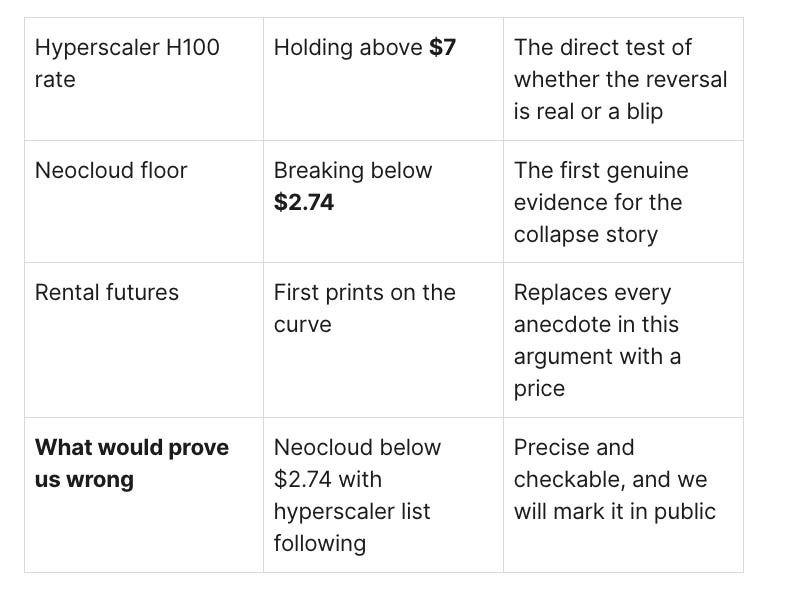
You can find details about which companies are in each tier, what they actually earn, and where we see mispricing in the comprehensive research at moatpeak.com.
Educational research only. Not personalized investment advice. MB “MoatPeak Group”.