


This has been a strange year for stocks. The S&P 500 is up about 15 percent in 2026, but the typical stock in the index is up only about 2 percent, Barron’s noted last week. More than a quarter of the index has fallen by double digits. The gains sit in chips and AI. The losses sit in food, drugs, retail and utilities.
That split has created something income investors have not seen in a while: high dividend yields on familiar names. Barron’s counted 117 S&P 500 companies yielding more than 3 percent, up from 80 five years ago. The index as a whole yields about 1 percent.
Here is the catch. Most of these yields did not rise because companies raised their dividends. They rose because share prices fell. When that happens, the market is usually asking a question: can the company keep paying?
The one number we use
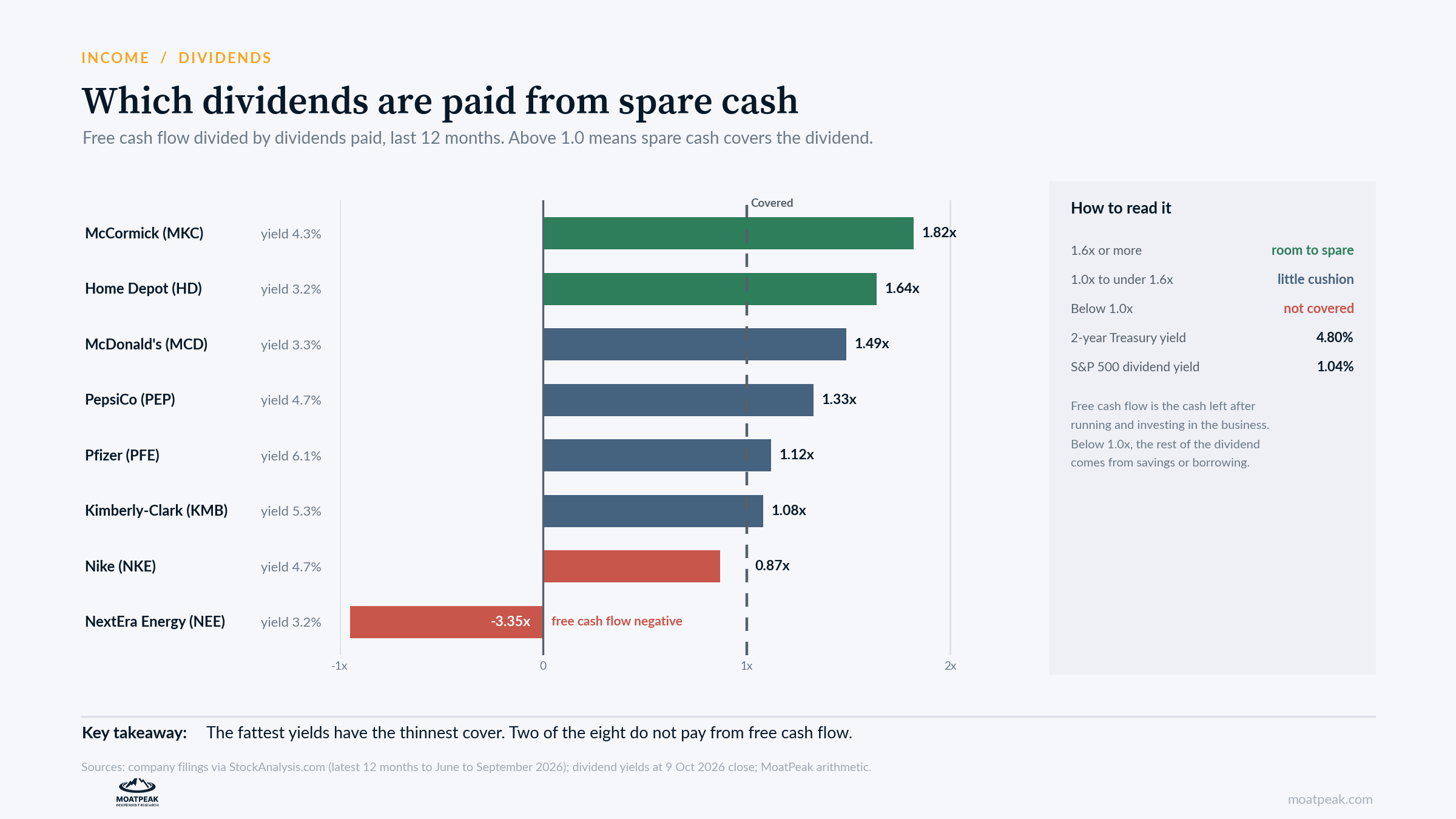
A dividend is only as safe as the cash behind it. Our yardstick is free cash flow coverage. Free cash flow is the cash a company has left after paying its bills and investing in its business. Divide it by the dividends the company pays, and you get the coverage.
1.6 times or more: the dividend comes from spare cash, with room to spare.
1.0 to 1.6 times: it is covered, but there is little cushion if business weakens.
Below 1.0 times: the company pays out more than it generates, and the rest comes from savings or borrowing.
We ran the test on eight of the new high-yield names, using each company’s last 12 months of reported cash flows and closing prices on 9 October.
What the test shows
Room to spare. McCormick, yielding 4.3 percent, covers its dividend 1.8 times. Home Depot, at 3.2 percent, covers it 1.6 times. Neither stock has done well. Home Depot is down about 24 percent over the past year as the housing market stays frozen. But both dividends look well funded.
Covered, with little cushion. McDonald’s (3.3 percent) covers its dividend 1.5 times, PepsiCo (4.7 percent) 1.3 times, Pfizer (6.1 percent) 1.1 times and Kimberly-Clark (5.3 percent) 1.1 times. These payouts come from cash today, but one weak year could change that. Pfizer’s dividend is more than twice its reported earnings, so its free cash flow carries the whole load.
Not covered. Nike (4.7 percent) paid out more in dividends than it generated in free cash flow, covering only 0.9 times. NextEra Energy (3.2 percent) had negative free cash flow, because it is spending heavily on new power plants and grid lines. That is normal for a fast-growing utility, but it means that, in practice, the dividend is paid with borrowed money. And borrowing costs more at today’s rates.
The second check: compare it with a bond
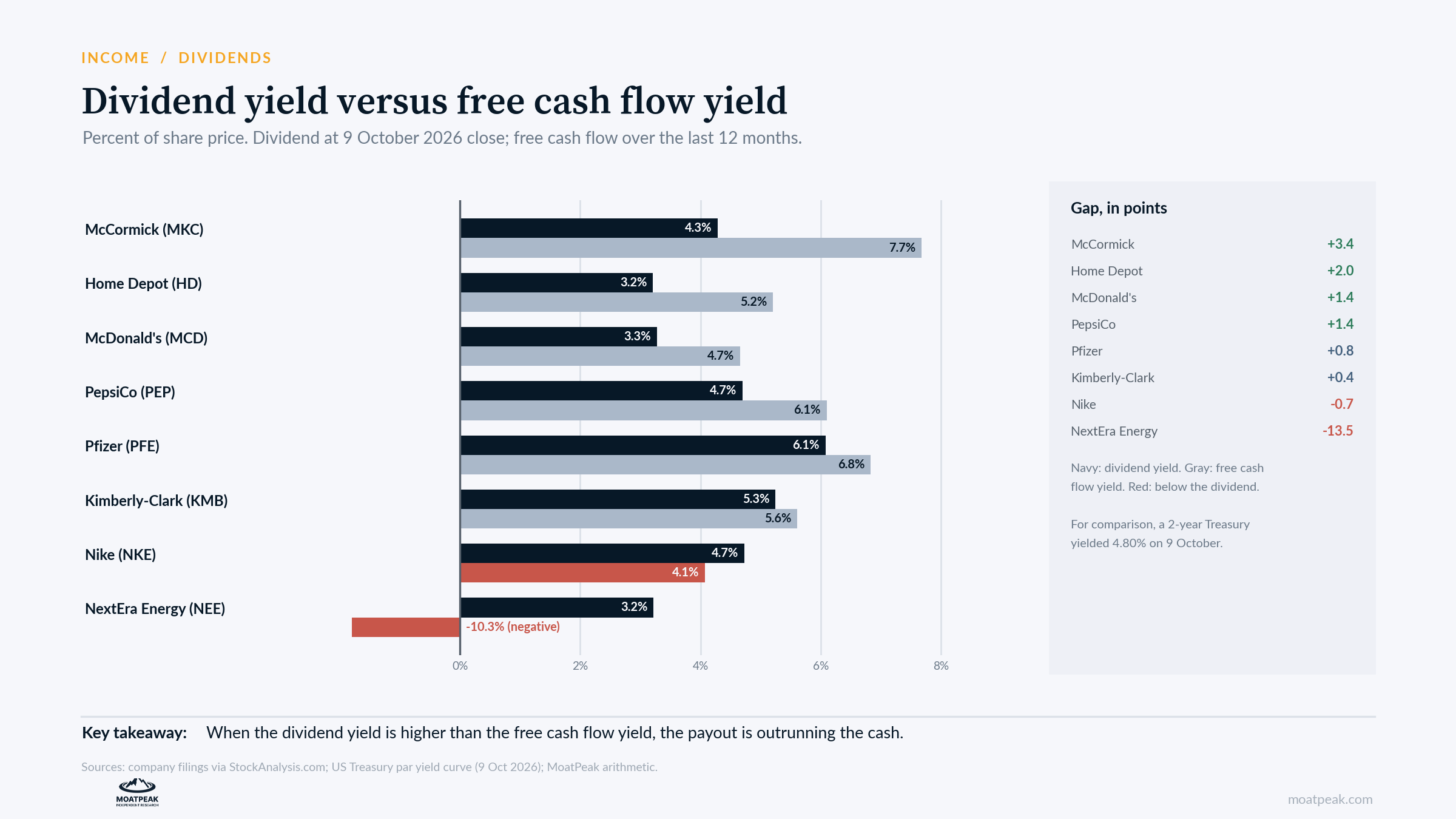
A two-year Treasury yields 4.80 percent, and you get your money back at maturity if you hold it. Nike’s 4.7 percent yield is below that, and its dividend is not covered by free cash flow. A stock that yields no more than a two-year Treasury needs a strong growth story to make sense. Otherwise you are taking stock market risk for bond-like income.
Another way to see it is to compare each company’s dividend yield with its free cash flow yield, which is free cash flow divided by the company’s market value. When the dividend yield is higher, the payout is outrunning the cash.
The case against us
Twelve months is a short window. Cash flow swings with inventories, taxes and big one-off projects, and a single bad year can make a strong company look weak. Some of these companies are also in the middle of large deals or restructurings that will change their numbers. And thin coverage can improve quickly if management cuts costs, which Kimberly-Clark’s management is working on, according to Barron’s.
What it means for your money
Treat a sudden high yield as a question, not a gift. Check the cash coverage first.
For income you rely on, look for coverage of 1.6 times or more.
Compare every stock yield with the 4.8 percent you can get on a two-year Treasury.
Read a long record of raises carefully. PepsiCo’s, Kimberly-Clark’s and McDonald’s records say a lot about management’s priorities. They say little about next year’s cash.
What we are watching
Third-quarter results over the next few weeks, for free cash flow and any change in dividend plans.
14 October: September inflation data, which moves bond yields, the bar every dividend has to clear.
Smaller-than-usual dividend raises. A slowdown in increases can be an early warning sign.
Educational research only. Not personalized investment advice. MB “MoatPeak Group”.
Why dividend stocks rather than treasury bonds? TR28 (British govt bond, Dec 2028) pays 6% coupon and costs 103.39%