


Humanoid robotics has all the elements required for an exciting market narrative—spectacular demonstrations, major companies involved, large labor markets, and a realistic route leading from science fiction to actual factories. Yet there is one major problem for equity investors: nobody at present knows which robot design is going to win.
Rather than trying to work out which humanoid robot is going to become the ‘iPhone of robotics’, it is more reasonable to consider what challenges every serious design has to meet.
The flags are marketing, the shipments are reality
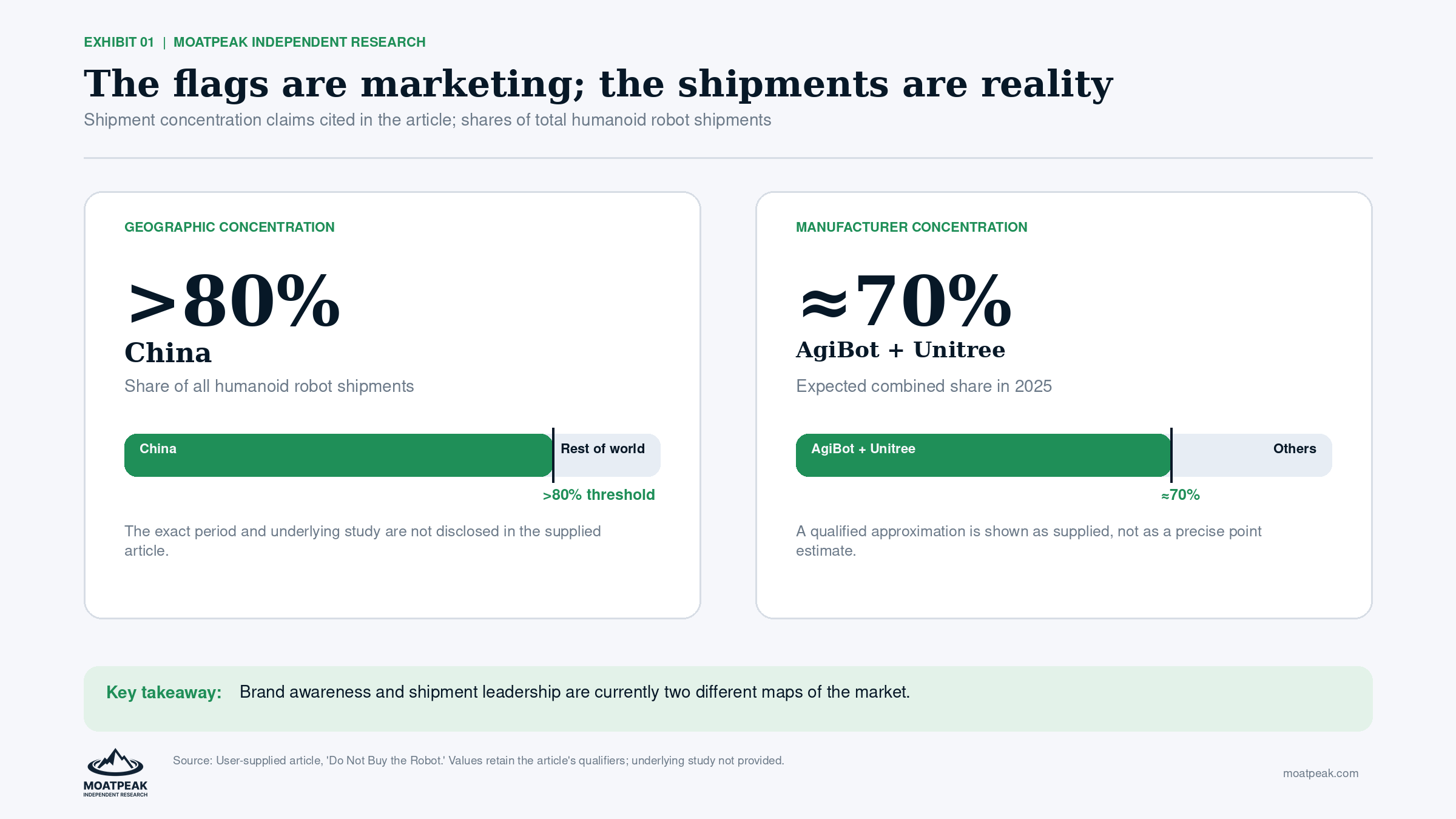
Humanoid robots usually appear to be American since Tesla, Figure, and Agility are the best-known companies. Yet a study reveals a different situation: China accounts for more than 80% of all humanoid robot shipments. AgiBot and Unitree together are expected to make up around 70% by 2025, whereas Tesla, Figure, and Agility together have only a minor portion.
It doesn’t mean that China has already won, but it does show that factors such as hardware improvements, robust supply chains, and large-scale deployments are important. With physical AI, unlike software, you can’t distribute it instantly; robots have to be built, shipped, installed, maintained, and made safe.
There is no standard robot
The sector still features bipedal, wheeled, quadruped, and hybrid robots, some of which use simple RGB cameras and others depending on more advanced sensors such as depth cameras and LiDAR; the robots operate in a variety of environments, including well-organized car factories, semi-organized warehouses and finally unstructured homes.
Since the market is so fragmented, it is very unlikely that a single company will become dominant in the near future. Rather, some sections of the industry will have a small number of companies taking on a larger share.
The joints are the economic center
Actuation accounts for approximately half of the material costs and is responsible for a large portion of the reliability risk; although a viral demonstration can show what a robot is capable of when performing at its best, actual use requires robots to last through long shifts, cope with heat, remain calibrated, be easy to maintain, and be manufactured in large numbers.
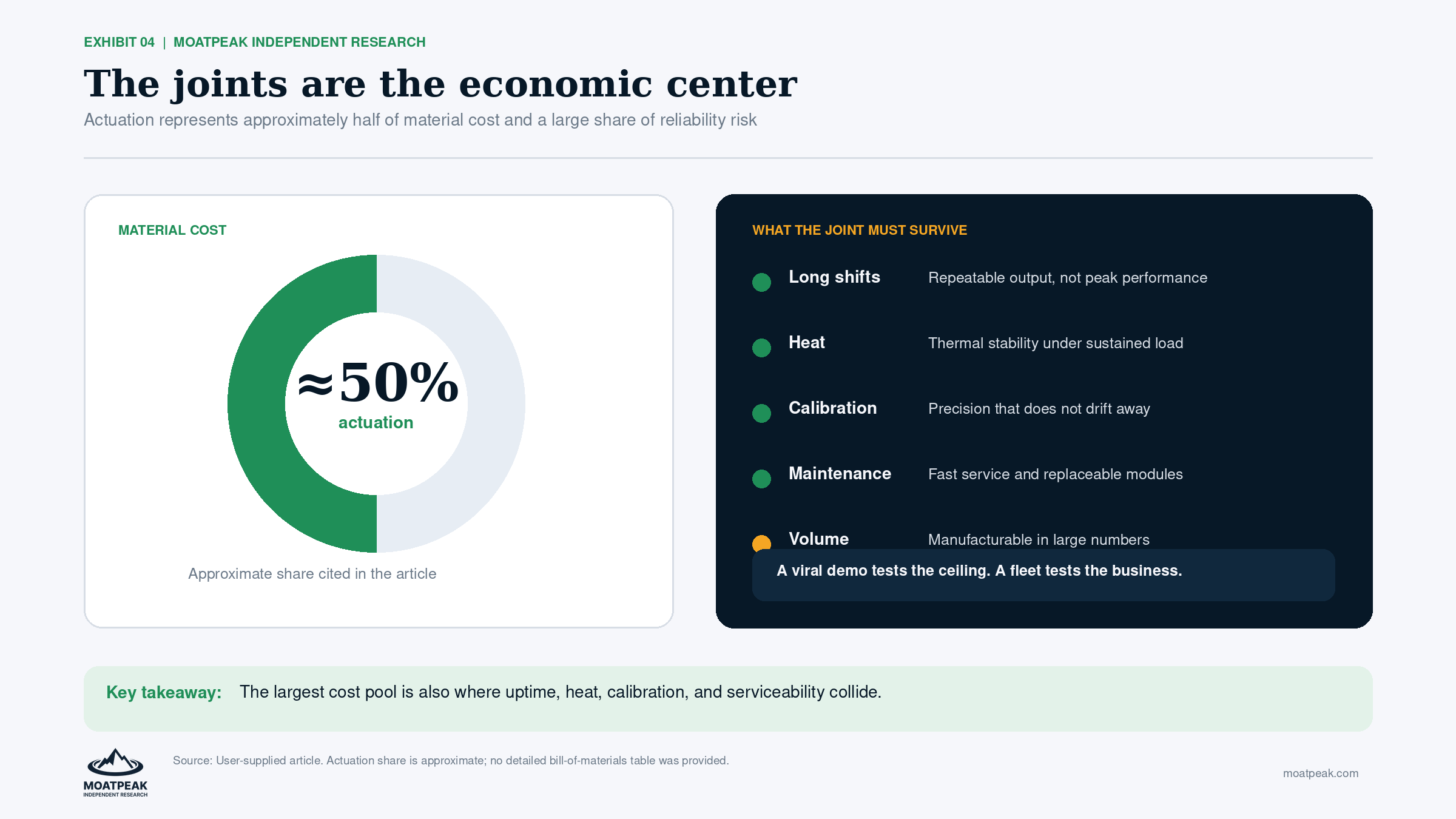
This is advantageous for suppliers who produce components such as reducers, roller screws, motors, drives, sensors, and thermal systems, which are used in various robots. The suppliers are able to grow in line with the market without having to rely on the success or costs of just one robot brand.
Embodied data are the other bottleneck
Robot intelligence cannot be trained solely on cheap text from the internet; it also requires demonstrations, remote control sessions, motion capture, and sensor data, all of which are difficult to obtain and expensive. Although simulations and digital models can be of some help, the only true test is how well these systems perform with real robots.
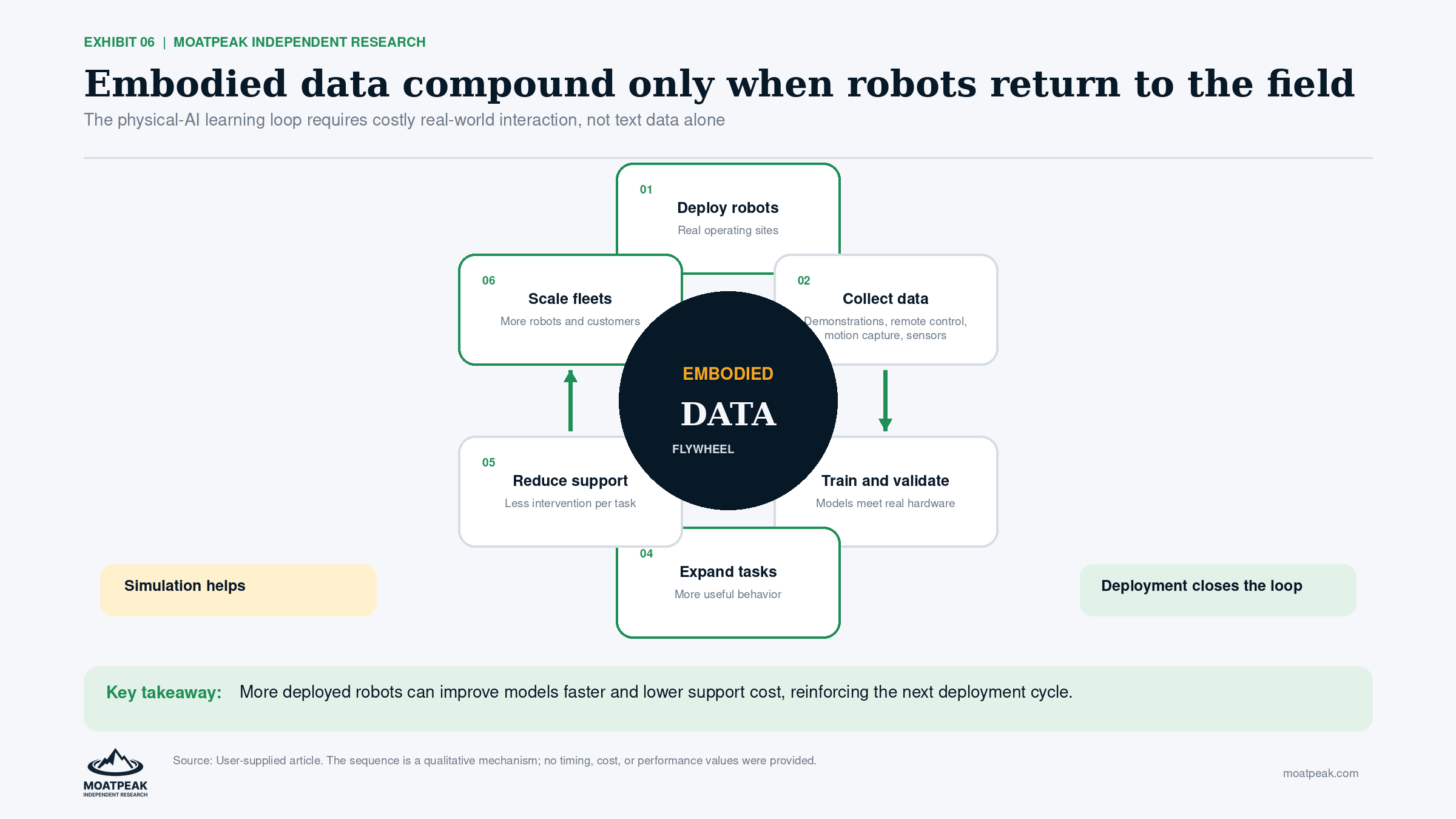
The main cycle involves deploying robots, gathering data, improving the models, carrying out more tasks, and reducing support costs. A company that has more robots in use will be able to make improvements at a faster rate. Tools that assist multiple robot manufacturers in this process can provide value even if they do not need to take market dominance.
What to watch
The major advance should result from being able to repeat results rather than just having impressive demonstrations. We should look at factors such as uptime, the frequency with which problems occur, the amount of maintenance required, the degree of remote control needed, the amount of support cost per robot, and whether businesses can go from serving one customer to many.
Physical AI is probably going to develop into a major market, but the robot that is most well-known might not be the most worthwhile investment. It isn’t until the designs have become standard and the economic aspects of large fleets are understood that the best opportunities will be found in the technology contained within the robots.
MoatPeak Team