


S&P 500 companies are on track for 29.0 percent earnings growth in the third quarter, according to FactSet’s figures of 16 October. It would be the third quarter in a row above 25 percent. Wall Street’s mood matches the numbers. Of the companies that have reported, 84 percent beat analysts’ estimates. In late September, 72 companies had given guidance for the quarter above analysts’ estimates, against a 10-year average of 41.
We think both ends of the earnings story are distorted. This quarter’s growth rests on fewer companies than the headline suggests, and the slowdown analysts expect for next year is partly an accounting echo of this year.
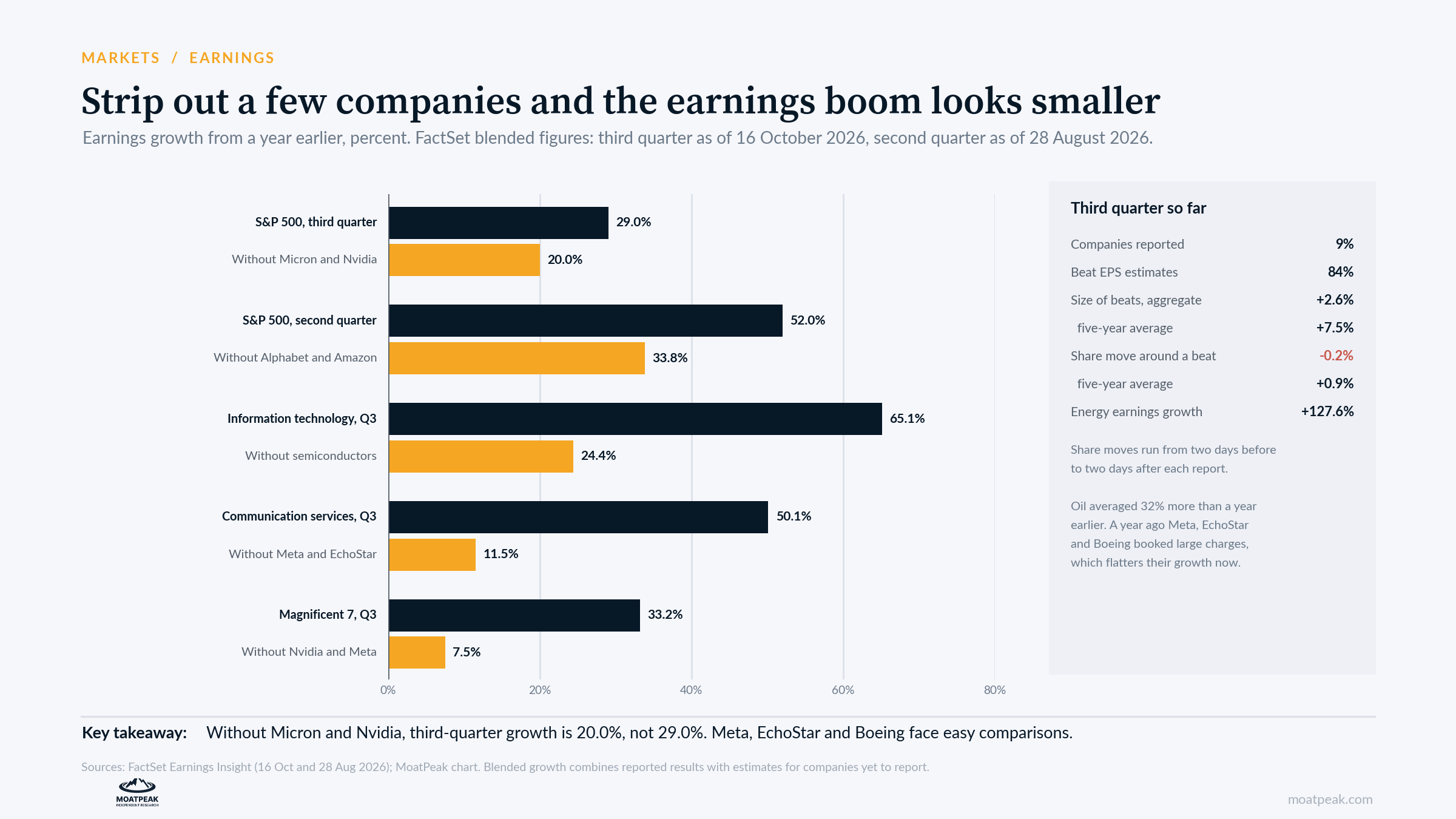
Where this quarter’s growth comes from
Without Micron and Nvidia, third-quarter growth falls to 20.0 percent, FactSet calculates. Information technology earnings are up 65.1 percent, or 24.4 percent without semiconductors. Communication services earnings are up 50.1 percent, or 11.5 percent without Meta and EchoStar, whose results a year ago included a $15.93 billion tax charge and a $16.48 billion impairment. Boeing, the fifth-largest contributor, is also measured against a year-ago quarter that included a $4.9 billion charge.
Oil does much of the rest. Energy earnings are expected to rise 127.6 percent, as oil averaged 32 percent more in the third quarter than a year earlier.
That is still a strong quarter. Growth of 20 percent is well above FactSet’s 10-year average of 12.6 percent. But the market seems to know where it comes from. Companies that beat estimates so far saw their shares fall 0.2 percent on average from two days before their report to two days after, against a five-year average gain of 0.9 percent.
Why 2027 may look worse than it is
Analysts expect growth to slow to 19.3 percent in the first quarter of 2027 and to 2.8 percent in the second. That second number has drawn the most attention, and much of it is a comparison problem.
In the second quarter of 2026, Alphabet booked a $98 billion gain in other income, mostly unrealized gains on its equity holdings, and Amazon booked a $53.4 billion gain on investments. Both gains count in the GAAP earnings that FactSet uses for these two companies. Growth for that quarter was 52.0 percent, or 33.8 percent without them. Analysts do not forecast gains like these, so the second quarter of 2027 is measured against an inflated base.
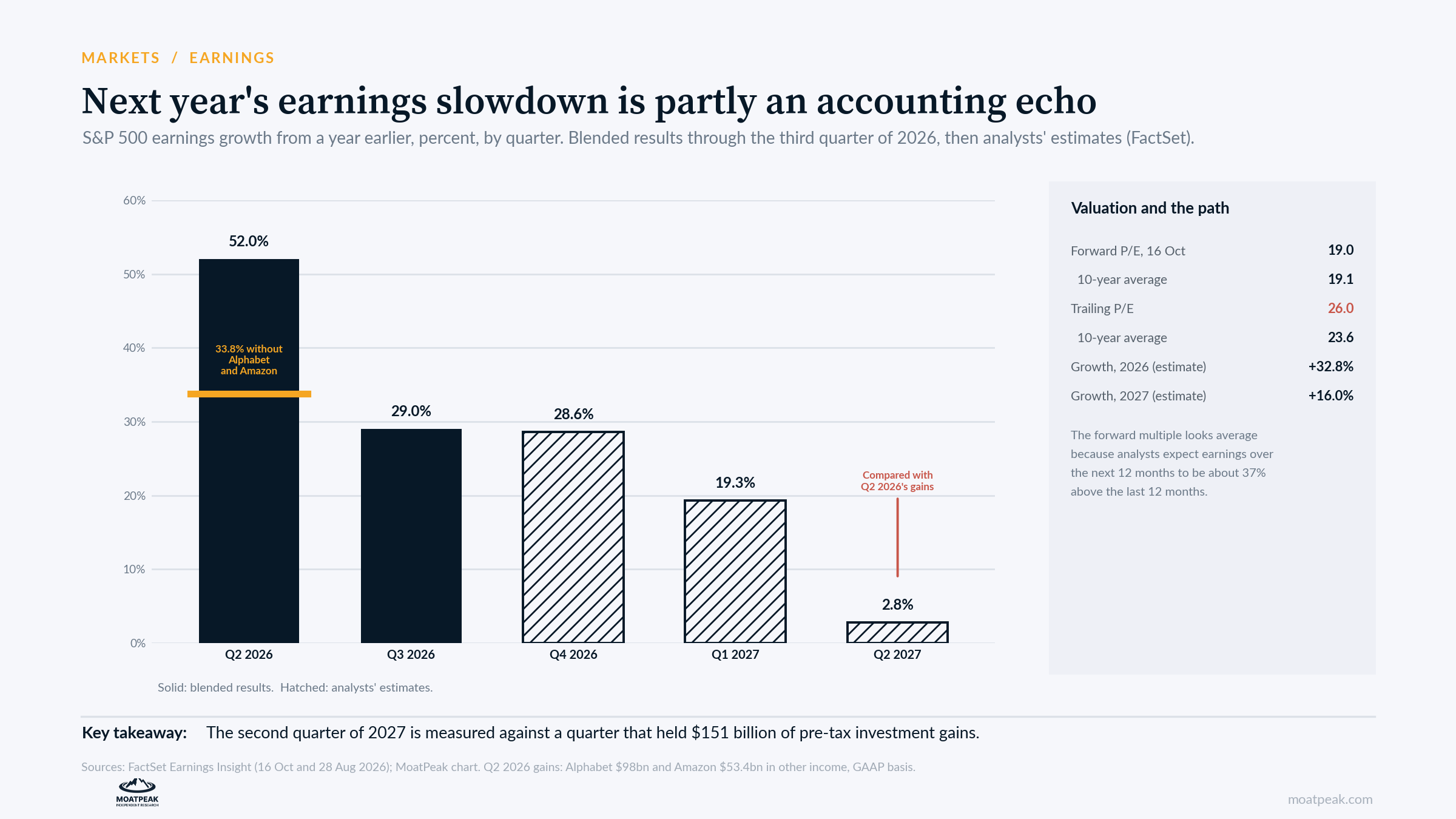
We cannot say exactly how much of the slowdown this explains without company-level forecasts. But 2.8 percent growth against a quarter that included $151 billion of pretax one-off gains does not describe a profit stall.
What the valuation assumes
The S&P 500 trades at 19.0 times expected earnings for the next 12 months, slightly below its 10-year average of 19.1, according to FactSet. On the past 12 months’ earnings, the multiple is 26.0, against a 10-year average of 23.6. The gap between the two means analysts expect earnings over the next 12 months to be about 37 percent higher than over the last 12.
That forecast leans on the same few companies. If chipmakers keep delivering, the index is reasonably priced. If memory prices turn, as they have near the end of past cycles, the forward multiple would prove higher than it looked.
The case against us
A narrow boom can still be a strong one. Without the two biggest contributors, earnings would still be growing about 20 percent. Revenue is up 12.6 percent, the third quarter in a row above 10 percent, and the net profit margin of 14.9 percent would be the second-highest in FactSet’s records since 2009.
It is also early. Only 9 percent of companies have reported, and results usually beat estimates. If analysts are still too low on chip profits, 2027 could beat today’s forecasts even without the one-off gains.
What it means for your money
Look at growth without the top contributors. For this quarter, 20 percent is a better guide than 29 percent.
Read the 2027 slowdown with care. Part of it comes from one-off gains in the year-ago quarter.
Know what the valuation depends on. The forward multiple stays near average only if chip earnings hold up.
What we are watching
21 October: Meta and Tesla, the first of the Magnificent 7 expected to report.
This week: 79 S&P 500 companies are scheduled to report, FactSet says.
28 October: SK hynix’s results, a test of memory prices.
Educational research only. Not personalized investment advice. MB “MoatPeak Group”.