


Europe is heading into winter with less gas in storage than on this date in any year since at least 2011. EU storage was 74.9 percent full on 26 October, according to Gas Infrastructure Europe. The 10-year average for the date is 90.6 percent, and the previous low was 77.0 percent in 2021.
In energy terms, Europe holds about 849 terawatt hours of gas, roughly 97 terawatt hours less than a year ago. It was still injecting gas on 26 October, so the level may edge up a little before winter withdrawals begin in earnest.
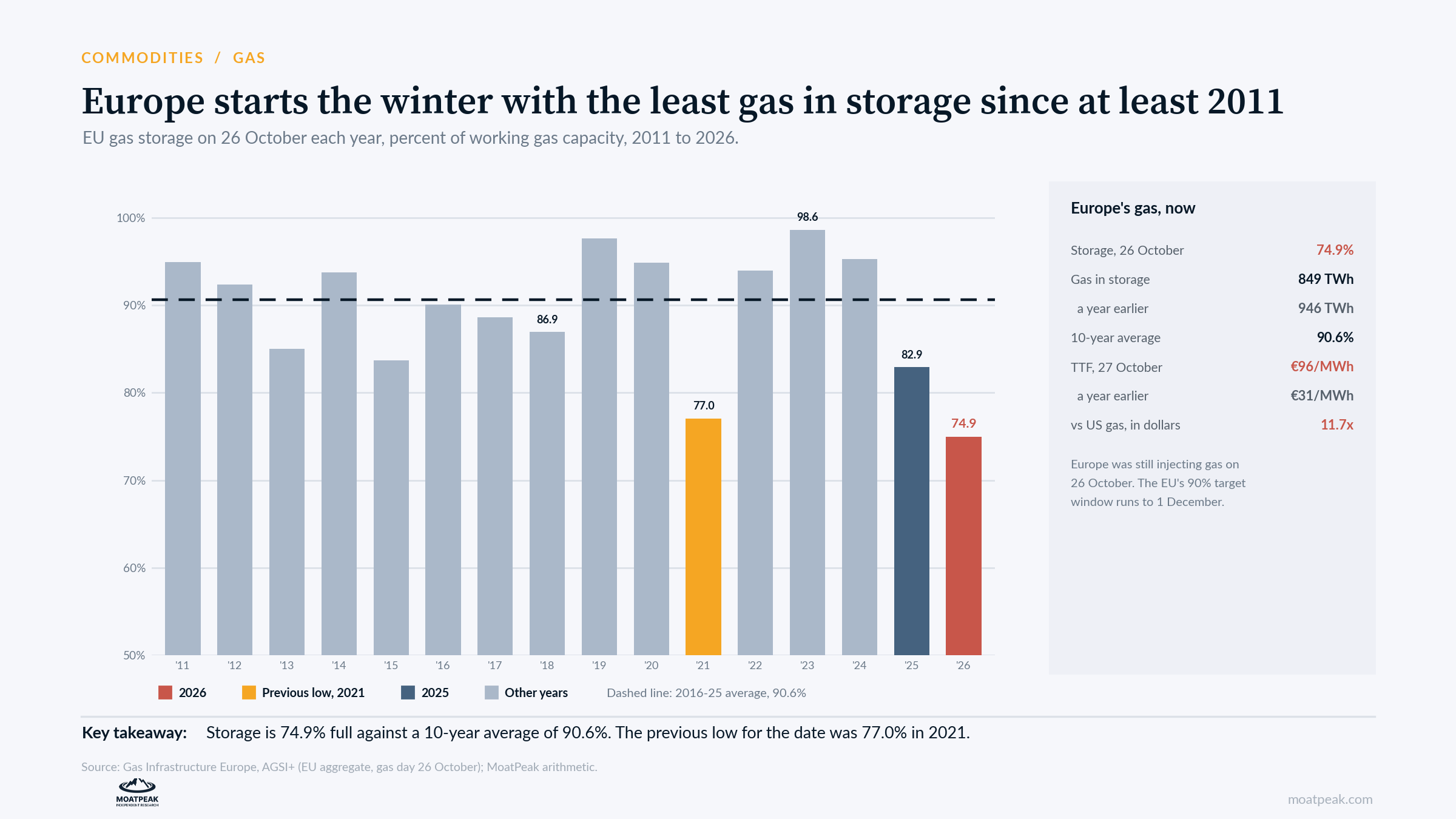
The price has already moved. The front-month Dutch TTF contract closed at about €96 per megawatt hour on 27 October, roughly three times its level a year earlier. In dollars, that is about $31 per million British thermal units, close to 12 times the US Henry Hub price of $2.70. A year ago, European gas cost about three times as much as US gas.
Why storage is low
ENTSOG, the association of Europe’s gas network operators, says storage enters this winter at historically low levels after a difficult injection season. It points to the conflict in the Middle East, which has constrained shipping through the Strait of Hormuz, a route for about 20 percent of global LNG trade, and has sharpened competition with Asia for cargoes.
Europe also started the summer from a low base. Storage was about 28 percent full on 1 April, after the previous winter’s withdrawals.
This winter
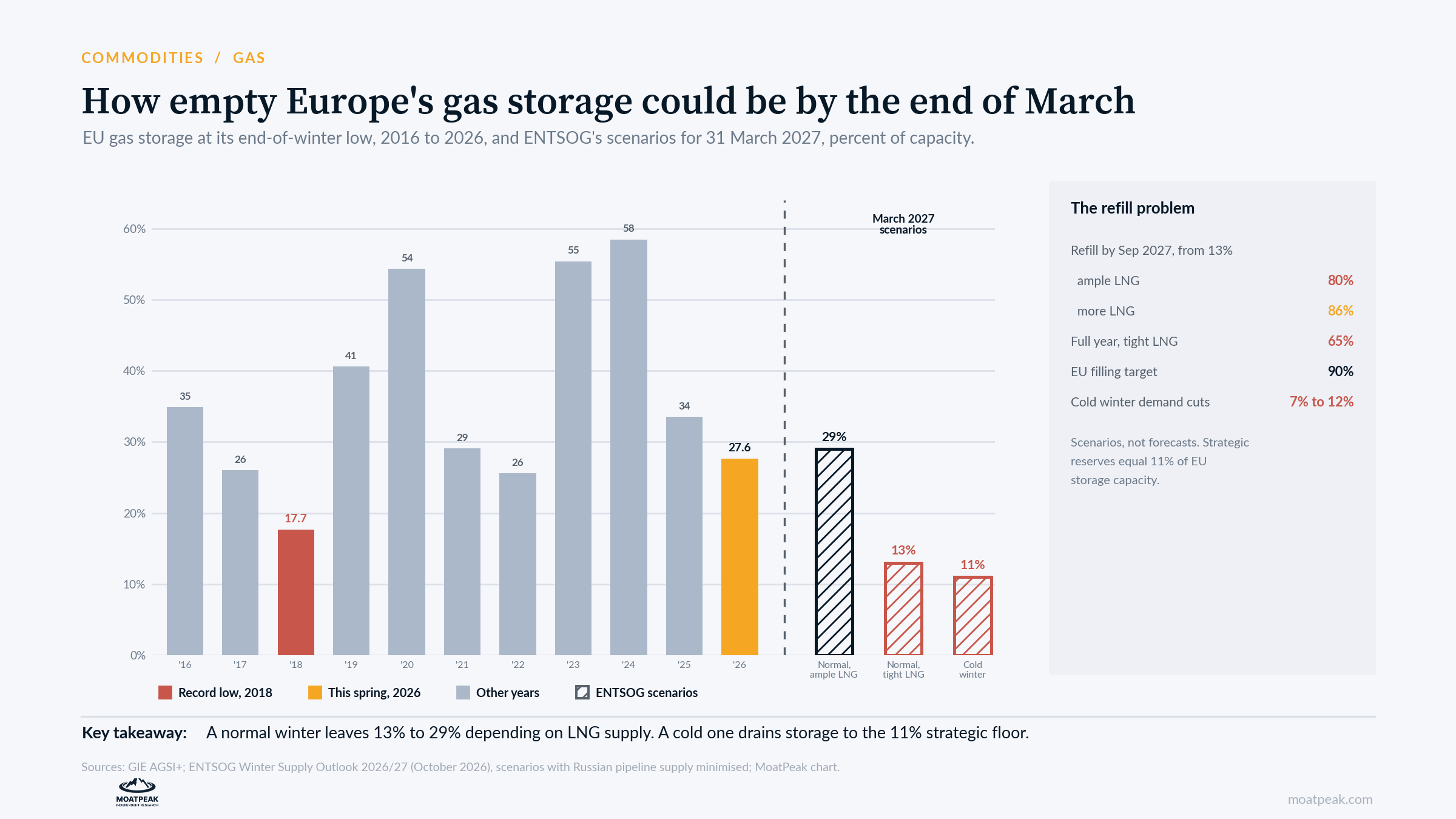
ENTSOG’s simulations show that Europe can meet demand in a normal winter. In its reference scenario, storage falls to 29 percent by 31 March 2027 if LNG supply is ample, and to 13 percent if it is tight. A cold winter is harder: about 7 to 12 percent of demand would have to be cut or would go unmet, and storage would fall to 11 percent, the level of reserves that some countries hold back for emergencies.
For scale, the lowest end-of-winter level since 2011 was 17.7 percent, in March 2018. Last winter, storage fell 55.5 percentage points, from 83.2 percent to 27.6 percent. The same drawdown from today’s level would leave about 19 percent.
The harder part comes next
Winter is only half of the problem. ENTSOG warns that “depleting storages too deeply over the winter may constrain the ability to refill them.” Starting from 13 percent, its simulation reaches only 80 percent by the end of September 2027 with ample LNG, and 86 percent with more. With tight LNG supply throughout the year, storage reaches just 65 percent, far from the EU’s 90 percent filling target.
So a hard winter could leave Europe entering the next one in an even weaker position than it is entering this one.
Our read
The market is pricing this winter: TTF has tripled in a year. The less obvious risk is that low storage compounds. Each winter that ends near empty makes the next refill more expensive, because Europe must buy more LNG in a market where it already competes with Asia for cargoes. That would keep European gas expensive relative to US gas for longer than any single cold spell.
For investors, the gap matters more than the level. A price gap of nearly 12 to 1 is a lasting cost disadvantage for Europe’s energy-intensive industries and a lasting advantage for exporters that can buy gas at US prices and sell it into Europe.
The case against us
A mild winter would leave far more gas in storage and ease the refill.
LNG supply could recover faster than expected if shipping through Hormuz returns to normal. Europe’s import terminals can take about 1,600 terawatt hours of LNG per winter season, according to ENTSOG.
High prices also cut demand, which ENTSOG’s scenarios partly assume. And EU storage rules allow some flexibility on the 90 percent target in difficult conditions.
What it means for your money
Separate the shortage from the price. The shortage is real, but TTF has already tripled, so much of the risk is priced in.
Watch the spread, not just Europe. The gap between US and European gas shapes costs for European industry and margins for gas exporters.
Keep an eye on next summer. If the winter ends near ENTSOG’s tight scenario, the cost of refilling in 2027 will be the story.
What we are watching
Thursday 29 October: the ECB’s rate decision, with energy costs feeding into euro-area inflation.
1 December: the end of the window for the EU’s 90 percent storage target, which allows flexibility in difficult conditions.
Every week: storage data from Gas Infrastructure Europe, and when injections turn into withdrawals.
Educational research only. Not personalized investment advice. MB “MoatPeak Group”.