


People often compare different options for hedging against inflation, but these comparisons usually measure something other than what they expect.
Many people compare TLT, which holds long-term nominal Treasuries, to TIP, which holds inflation-protected bonds. They believe this is a simple way to tell if the market is more concerned about inflation or deflation.
However, two important numbers on the first page of each fund’s factsheet complicate this comparison.
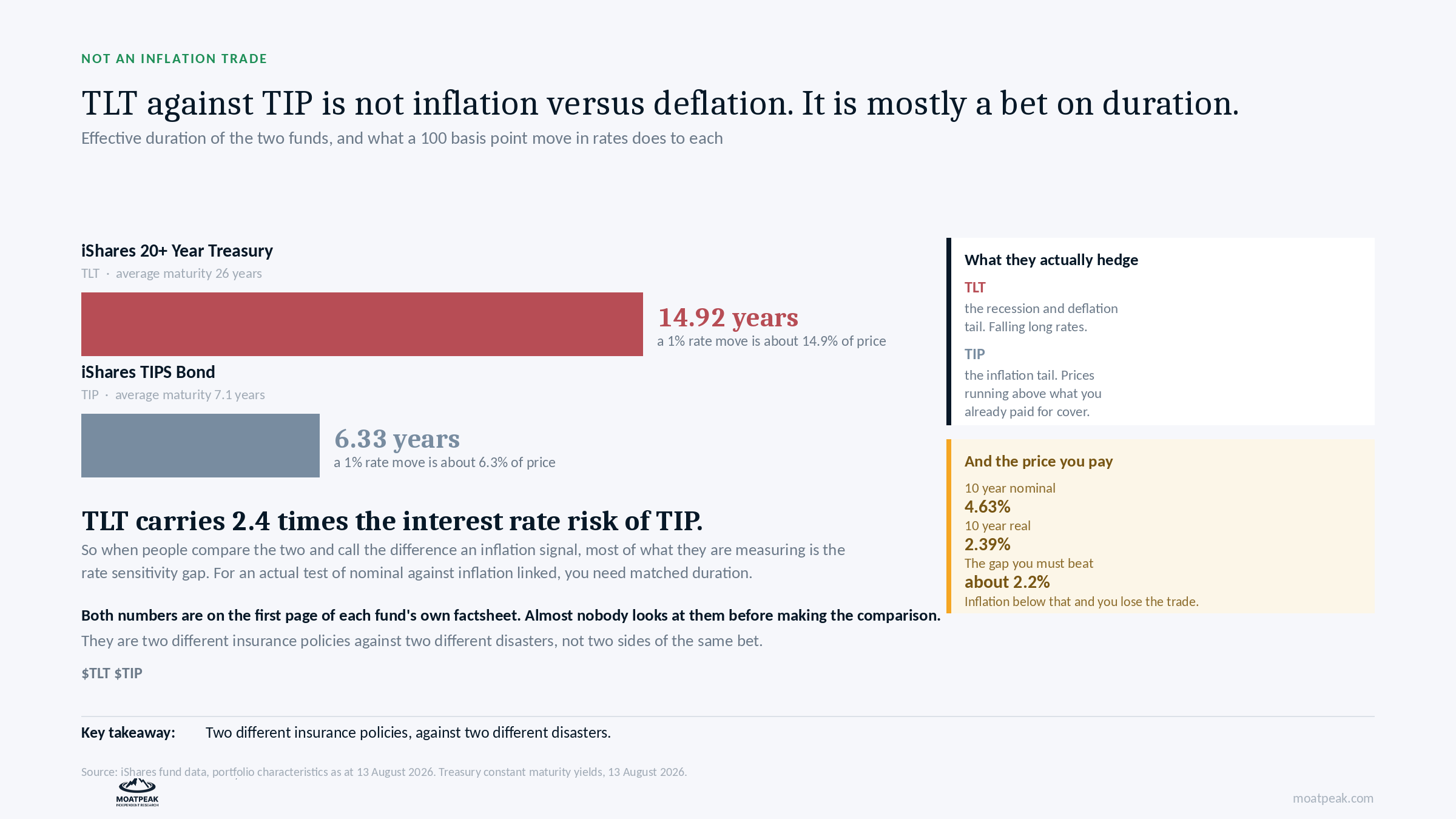
TLT has an effective duration of 14.92 years and an average maturity of 26 years. TIP’s effective duration is 6.33 years, and its average maturity is 7.1 years.
This means if rates move by one percent, TLT’s price changes by about 14.9%, while TIP’s changes by about 6.3%, even before factoring in inflation.
So when TLT and TIP perform differently, it’s mainly because their durations are not the same. To compare nominal and inflation-linked bonds fairly, you should look at bonds with similar durations. Choosing TLT or TIP means picking between two different risks. That’s a real choice, but it isn’t a direct comparison.
What is the logic behind these two?
TLT is a bet on recession and deflation. It does well when growth slows, the Federal Reserve cuts rates sharply, and investors look for safety. But there’s a catch: a rate cut doesn’t always mean TLT will go up. If inflation expectations or the term premium rise at the same time, long-term bonds can still fall.
TIP is a bet on higher inflation, but it only pays off if actual inflation ends up higher than what the market expected when you bought the bond.
These are two types of insurance for two different risks. Holding both doesn’t create a hedge; it just means you have two separate bets.
The three main factors, not just one
This is the main point, and it’s why people are often surprised.
First, compare actual inflation to the breakeven rate you paid. This matters because when you buy an inflation-linked bond, you pay for protection at the breakeven rate. Future inflation must be higher than what’s already priced in. For example, if the ten-year nominal rate is 4.63% and the ten-year real rate is 2.39%, the breakeven is about 2.2.%.
Second, watch for changes in real yields. This is where you can lose money. If real yields go up, the bond’s price falls, no matter what happens with inflation. The longer the duration, the bigger the impact.
Third, think about your own time frame. A one-year inflation-linked bond is almost a pure inflation play. A thirty-year bond is an inflation hedge plus a big bet on real rates.
If you combine the first two factors, you can end up in a tough spot. Inflation is high, you guessed right, but real yields also go up, so the bond you thought would protect you still loses value. That’s not a mistake; it’s just how these bonds work.
Four things this protection does not cover
These details are in the documentation, but most people don’t take time to read them.
The deflation floor is more limited than many people think. It only applies at maturity and only guarantees the original face value. If you bought a bond above face value because it had built-up indexation, the floor doesn’t protect what you paid.
In a taxable account, you might owe taxes before you get any cash. If the principal goes up, you could get a tax bill in a year when you don’t actually receive any money.
An ETF is not the same as a bond. A fund without a maturity date keeps rolling its holdings, so you never get what makes an individual inflation-linked bond special—a known real return on a set date.
It only hedges one specific index, the United States CPI, with about a three-month delay. It doesn’t cover your personal inflation, another country’s inflation, exchange rates, or even changes to the index itself.
Where things stand right now
There isn’t a clear trend right now, and we want to be honest about that. Inflation has slowed, with July at 3.4% year over year. But real yields are still high, even after dropping from their late July peak.
Both long nominal and long inflation-linked bonds face real duration pressure, while cash and short-term bonds do better. It’s not an exciting answer, but it’s probably the honest one.
Why should we care about this?
If you buy an inflation-linked bond today and hold it to maturity, you lock in a positive return above U.S. consumer prices for a long time. That’s genuinely useful, and it’s available right now.
But it’s not an automatic bet on rising inflation, and it doesn’t replace long nominal bonds. Each one protects against a different kind of risk.
A good habit to keep is to check what you’re paying for protection before you buy, and ask what needs to happen for it to be worth more than the cost. In this market, that number is public, which is more than you get with most insurance.
Our full regime map, showing which asset leads in each of nine macro environments, is at moatpeak.com.
Educational research only. Not personalized investment advice. MB “MoatPeak Group”.