


The Secretary raised the largest long-term buyback in the programme’s history by a factor of three; however, when compared with the amounts the Treasury issues at the long end, it is still very small.
On August 19 the Treasury took an unusual action. Rather than sticking to its normal quarterly routine, it announced that the maximum amount to be spent on buying back long-term debt would be increased from $2 billion per operation to at least $4 billion. The new schedule was published yesterday, and the first buyback, which took place this afternoon, was set at $6 billion.
The Treasury has never before planned a single long-term buyback of this scale. Each of the 53 previous operations since the program was restarted in 2024 has been limited to $2 billion.
People are currently asking whether this will cause yields to remain low. Instead, we opt to concentrate on a question that is answerable – namely, how big is the buyback?
The ratio
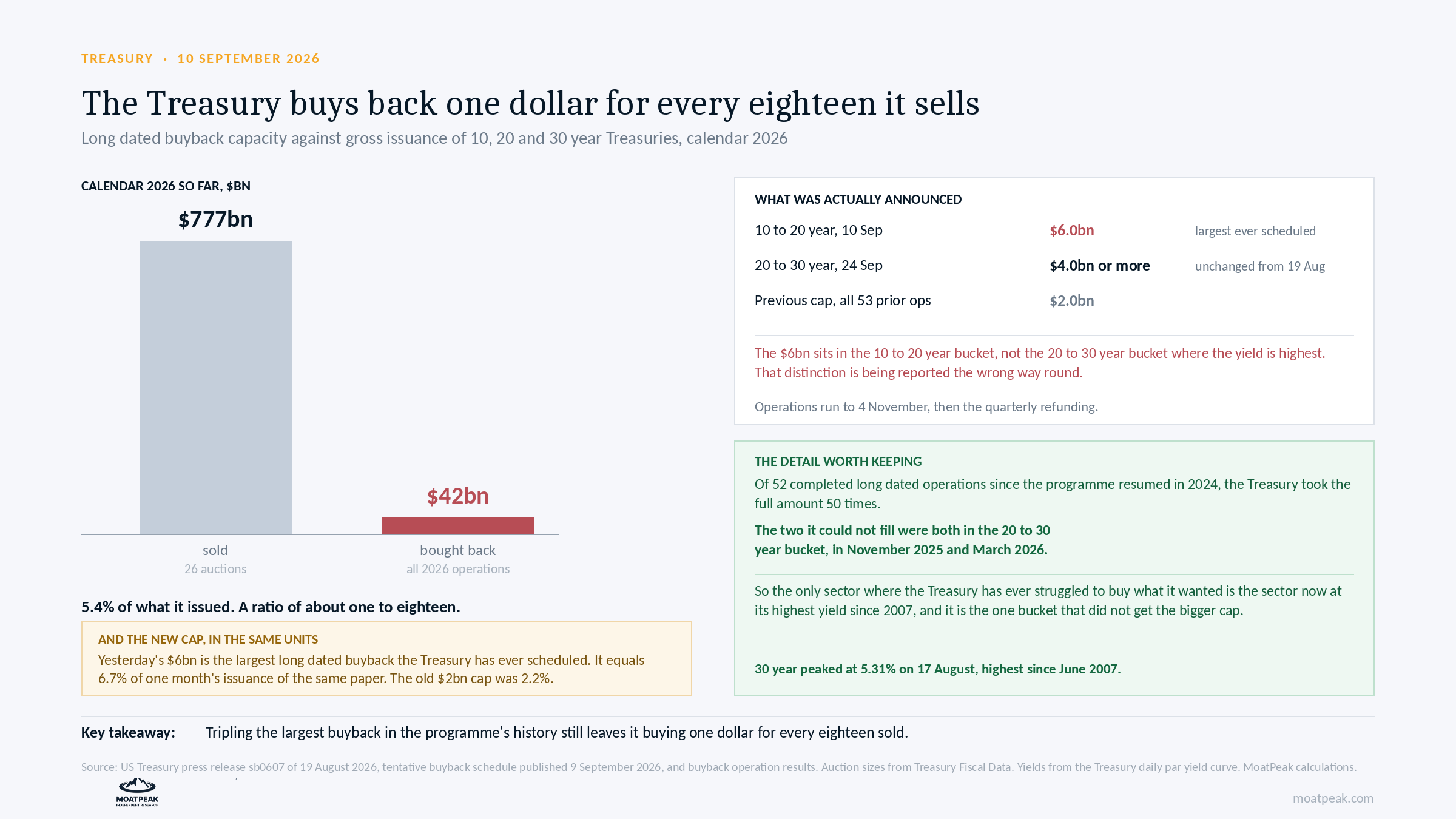
In 2026, the Treasury sold $777 billion of 10-, 20-, and 30-year bonds in 26 auctions. Each 10-year auction averaged $46 billion. Each 30-year auction averaged $26 billion.
At the same time, the total of all the long-term buyback programmes amounted to around $42 billion.
This makes the amount spent on buybacks equal to 5.4% of the total shares issued, or roughly one dollar being spent for every eighteen shares sold.
The $6 billion buyback carried out yesterday represents 6.7% of the amount of those bonds issued in one month. The earlier cap of $2 billion was equivalent to 2.2%. When the size was tripled, the ratio increased from approximately one-fiftieth to approximately one-fifteenth of a month’s supply.
Why the denominator matters, and why it is often misunderstood
People have compared the buyback to “more than $2 trillion a year of gross issuance.” However, that figure is in fact net borrowing, not gross. The amount of gross coupon issuance this fiscal year is approximately $4.6 trillion, and the total marketable issuance is even greater since a four-week bill is reissued thirteen times each year.
That is not the appropriate comparison; instead one should compare long-term buybacks with long-term supply since it is that aspect of the market which these operations are aimed at. This was the comparison we made above.
A detail worth noting
What strikes us as particularly interesting is what the Treasury itself has found.
Of the 52 long-term operations which were completed since 2024, the Treasury managed to purchase the full amount on 50 occasions and only fell short on two occasions, in November 2025 and March 2026.
Those deficiencies also occurred during the age group from 20 to 30.
It is in this section of the market that yields are at their highest. On August 17, the 30-year bond reached 5.31 percent, which was its highest level since June 2007. Moreover, it is the only range which wasn’t given a higher cap yesterday: the $6 billion buyback applies to the 10- to 20-year range, the operations for the 20- to 30-year range remaining at “$4 billion or more”.The only section of the market in which the Treasury has had difficulty buying as much as it wanted has now reached a high point after nineteen years, and it is also the section that wasn’t given a higher cap. Most reports get this fact wrong.
What we are not saying: We are not claiming that the intervention has failed; a substantial buyback took place this afternoon and we are writing before the results have been obtained.e.
We do not regard yesterday’s yield movement as a final judgment. The 10-year yield increased by 3 basis points to 4.83 percent following the release of the schedule, but the Treasury also sold $39 billion worth of 10-year notes that same afternoon. The data does not justify attributing the rise in yields to the buyback, particularly given the size of the auction, and we have seen this error before.
By the way, the auction performed well in the key areas. It concluded at 4.834%, which was the highest yield achieved at a 10-year auction since August 8, 2007. Indirect bidders secured 79% and dealers received only 4.3%. A high yield together with strong demand does not constitute a failed auction.
What this changes
Now you are able to assess the level of support the Treasury is providing for long-term Treasuries since you have reason to believe it will do so, the support amounting to one dollar out of every eighteen at the longer end and being a little displaced from the area that is under the most pressure.
The fact is that the programme is not useless. It helps to improve the liquidity of older bonds, which is precisely what the Secretary states the programme is intended for. This is a more modest and realistic aim than attempting to alter prices. The programme should be regarded as a means of keeping the market running smoothly, not as a measure to support prices.
What would change our view
If the Treasury increases the cap on the 20- to 30-year bonds when it carries out the refunding on November 4 and purchases the entire amount, the programme will be focusing on the appropriate section of the market; in that situation we would have to say that the importance of the buyback size is less than we previously thought.
If a further long-term buyback fails to materialize, that would make it the third instance within the same range. Such a situation would indicate more clearly who is willing to sell than how much the Treasury wants to buy.
A useful habit
Whenever a government enters a market it is necessary to evaluate the intervention and the market using the same units before assessing the impact; although six billion may seem like a large figure, it does become more understandable when compared with eighty-nine billion per month.
You can find our complete research, along with the tests we publish and track, at moatpeak.com.
Educational research only. Not personalized investment advice. MB “MoatPeak Group”.