


In fact, one line in those projections stands out more than anything the chairman said.
On Wednesday, the Federal Open Market Committee raised its target range by a quarter point to 3.75 to 4 percent. The vote was unanimous at 12 to 0. This is the first increase since July 27, 2023.
The unanimous vote is notable, especially since in July the committee was split 9 to 3, with three members wanting a rate hike that didn’t happen. In just eight weeks, the group went from divided to fully united.
But the rate hike was already expected by about ninety-two percent of the market, so it wasn’t really news. The projections, however, were.
The key line that stands out
We looked at the Summary of Economic Projections and focused on Table 1.
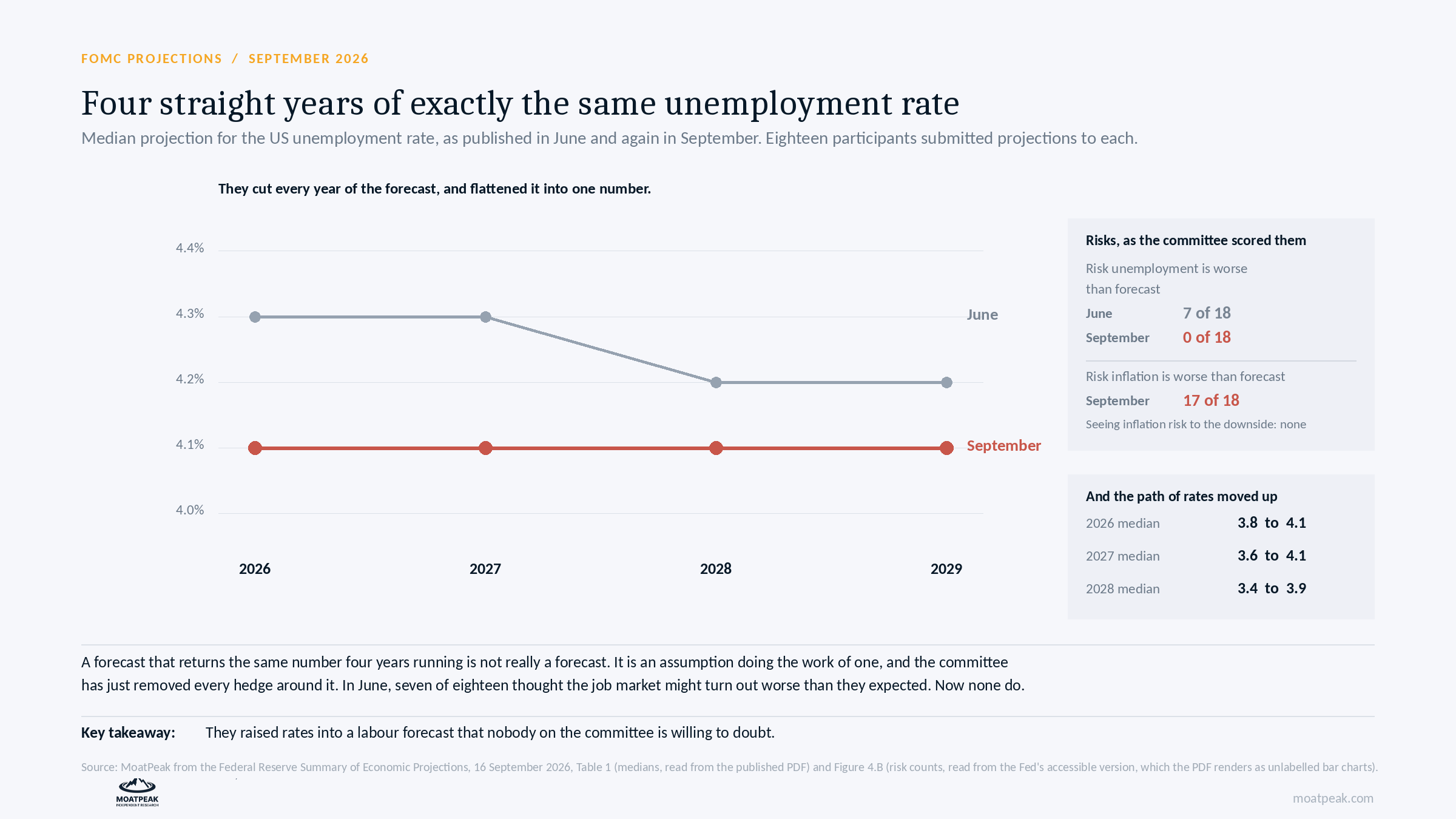
The committee’s median forecast for the unemployment rate is 4.1 percent in 2026, 2027, 2028, and 2029.
Four consecutive years, the same number, to one decimal place.
Back in June, the same table showed 4.3, 4.3, 4.2, and 4.2. So, they didn’t just flatten the forecast – they lowered each year’s number and then made the path flat.
When a forecast shows the same number for four years in a row, it’s not really a forecast – it’s more of an assumption. The rest of the document relies on this idea. If unemployment stays flat for four years, there’s no job loss from tightening policy, so the only thing left to focus on is inflation.
And they removed the hedges.
The projections also include a section most people don’t look at. Each member is asked if the risks to their forecast are tilted higher, lower, or are balanced.
In June, seven of eighteen thought unemployment could end up higher than they forecast, which would mean a weak expected drop to zero.
Now, none of the eighteen officials think the labor market could turn out worse than expected. In the same three months, seventeen out of eighteen expect inflation to be higher than forecast, and none expect it to be lower.
That’s about as one-sided as this document gets. The committee went from seven members hedging on the labor market to none, all while raising rates. They haven’t just changed their forecast – they’ve stopped protecting against surprises.
Why we’re not so sure
Two new numbers came out this week that show a single rate can’t really sum up the labor market.
Initial jobless claims dropped to 196,000, and continuing claims fell to 1,730,000 – the lowest since early January 2024. By itself, this suggests a very tight job market where almost no one is being laid off.
But housing starts fell 2.6 percent to an annual rate of 1,275,000, and building permits dropped 2.7 percent to 1,394,000. Construction doesn’t look like a sector that’s about to start hiring.
The way to explain both numbers is that almost no one is being fired, but almost no one is being hired either. In this situation, the unemployment rate stays steady, but not for a good reason. It remains flat because nothing is changing, and it will stay that way until layoffs begin. When that happens, the rate could jump quickly since there’s no hiring to offset it.
A flat unemployment rate can mean either a strong job market or one that’s stuck. The projections have picked one interpretation, removed any disagreement, and set policy based on it for the next four years.
Here’s the rest of the table for reference
Growth for 2026 was revised up to 2.3 percent from 2.2. Headline inflation is now 3.7 instead of 3.6, and core inflation is 3.4 instead of 3.3.
The policy path also changed a lot. The median federal funds rate for 2026 went from 3.8 percent in June to 4.1 now. For 2027, it moved from 3.6 to 4.1, and for 2028, from 3.4 to 3.9.
The 2027 change is the biggest and has gotten the least attention. It’s a half-point increase, which means two rate cuts have been taken off the table for next year in just three months.
A quick correction to a widely shared figure: the dot plot shows twelve officials expect exactly one more rate hike this year, four expect two, and two expect none. So, sixteen expecting at least one more is correct. But the rest of the breakdown being quoted has every label off by one hike.
What could make us rethink
If the December projections add back any rate cuts for 2027, then Wednesday’s move was probably an overshoot, not a new trend.
If more officials start hedging on the labor market again in December, then the unanimous vote was just a one-time event, not a lasting position.
Both sets of projections are published, free to access, and clearly dated.
Educational research only. Not personalized investment advice. MB “MoatPeak Group”.