


It is believed that agriculture is about to enter a long phase of growth, even though farm incomes are falling, tractor sales are sluggish and wheat production has reached its lowest level in sixty years; the general opinion is that grain prices will go up and the companies which serve farmers will recover.
We investigated this for three weeks and reached a different conclusion. The full reason for this is what is most important.
The acre that explains everything
Let us consider one acre of high-yield land in Central Illinois, on which corn is grown upon rented fields.
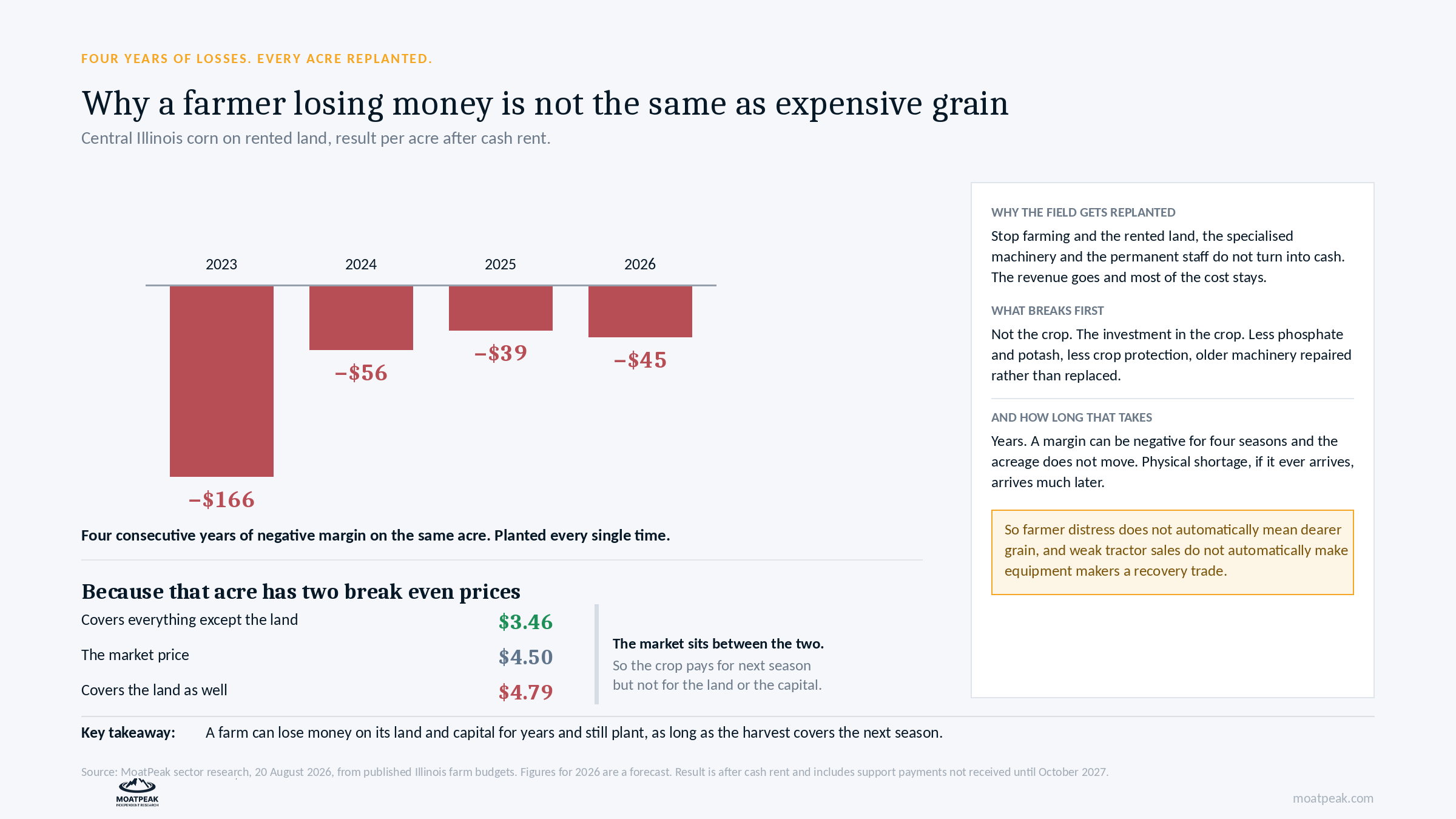
This acre in fact has two break-even prices, not just one.
The corn brings in $3.46 a bushel, which covers the cost of the seed, fertilizer, machinery, labor, and interest – except that of the land.
It also includes the cash rent at $4.79.
The present market price is $4.50 and this amount is somewhere between the two break-even points.
It therefore results in the farmer making $1.04 for each bushel over and above the costs which are not related to land, but he still ends up with a loss of around $45 per acre after having paid the rent. He does not obtain a return on either his land or his capital. The crop still generates enough cash to allow him to plant again the following year.
He continues to plant; over four consecutive years, from 2023 through to 2026, he has suffered losses of $166, $56, $39 and $45 per acre.
It’s been four consecutive years of losses, but no acreage has been removed from production.
Why that is not stubbornness
If the farmer ceases operation, the rented land, the specialized equipment, and the permanent staff do not at once become cash. Although the income vanishes most of the expenses stay, so it is sensible to continue and this will be the case for a long time.
What distinguishes farming from oil drilling is this: when an oil well stops producing, its output is lost forever, but if a farm fails, the land itself remains. A more powerful neighbour can then buy it or rent it and someone else will grow crops on it the following season.
So what actually breaks, and when
What breaks isn’t the crop but the investment made in the crop.
Farmers begin to use smaller amounts of phosphate and potash, spend less on crop protection, repair their equipment rather than purchase new equipment, and alter their crop rotations. As a result, their cash reserves decrease and they have to depend more on loans.
This is the order in which things usually happen:
The first thing to happen is that the margins become smaller. Then investment is put off. After that, the credit quality falls. It is only after all these things that the physical supply is impacted.
The time it takes for one stage to progress to the next can be several years. This period is important to investors since the money doesn’t disappear during it; it simply ends up in another place.
Where the money goes in the meantime
We think that few people have given a clear explanation of this, which is the reason why we regard 2026 as a year involving selective redistribution rather than global scarcity.
Funds are moving from grain farmers to creditors, as well as to traders, to the larger farms which are buying out the smaller ones, and also to certain input suppliers. The price of ammonia is now $963 per ton, a 26 percent increase on the figure from last year. European nitrogen prices are 56 percent higher than they were in 2024. Diesel costs are just about $5.26 per gallon. Even if grain prices fall by 30 percent while costs only decline by 5 percent, the margin doesn’t vanish—it simply passes to somebody else.
And the harvest is not what the headlines say
There are three figures that are worth knowing.
US winter wheat production has dropped to 990 million bushels, the lowest level it has been since 1963. That is a genuine and significant decrease.
Global grain production is the second-largest harvest on record, amounting to 2,949.6 million tonnes. It has decreased by 2.2 percent compared with the previous year, but is still an extremely large figure.
Here’s the number that ties it together: China holds about 60% of the world’s corn stocks, but almost none of it is sold internationally. Without China, corn stocks compared to annual use are 11.0%, not the headline 20.8%.
Two further signs back this interpretation. The futures for wheat in Kansas were 79.5 cents higher than those in Chicago, indicating that buyers are paying for a particular scarce grade rather than for wheat as a whole. Moreover, corn is in contango, with the prices for December exceeding those for September. Markets that are actually experiencing a real shortage generally do not exhibit this kind of behaviour.
What this means if you are thinking about buying something
There are three points to take away, and none of them provides a specific trading idea.
The fact that farmers are having difficulties doesn’t mean that grain prices will go up; the process lasts for years and may come to a halt at any time.
The fact that sales of tractors are slow doesn’t necessarily mean that the equipment manufacturers are on the verge of recovering; the cycle has to reverse and the prices had to have already reached their lowest point.
Agriculture isn’t just a single story; in 2026 the best opportunities won’t be in the commodities themselves but in the difference between the values of certain companies and their costs. The size of these gaps differs from company to company.
What is in the full report
We have carried out a study of six different investments in the areas of machinery, trading, and inputs. For each of these we give our opinion, the price at which we consider the risk to be worth taking, our value range, and the time frame involved. Additionally, we have included three that we are still keeping an eye on and four that we do not find attractive, together with the reasons for each.
The levels are given as of 14 August and have the date of the report.
We would like to make it clear what you are actually buying. The principal aim of our report is that the exciting narrative is not supported by the data; instead, the greatest value lies in the ideas that we dismissed together with the reasons for doing so. Should you be in the market for a supercycle thesis, then this report is not the one for you.
For more information on the sector research, visit moatpeak.com.
Educational research only. Not personalized investment advice. MB “MoatPeak Group”.