


Having undergone four gradual changes, France – which had previously been priced almost at the level of Germany – is now above Italy.
It has been observed that France is now paying more to borrow than Greece; this situation has, at various times, been true for roughly eighteen months. In that case, it comes as a surprise.
But if you look at it from a different perspective, this actually represents one of the most important gradual changes in European markets and has never been completely explained up to now. Here is the full situation.
The order at the end of 2021
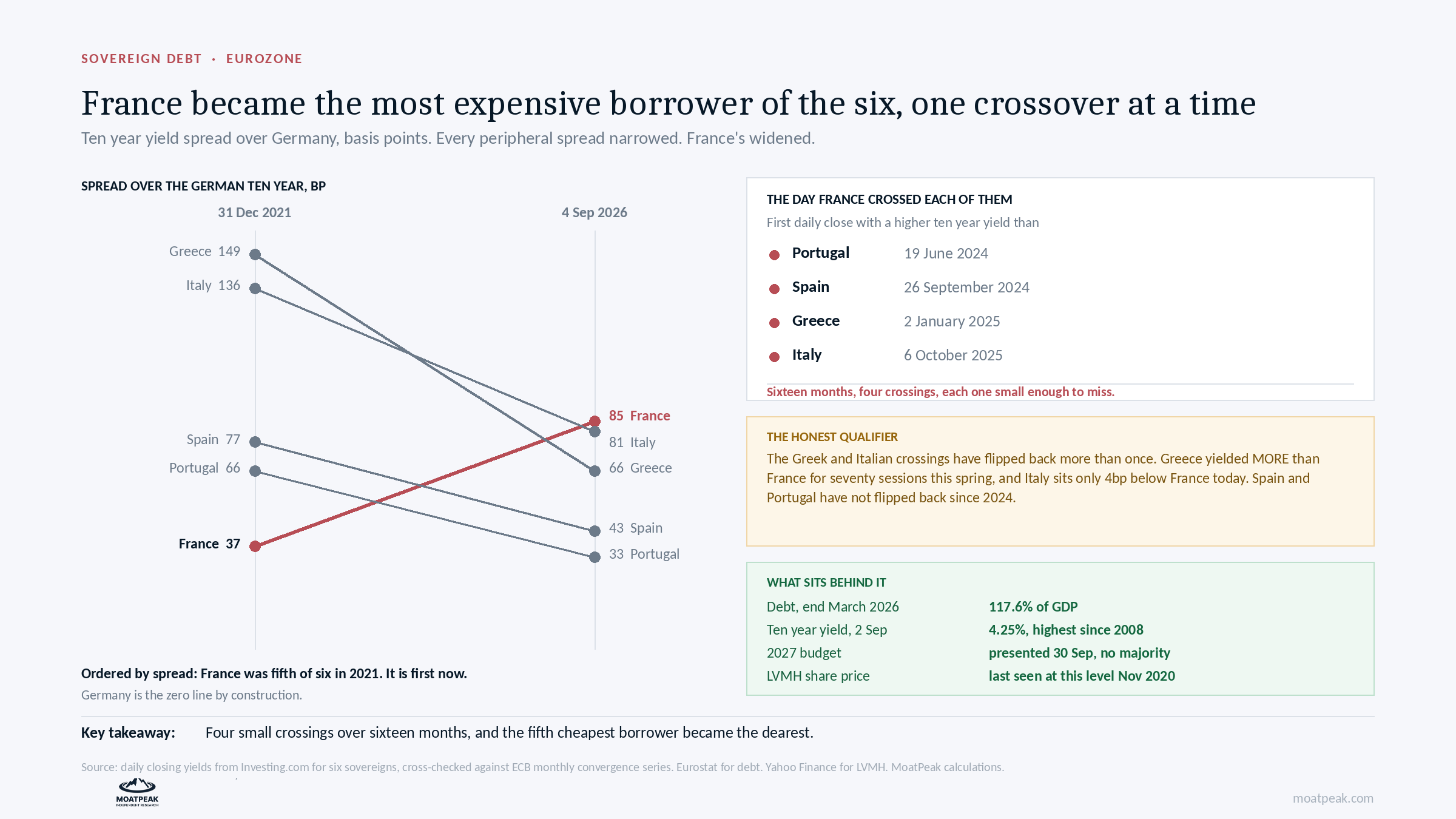
If you want to compare them, look at the six largest government borrowers in the euro area and compare each country’s ten-year yield with that of Germany’s, expressed in basis points. This is the conventional method of determining how much more each country has to pay in order to borrow.
By the end of 2021 the order from most expensive to cheapest was Greece at 149, Italy at 136, Spain at 77, Portugal at 66, France at 37 and Germany at 0.
France came fifth among the six countries. It was regarded as one of the core borrowers, situated just above Germany and well removed from the periphery. This had been the standard situation for many years.
The order now
On 4 September 2026 the order is France with 85, Italy with 81, Greece with 66, Spain with 43, Portugal with 33, and Germany at 0.
The spreads for all the countries except France narrowed: Greece by 83 points, Italy by 55, Spain by 34, and Portugal by 33. France, on the other hand, saw its spread increase by 48, which was the only such change and was sufficient for it to overtake the other four.
The four crossings, and why nobody noticed
France did not take a sudden action; rather, it gradually overtook each of its peers, one by one, over a period of sixteen months.
It went past Portugal on 19 June 2024, Spain on 26 September 2024, Greece on 2 January 2025, and Italy on 6 October 2025.
The changes each time were only a few basis points, which is why none of these events made the news. The true picture emerges when all four dates are considered together and it is seen that France had moved from being the fifth cheapest borrower to the most expensive, even though there were no dramatic single-day shifts.
The honest qualifiers, which we would rather print than have found
The situation between Greece and Italy has seen several reversals. This spring, Greece’s yield was higher than France’s for seventy consecutive sessions, the difference at times reaching as much as 35 basis points. Italy is currently only 4 basis points below France and the two countries’ positions have been reversed six times this year. By the ECB’s monthly averages, Italy was above France from March to July.
To sum up, France has been ranked above Spain and Portugal since 2024, above Greece from mid-June, and it is currently above Italy by a margin which could vanish if Italy has a poor day. Although the general trend is clear, the precise position of France at the top remains uncertain.
The surge that took place last week was not something that occurred only in France. When on 2 September the ten-year bond yield in France hit 4.25%, the highest level it had been since 2008, other countries also experienced similar rises. Inflation in the Eurozone stood at 3.3%, with an expected increase in the ECB’s interest rates this month, and oil prices are now near $96. The important aspect for France is the slow development over a period of sixteen months, not the recent short-term jump.
What sits behind it
Eurostat reports that general government debt stood at 117.6% of GDP by the end of March, compared with 115.7% at the end of the previous year. Growth for 2026 has now been reduced to 0.7%, and the second quarter has been revised to zero. The deficit for last year was 5.1%, with a 5% target for this year which most people outside the finance ministry do not believe will be reached.
What the yield is actually showing is the political situation. The prime minister doesn’t have a majority; the budget for 2027 will be presented on 30 September to a parliament where the left intends to move a censure motion and the far right has not excluded any possible actions. A special law was needed last year since no budget could be passed. The presidential election will take place in the spring.
On 28 August Fitch confirmed France’s rating at A+ with a stable outlook, which was regarded as good news. Yet this is still a downgrade compared to AA from a year ago.
One company as a proxy
LVMH, which is the largest company in France, is currently trading at €429; the last time it closed at that level before this year was in November 2020. It is now 52% lower than its peak in April 2023 and has fallen by 33% this year – something that is due to both the cycle in the luxury market and the state of the French economy. Although the bond market is not the only factor, it is noteworthy that France’s top company has returned to pandemic-level prices in the same year that France became the most expensive borrower among its peers.
What we think it means for a holder
Three things.
The conventional method of dividing the euro area into core and periphery has become outdated; it currently causes France to be placed in the incorrect group, and investors who hold European bond funds according to these outdated categories are facing risks different from what they would expect.
The fact that spreads in the periphery have narrowed is genuine and has been substantial; Greece is currently 66 basis points above Germany and is no longer regarded as a borrower in difficulty. It is open to debate whether this assessment is fully justified, but the market has already reached its conclusion.
The next important date for France is 30 September. In the event that the budget is passed, even if it is not perfect, the spread is likely to stay stable; but if the budget fails and another special law has to be introduced, the market will then assess whether 85 basis points is the highest or lowest point.
What would change our reading
If the spread of France over Germany falls below 60 basis points and remains at that level during the budget process, this would indicate that the rise had been caused by political risk a situation which a properly functioning parliament could remedy. Under those circumstances, this analysis might have overemphasised the structural problems.
If Italy’s figure exceeds that of France and remains higher for a month, then the position at the top would be just a temporary fluctuation and we would recognise that.
The complete details of our research, together with the tests that we publish in advance and evaluate ourselves against, can be found at moatpeak.com.
This content is based solely on educational research and does not provide personal investment advice. MB “MoatPeak Group”.