


There’s a new tool in the average investor’s pocket, and it’s genuinely useful: ask an AI what it makes of a stock, a sector, a strategy, and you get a clear, confident, well-organised answer in seconds. The catch is hiding in plain sight. Your neighbour is asking the same kind of model the same kind of question, and getting a very similar answer.
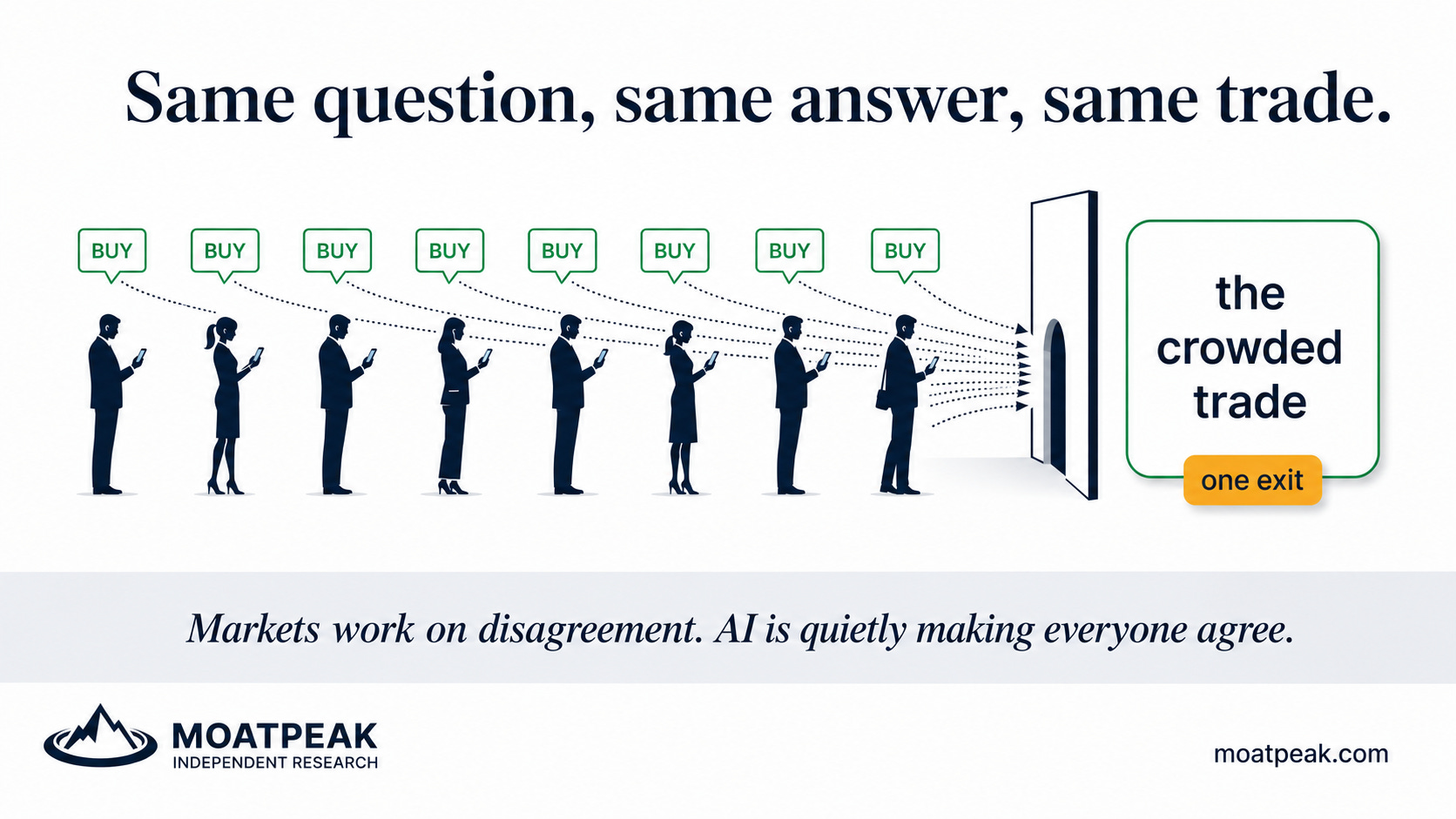
Markets work because people disagree. For every buyer there’s a seller, and the price is the truce struck between a million different opinions. Anything that quietly makes those opinions more alike makes the market more fragile, because it thins out the people willing to take the other side. A handful of popular AI tools, trained on overlapping data, nudging millions of users toward the same few “obvious” picks, is a machine for making opinions more alike.
You don’t have to take that on faith; the plumbing already shows it. Retail trading has roughly doubled its share of the market over the last fifteen years, and the defining trade of the cycle — anything with “AI” stamped on it — is, by Wall Street’s own measures, about as crowded as crowding gets, with positioning in the momentum names pinned near the top of its multi-year range. When a trade is that one-sided, it doesn’t need bad news to break. It just needs the crowd to reach for the exit at the same moment.
The uncomfortable implication is that the better and more widely used these tools get, the more they can quietly synchronise everyone. It isn’t that the AI is wrong. It’s that being right in the same way as everybody else is its own kind of risk: you all buy near the same time, and you all want out near the same time. The edge in investing has always come from seeing something the crowd doesn’t. A tool that hands the entire crowd the same view, instantly, is the opposite of an edge.
So use the tools — they’re good for research, for pressure-testing your thinking, for learning quickly. Just don’t mistake a popular answer for a private one. If a thesis feels obvious and everyone you ask, human or machine, nods along, that isn’t confirmation; it’s a crowd forming. The most valuable question to put to the AI might be the one it’s worst at: who is on the other side of this trade, and what do they see that I don’t? How we think about crowding and positioning is part of the desk’s work at moatpeak.com.
Free weekly letter and explainers like this; the daily research, levels and the Daily Compass are at moatpeak.com.
Educational research only — not investment advice. MoatPeak Group, UAB.