


The largest ever effort by Japan to buy yen was accompanied by a record decline in its reserves; although the ministry has not stated what was sold, its figures together with those of the US Treasury point to the same conclusion.
The Japanese Ministry of Finance published its August reserve figures on Monday. Although these are among the most important government figures of the week, they have attracted little notice outside the circles where currency trading takes place.
What the ministry published
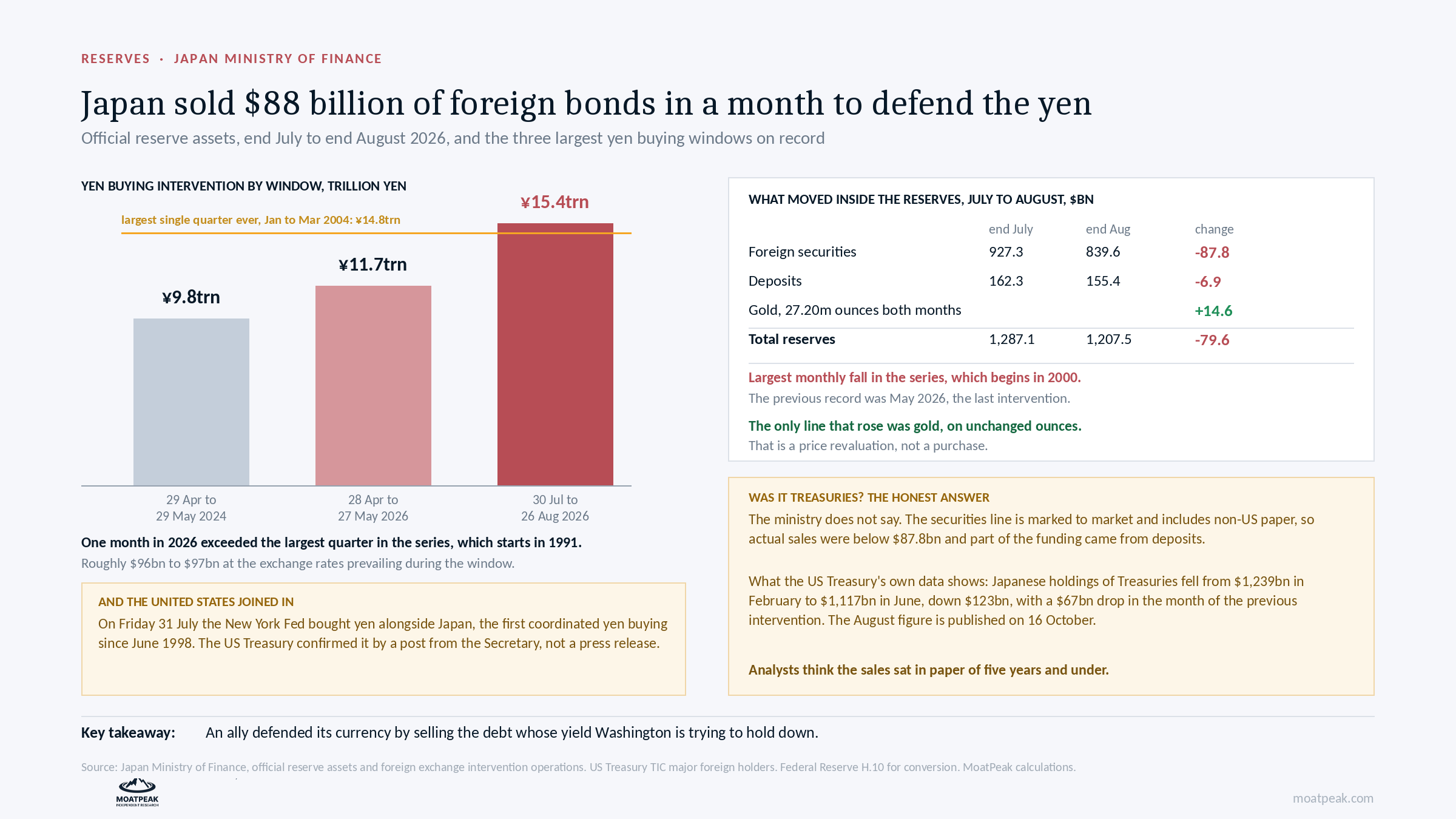
Japanese foreign securities holdings fell from $927.3 billion at the end of July to $839.6 billion at the end of August, a reduction of $87.8 billion over the course of one month. Deposits decreased by $6.9 billion as well and total reserves dropped by $79.6 billion.
This represents the largest monthly decrease ever recorded since the data series started in 2000; the previous record was achieved in May of this year, at the time of the last intervention.
The only thing that increased was the value of gold, which went up by $14.6 billion, even though Japan still held the same amount of 27.20 million ounces as before. Japan had not bought any additional gold; it was the value of its existing gold that had risen. Instead, it got rid of all the other assets it could.
What it was paying for
Three days earlier the ministry had given figures for its total intervention from July 30 to August 26: it had spent ¥15,399 billion in order to buy yen. At the exchange rates that existed during that period, this was equivalent to about $96 to $97 billion.
The ministry has never seen a monthly intervention of this magnitude, its records extending back to 1991; it beats the previous record set in April and May of this year amounting to ¥11.7 trillion, and in fact goes beyond the highest figure achieved in a single quarter, which was ¥14.8 trillion in early 2004.
In a period of one month Japan has overtaken the biggest quarter of the last 35 years, and so far this year it has spent 271 trillion yen in order to defend the yen, setting a new record.
And the United States joined in
On Friday, July 31, the New York Federal Reserve joined Japan in purchasing yen; this marked the first such coordinated acquisition of yen since June 1998. The Treasury Secretary announced it on August 3 by means of a personal post rather than issuing a press release, and the figure in question will not be made public until the New York Fed’s quarterly report in November.
Well, Washington does support the aim. The following section deals with the method by which it was achieved.
Was it Treasuries?
The ministry has not stated exactly what was sold, and we would rather follow the facts than make guesses.
The following is what we know: the securities portfolio decreased by $87.8 billion. This amount is based on mark-to-market valuations and takes into account non-U.S. bonds, meaning that the actual sales were a little lower. Furthermore, the rising yields during the month had a downward effect on the valuation. Part of the funds came from deposits.
US Treasury data shows that Japan’s holdings of US Treasuries decreased from a peak of $1,239 billion in February to $1,117 billion in June, a decline of $123 billion. The largest monthly fall was $67 billion in May, which was during the most recent intervention. The figure for August will be published on October 16.
It is believed by analysts that the sales were carried out through bonds having maturities of five years or less, since this method allows the pressure on long-term yields to be avoided, something the Treasury Secretary has been trying to achieve by keeping them low this summer.
Although we think that this inference is reasonable, it has not yet been confirmed and will not be settled until another five weeks have passed.
This should be included alongside the ten-year term at 4.79 percent.
The present situation is that the United States has launched a scheme to back long-term bonds. The Treasury has increased its buybacks of ten- to thirty-year debt to a level of at least $4 billion per operation, beginning this week. At the same time, its closest ally in Asia, with support from the United States, has probably raised about $90 billion by selling U.S. government bonds.
In order not to affect the long-term yields, Japan decided to issue short-term bonds. This was a thoughtful action and reflects the care that all parties are taking in the current bond market, which has reached its highest levels of yields in Europe since 2008 and in the United States since January 2025.
At the moment these actions are not affecting the prices; rather they determine the level of pressure that will be placed on long-term bonds in the next quarter within a market which still anticipates a smooth result.
What would change our reading
If the October TIC report indicates that Japan’s treasury holdings had either remained unchanged or increased in August, it would mean that the sales had been of other assets and therefore our earlier conclusion was wrong. We will provide an update on October 16.
It should be pointed out that the act of selling reserves in order to protect a currency is not a criticism of American debt. Japan sold the assets it had, and those assets were Treasuries. The fact that it held Treasuries is a reflection of the composition of its reserves, not of its confidence in the United States as a borrower.
Our complete research, together with the tests that we publish and track, can be found at moatpeak.com.
Educational research only. Not personalized investment advice. MB “MoatPeak Group”.
Japan really sold $88 billion in foreign bonds just to remind the yen who is supposed to be in charge.