


“Depression” has become the go-to word for China’s economy. It is a strong word, so we tested it against the classic case: the United States from 1929 to 1933.
What a depression looks like
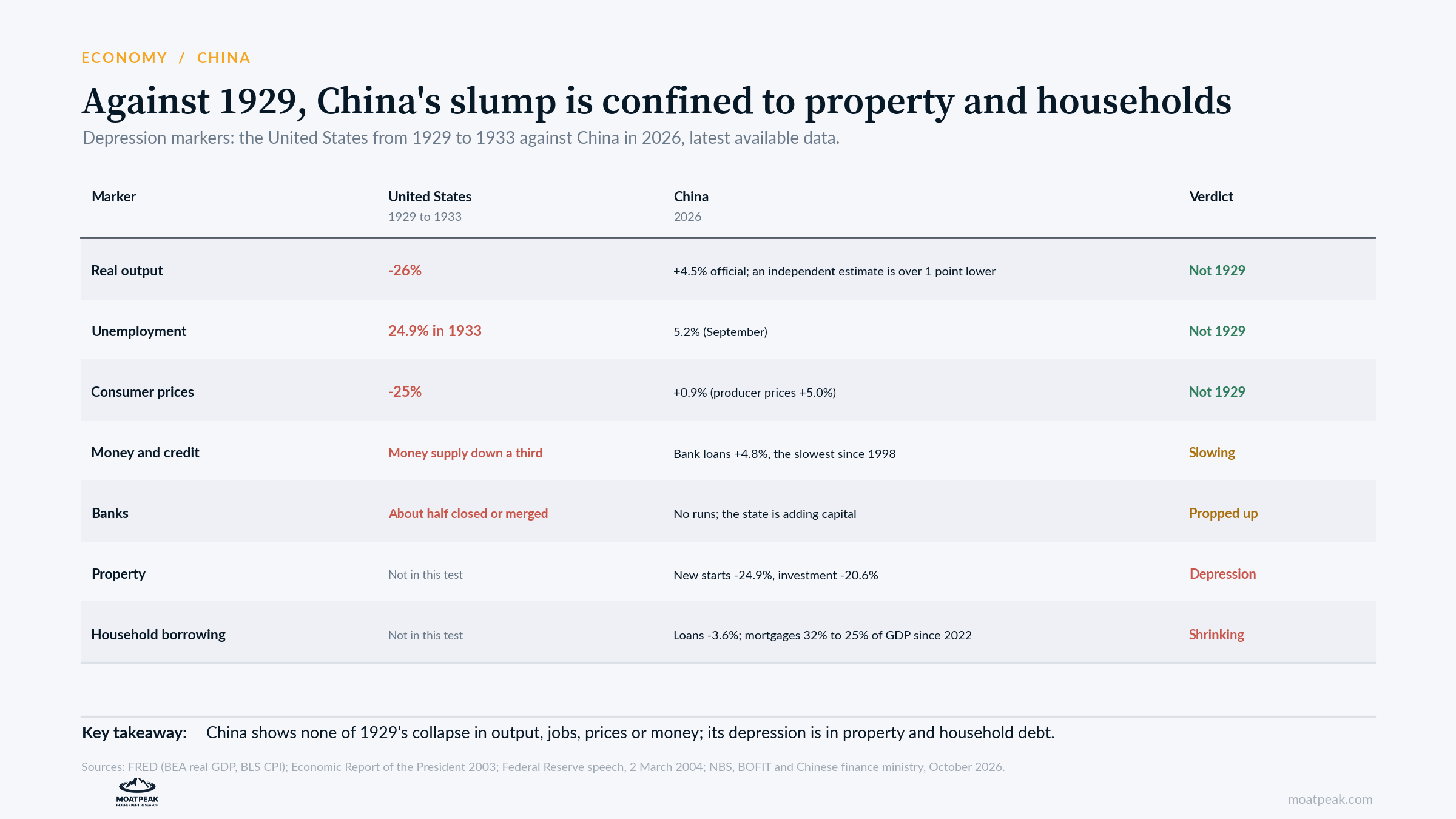
In those four years, American real output fell 26.3 percent. Unemployment reached 24.9 percent in 1933. Consumer prices fell by about a quarter, the money supply shrank by about a third and about half of all banks closed or merged.
China in 2026 looks nothing like that on those measures. Official real GDP grew 4.5 percent in the third quarter. An independent estimate from the Bank of Finland’s research institute puts growth more than a point lower, within a wide range. Urban unemployment was 5.2 percent in September. Consumer prices rose 0.9 percent and producer prices 5.0 percent. Bank lending is still growing, by 4.8 percent, and there have been no bank runs.
Where China fails the test
Two parts of the economy do look like a depression. Property is the first. Investment in development fell 20.6 percent in the first nine months of the year. New starts fell 24.9 percent and completions 25.1 percent. Revenue from land sales, a mainstay of local budgets, fell 27.9 percent.
Household balance sheets are the second. Household loans fell 3.6 percent in the year through September. Outstanding mortgages have shrunk from almost 39 trillion yuan in September 2022, 32 percent of GDP, to 35.9 trillion, 25 percent. Families are paying down debt and saving more: real spending per person grew 2.7 percent while real income grew 4.4 percent.
The state is filling the gap. Government bonds outstanding rose 13.7 percent and now equal 72 percent of GDP, up from 67 percent a year earlier. Total bank lending is growing at its slowest pace since records began in 1998, and what growth remains goes mostly to companies and government bodies.
That pattern has a name: a balance-sheet recession. After an asset bust, private borrowers repair their finances, and the government borrows to keep the economy turning.
Japan’s version
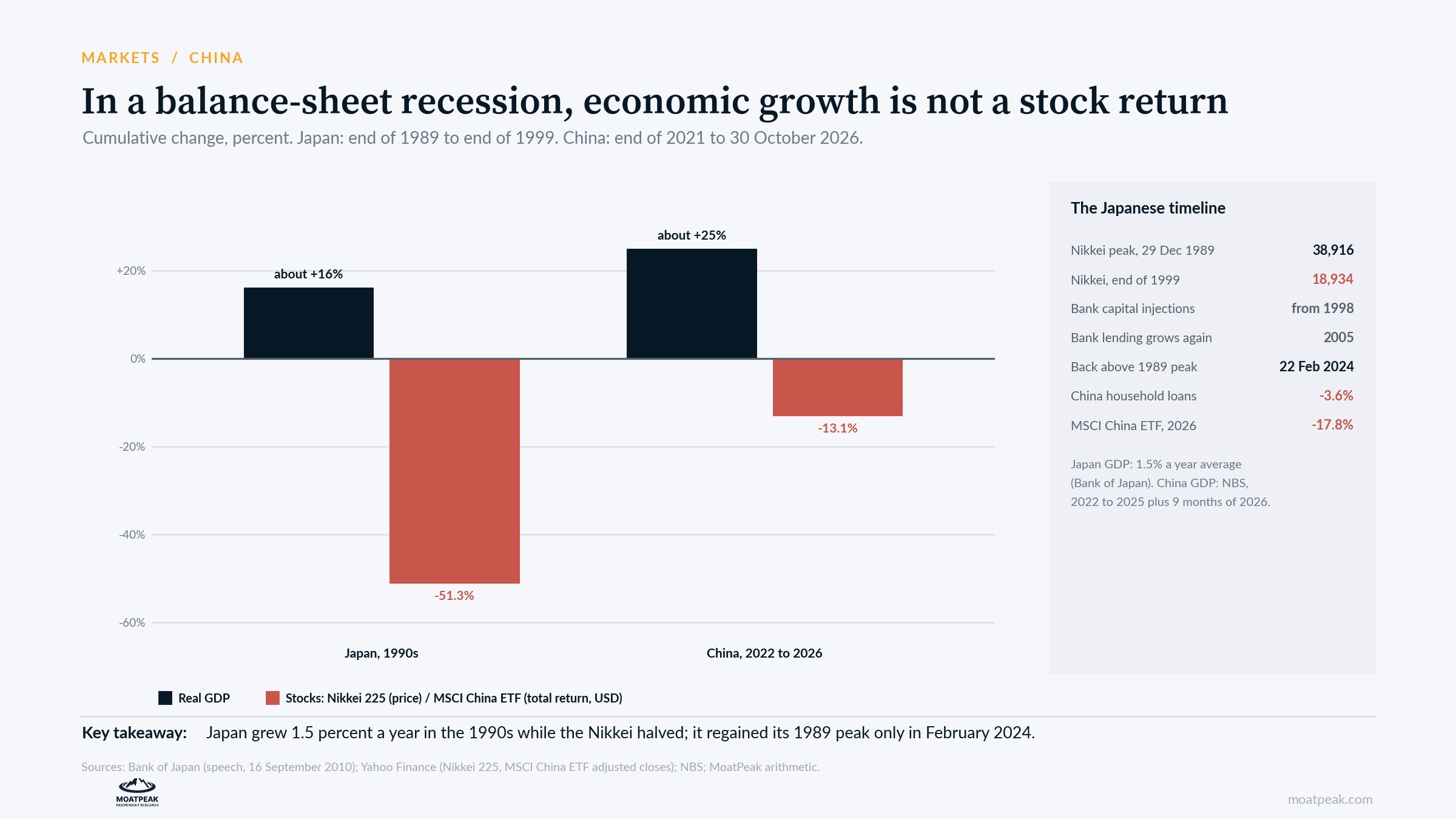
Japan is the closest match, and its central bank has documented what happened. After the bubble burst, Japan’s real growth averaged 1.5 percent a year in the 1990s, against 4.4 percent in the 1980s. The economy never collapsed. Bank lending, however, did not grow again until 2005, and public capital injections into the banks began only in 1998.
For investors, the result was brutal. The Nikkei 225 peaked at 38,916 on 29 December 1989. By the end of 1999, it was down 51 percent, while the economy had grown by about a sixth. It first closed above its 1989 peak on 22 February 2024.
China’s market has already shown a milder version of the same disconnect. Since the end of 2021, official real GDP has grown about 25 percent. Over the same period, the MSCI China ETF has returned minus 13 percent, including dividends, in dollars.
Our read
The depression debate is the wrong question for investors. A depression is a crash that clears debts and resets prices, and markets often bottom while it is still under way. A balance-sheet recession managed by the state avoids the crash and stretches the repair over years, with positive growth all the way. For shareholders, the slow version can be just as costly, because there is no clear moment when the market bottoms out.
China has more tools than Japan had. Its state owns the big banks and can recapitalize them quickly, and the country runs large trade surpluses, with exports up 16.4 percent this year. The yuan has even gained 5.0 percent against the dollar in 2026. Still, none of those tools can make households borrow.
The case against us
The official data may flatter growth. If the true pace is a point or more lower, as one independent estimate suggests, the distance to a recession is shorter than our scorecard shows.
China’s state can act faster than Japan’s did. Beijing injected 500 billion yuan of capital into its largest banks last year and plans 300 billion more in the fourth quarter. A faster clean-up would shorten the repair.
A policy turn toward household incomes would change the picture. Beijing began subsidizing one percentage point of interest on qualifying first-home mortgages on 1 October. A larger, permanent shift of money to households is what would end the balance-sheet recession early.
What it means for your money
Do not buy China on GDP. In Japan, annual growth of 1.5 percent came with a halving of the stock market.
Use household credit as your signal. A sustained return to growth in household loans would be the first sign that the repair is ending.
Pay for balance sheets and cash flow. In a long repair, low valuations can stay low. Verifiable cash, modest debt and dividends matter more than a cheap multiple.
What we are watching
Mid-November: October credit and activity data.
The fourth quarter: the 300 billion yuan capital injection into the big banks.
The mortgage subsidy: whether first-time buyers respond, the clearest test of whether households are willing to borrow again.
Educational research only. Not personalized investment advice. MB “MoatPeak Group”.
I agree the 1929 comparison is the wrong frame, and Japan is clearly closer. One worry I have with the balance-sheet recession diagnosis: the signal you propose, household loans which fell 3.6 percent in the year through September, moves slowly by construction, so it may confirm the repair is ending long after markets have decided. What I am watching instead is the 300 billion yuan capital injection into the big banks this quarter and whether the one percentage point mortgage subsidy moves first-time buyers. If neither shifts household borrowing over the next two quarters, the repair is not ending, it is being extended, and low China valuations stay low.
China’s economic slowdown just got a 1929 comparison.