



For two weeks the same question has been everywhere. The Shiller CAPE just crossed 40 for only the second time in a century, the first was the peak of the dot-com boom, and so the internet has settled into a familiar argument. Is this a bubble, yes or no.
It is the wrong question. Not because the answer is comforting, but because “bubble” with no further detail is not a diagnosis. It is a mood. And a mood tells you nothing about what to actually do.
There are three different things people mean when they say bubble, and they are not interchangeable. They nest inside each other like a set of dolls. A stock bubble can live inside a perfectly healthy theme. A theme bubble can live inside a perfectly healthy market. The level you are standing on decides everything that matters next: whether diversification protects you, what actually fixes it, and how long the damage takes to heal.
Level one: the whole market
A market bubble is when the broad index is expensive and the leverage sits on ordinary balance sheets, households and banks, across a wide front. This is 1929, when the public bought stock on ten percent margin and the borrowing itself became the channel that spread the damage. It is Japan in 1989, where the whole market went to an extreme and then needed more than three decades to see that high again.
This is the dangerous one, because there is no place to hide. When the entire market is the bubble, diversifying between stocks does not help you. The contagion travels through credit and the loss of household wealth, and it heals over years, sometimes decades.
Level two: one theme
A theme bubble is when a single story is overpriced while the rest of the market is reasonable, and the debt sits with the builders rather than with households. This is the railways of the 1840s, where the track got built, survived, and outlived the shareholders who paid for it. It is the dot-com peak, where the Nasdaq fell seventy-eight percent while the unfashionable corners, value stocks and real estate, came through largely intact. It is telecoms in 2001, where the debt belonged to the companies laying fibre.
The important feature is the opposite of a market bubble. Diversification outside the theme works. And after the crash the infrastructure remains. The cheap overcapacity left behind by the telecom bust, the so-called dark fibre, went on to carry the internet of the 2000s.
Level three: one name
A stock bubble is when a single company detaches from its own business, while the theme and the market around it are fine. The cleanest example is Cisco. The business was real and kept growing for a quarter of a century. The stock is the problem: a buyer at the March 2000 top waited roughly twenty-five years, until December 2025, simply to break even. Cisco was the right company at the wrong price. Being right about the business still cost a generation of investors twenty-five years, because the price already contained a decade of growth before the growth arrived.
This level is not cured by diversification or by rotation. It is cured by testing the individual company: what is already priced in, and how many years of future success have you been asked to pay for today.
So which one is this
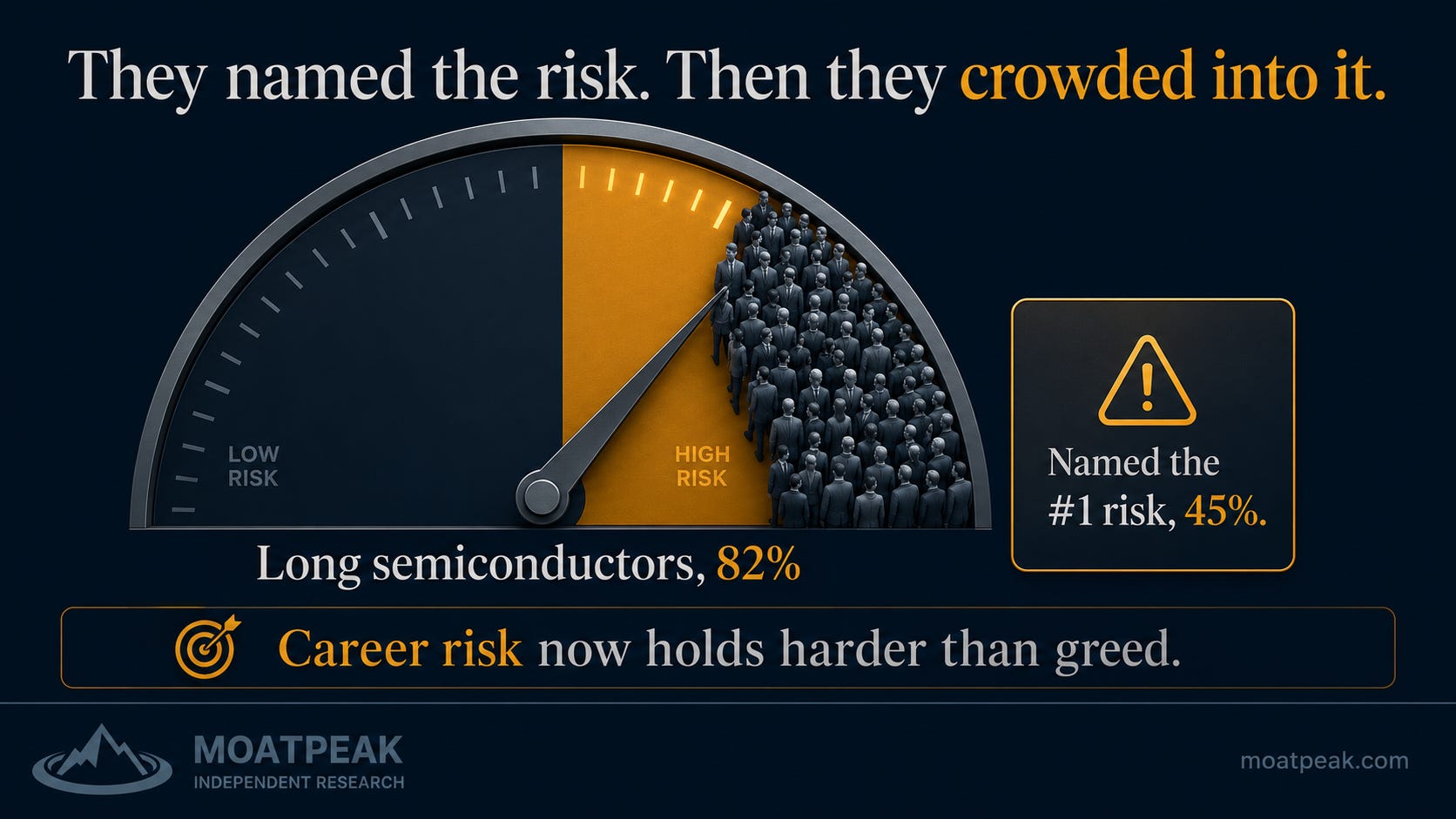
On our read, today is a theme bubble, not a market one. The evidence points the same way from several directions. Valuation is stretched at the top of the index, with the CAPE near its all-time extremes and more than a third of the S&P 500 sitting in ten names. Leverage is real: margin debt hit a record 1.42 trillion dollars in May, up fifty-four percent in a year, and the only three times it ever grew that fast were 1999, 2007 and 2021. Positioning is extreme: Bank of America’s July survey found the most crowded trade its managers have ever reported, “long semiconductors,” at eighty-two percent.
But the leverage is not sitting broadly on household balance sheets the way it did in 1929. It sits in two separate populations: retail using margin and options inside a handful of stocks, and institutions funding the physical build of AI infrastructure. Two debts, two mechanisms, two different pockets. That is the signature of an expensive market with a bubble pocket in one theme, not a 1929 sitting on top of everyone at once.
The part that keeps us honest
Here is where our own model strains, and we would rather show you than hide it.
The textbook says smart money leaves before the mania peaks. The data says the opposite is happening. In that same July survey, the professionals who named the AI bubble as the single biggest risk in the market are also the most crowded into it they have ever been. They see the thing they are afraid of, and they are standing inside it. Either we are earlier in this than it feels, or the old rule is broken, because career risk now holds harder than greed. A manager who sells too early and watches the theme run underperforms, loses clients, and is gone. So they stay.
And there is a deeper humility the loud version of this debate skips. The most careful academic work on bubbles, by Greenwood, Shleifer and You, studied every sharp industry run-up in a century of data. Two findings matter. First, after a doubling in price, only a little more than half of these episodes actually crashed. Almost half did not. Second, a sharp run-up does not, on average, predict a poor return going forward. It only widens the tail, the chance of a bad outcome, without lowering the expected one.
Read those together and three sentences that everyone treats as one come apart. “This is a bubble,” “this will crash,” and “you should short it” are three different statements. The industries that did eventually crash tended to keep rising for months after the first warning, and to gain a good deal more before they broke. Being early is indistinguishable from being wrong right up until it isn’t.
What the level actually tells you to do
This is why the level matters more than the verdict. A market bubble is answered with allocation, how much you hold in stocks at all. A theme bubble is answered with rotation inside the theme, because the crash sorts the durable links of the chain from the fragile ones rather than ending the story. A single-name bubble is answered by testing that one company, not by touching the rest of the portfolio.
The map tells you what is happening. It does not, by itself, tell you the weights to hold, the exact lines that should change your behaviour, or which names are carrying the theme versus quietly hollow. That is the work we do at moatpeak.com: the live monitor that turns this diagnosis into a small number of watch lines, and the positioning that follows from it.
The question was never whether there is a bubble. It is which of the three you are standing on. Get that wrong, and you either sell a healthy market out of fear, or you hold a single name that needs twenty-five years to come back.
Educational research only. Not personalised investment advice. Diagnosis is not timing. MB “MoatPeak Group”.