


For thirty years, Japanese savers invested abroad because returns at home were so low. That has changed.
On Friday, the Japanese government’s ten-year bond yielded 2.987 percent.
We checked the daily data from the Ministry of Finance, which goes back to July 1986, to see when yields were last this high. The answer is 13 September 1996, when the yield reached 2.993.
That was thirty years ago this week.
Earlier this month, on 2 September, the yield briefly reached 3.006, the first time it has hit three percent since 6 September 1996. The Bank of Japan will meet on Thursday and Friday, with an announcement expected on Friday, 18 September.
Why a Japanese bond yield is an American problem
Japan is the world’s largest creditor nation. For most of the past thirty years, Japanese pension funds, insurers, and banks had few good options at home. Government bonds paid almost nothing, and sometimes even less than nothing.
So, Japanese investors sent their money overseas. They bought American Treasuries, French and Australian government bonds, and American corporate and mortgage debt. These assets were not especially attractive on their own, but they looked better than earning nothing at home.
This flow of money has quietly supported the global bond market. For thirty years, whenever a developed country issued long-term debt, some of the buyers were Japanese investors searching for better returns than they could get at home.
This strategy only worked if the yield on foreign bonds was high enough above Japanese yields to cover currency hedging costs and still offer a profit.
Here’s how that gap has changed this year.
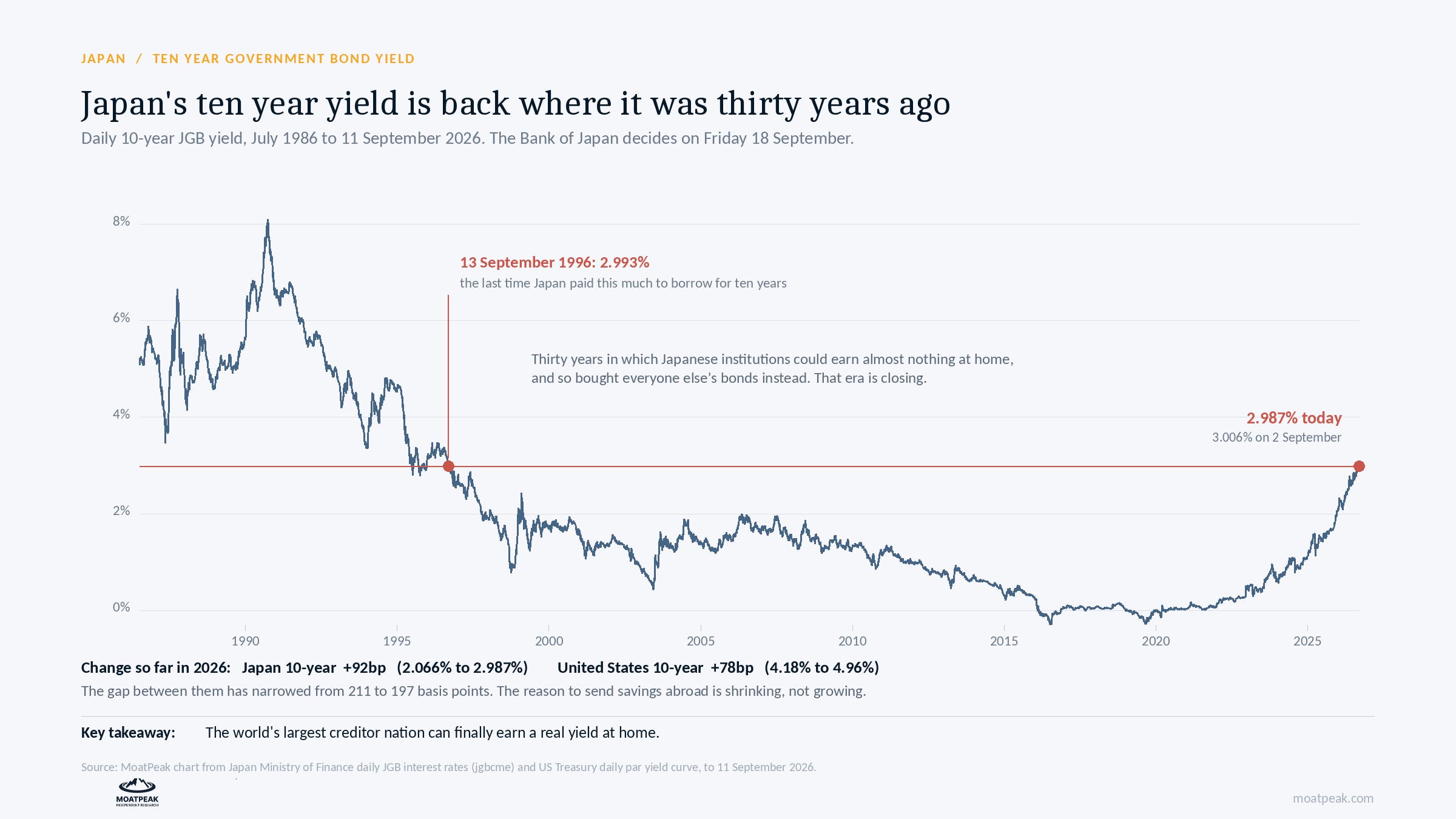
The gap is closing from the wrong end.
Since December, Japan’s ten-year yield has climbed from 2.066 to 2.987 percent, an increase of ninety-two basis points.
Over the same period, the American ten-year yield rose from 4.18 to 4.96 percent, up 78 basis points.
Japanese long-term rates have increased faster than American rates this year. The gap between them has narrowed from 211 to 197 basis points.
We think this part of the story is not being fully recognized. Most commentary treats Japan’s rate rise as just a Japanese or yen issue. It’s more than that—it’s about who is buying long-term government debt around the world.
Now, Japanese institutions can earn nearly three percent in yen from their own government bonds, without taking on currency risk. The incentive to invest abroad is smaller, even as the rest of the world needs more buyers for long-term debt.
It is already visible in the holdings.
This isn’t just a prediction. The shift has already started, and the U.S. Treasury’s monthly data shows it.
Japanese holdings of US Treasury securities stood at $1,239.3 billion in February. By June, the most recent month published, they were $1,116.7 billion.
That’s a drop of $122.6 billion in four months, almost ten percent of the total holdings.
Japan remains the largest foreign holder of U.S. government debt. But the trend has reversed, and it’s the direction of change that affects prices at the margin.
And the American long end is where you would expect it to be
On Friday, the twenty-year Treasury yielded 5.38 percent.
We looked at the daily yield curve data for each year. The last time the twenty-year yield was this high was on 14 June 2007. The peak of the widely discussed 2023 bond selloff was 5.30 percent. We have now surpassed that.
The ten-year yield is at 4.96 percent and the thirty-year at 5.35 percent, so the twenty-year now yields more than the thirty-year. Last week, from Tuesday to Friday, the twenty-year yield rose by twelve basis points and the ten-year by sixteen.
This updates what we wrote two weeks ago, and we want to be clear about it. On 1 September, we said that August’s bond selloff was not really about long-term bonds. The biggest moves were at the short end, where the Fed’s decisions have the most impact. That month, the thirty-year yield actually fell by two basis points and the twenty-year by four.
That was true at the time, but it’s no longer the case. In September, the biggest changes have happened at the long end of the yield curve.
The honest uncertainty
We don’t think the Bank of Japan’s decision on Friday is the main event. Whatever the bank decides, it will be reacting to changes that have already taken place in the market.
The real question is harder to spot: will Japanese institutions see three percent yields at home as a reason to bring money back, or will they view it as a temporary change and keep their foreign investments? Large institutions don’t move quickly, but Treasury data shows some have already started shifting.
There are good arguments against our view, and we want to acknowledge them. Hedging costs can change, and if it becomes cheaper to hedge dollars back into yen, investing abroad could become attractive again, even if the yield gap is smaller. An unhedged Japanese investor cares more about the yen’s value than the yield difference. Neither factor makes domestic yields unimportant, but both could slow down the shift.
What would change our view? If Japanese Treasury holdings rise for two months in a row, or if the U.S.-Japan ten-year yield gap widens past 230 basis points. We’re putting this in writing today.
Where we think this lands
If the world’s biggest exporter of savings stops being the main buyer of long-term government debt, those bonds will need new buyers, likely at different prices.
There’s nothing dramatic about this. It won’t be settled on any single day. It’s simply a shift in who is buying at the auctions.
The American twenty-year yield hitting a 2007 high, while the Japanese ten-year is at a 1996 high, shows what this transition looks like in real time.
Educational research only. Not personalized investment advice. MB “MoatPeak Group”.