


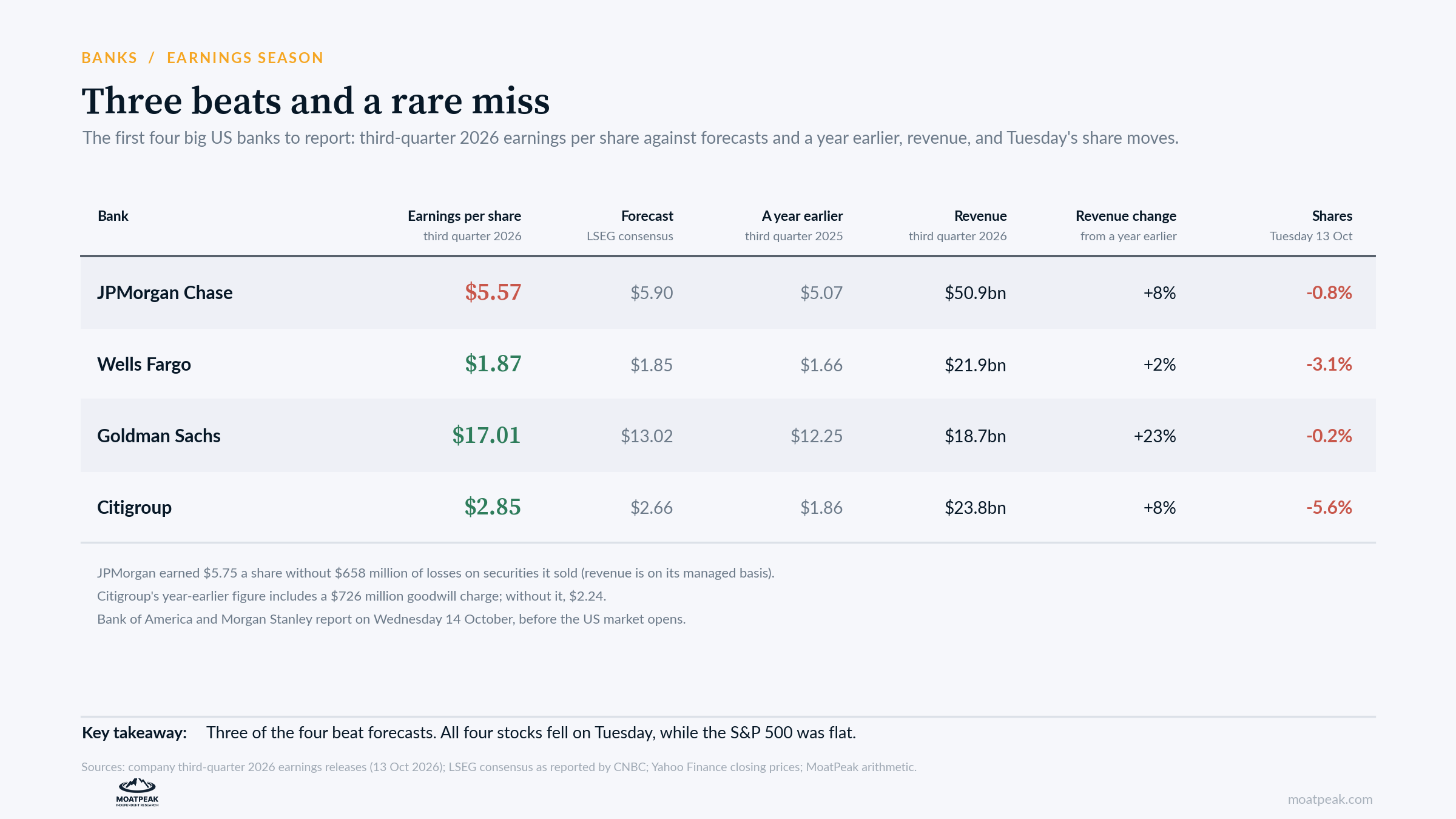
Bank earnings season opened on Tuesday with an unusual split. JPMorgan Chase, the biggest US bank, earned $5.57 a share in the third quarter, below the $5.90 analysts expected, according to LSEG. It had beaten forecasts in 16 of the previous 20 quarters, according to StreetAccount. Goldman Sachs earned $17.01 a share against a forecast of $13.02. Citigroup ($2.85 against $2.66) and Wells Fargo ($1.87 against $1.85) also beat, although Wells Fargo’s revenue came in below forecasts.
The shares told a different story. All four fell on Tuesday while the S&P 500 ended flat. Citigroup dropped 5.6 percent, Wells Fargo 3.1 percent, JPMorgan 0.8 percent and Goldman Sachs 0.2 percent, although Goldman had traded almost 4 percent higher before the open, CNBC reported. The KBW Nasdaq Bank Index fell 1.4 percent. For now, beating forecasts was not enough.
Most of the split in the results comes down to one thing. Stock trading had a huge quarter, and trading in bonds, currencies and commodities did not. Below, we go through what the four reports say about trading, about consumers and about the risks the bosses are watching.
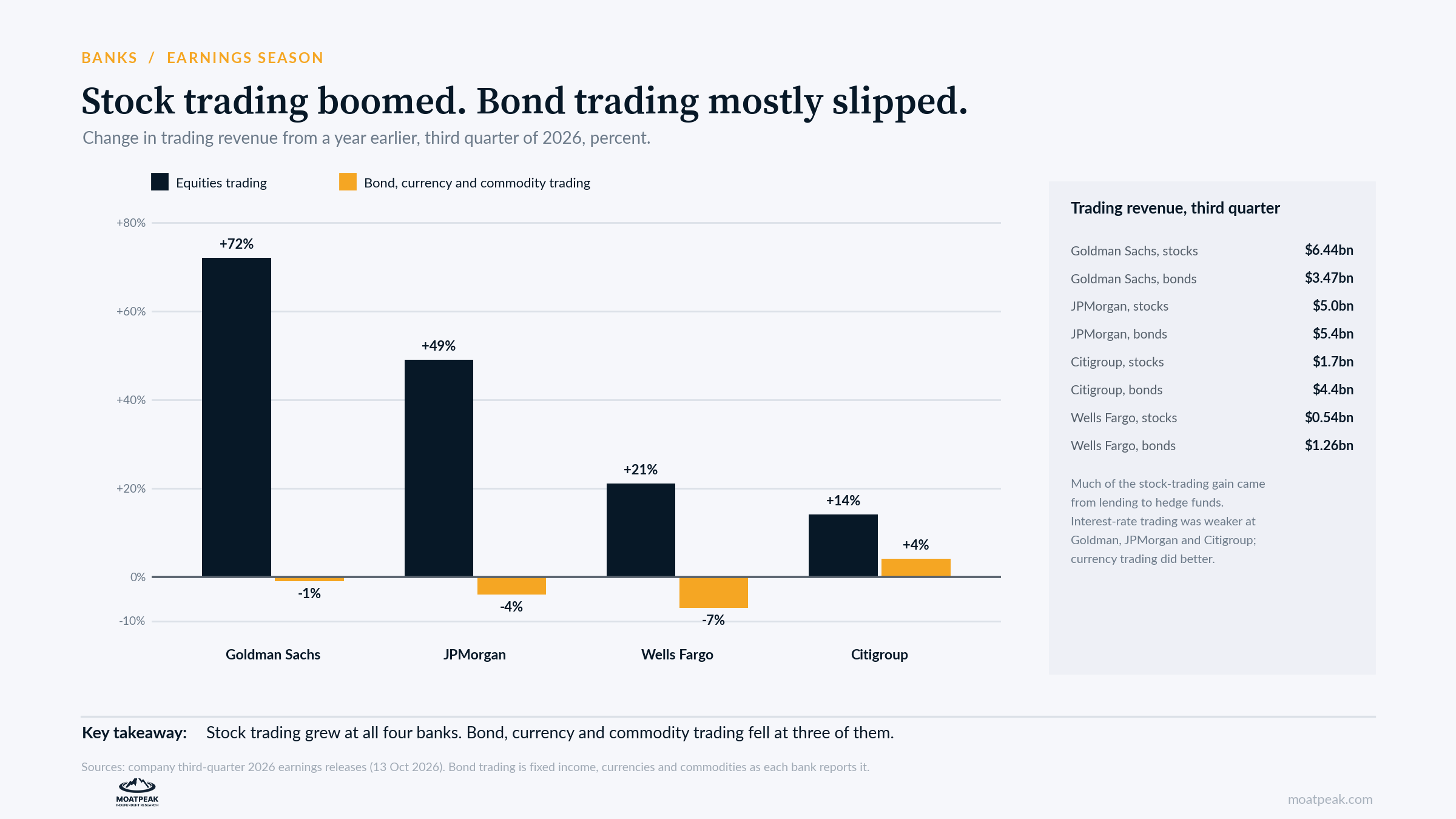
Stock trading boomed. Bond trading mostly slipped.
Revenue from trading stocks rose 72 percent from a year earlier at Goldman Sachs, 49 percent at JPMorgan, 21 percent at Wells Fargo and 14 percent at Citigroup. Much of the gain came from lending to hedge funds, a business called prime brokerage, and from derivatives. Goldman’s revenue from financing its clients’ stock trades nearly doubled.
Bond trading went the other way at three of the four. Revenue from fixed income, currencies and commodities fell 1 percent at Goldman, 4 percent at JPMorgan and 7 percent at Wells Fargo. Citigroup was the exception, with a 4 percent rise. Goldman, JPMorgan and Citigroup all said interest-rate trading was weaker, while currency trading did better.
That explains most of JPMorgan’s miss. Its bond trading revenue of $5.4 billion was about $550 million below analysts’ estimates, according to StreetAccount as reported by CNBC. Its costs also rose 12 percent while revenue rose 8 percent. On top of that, JPMorgan booked $658 million of losses on investment securities it chose to sell, which cut 18 cents from earnings per share. Without that item, it earned $5.75 a share, still below forecasts.
Consumers are still paying their bills
Credit was the good news. JPMorgan’s credit card charge-off rate, the share of card balances written off as unlikely to be repaid, fell to 2.91 percent from 3.15 percent a year earlier. Wells Fargo’s consumer charge-off rate fell to 0.70 percent, down from the second quarter. At Citigroup, net credit losses on US cards were 4 percent lower than a year earlier.
“Consumers are spending more, loan delinquencies are low, and deposit and investment balances have grown,” said Charlie Scharf, Wells Fargo’s chief executive.
The banks did set aside more money for future losses, but mostly for loans to companies. JPMorgan added $539 million to its reserves, mainly for corporate loans. Goldman’s $368 million charge for credit losses mostly reflected write-downs on corporate loans, and Wells Fargo’s commercial charge-off rate rose to 0.18 percent from 0.10 percent in the second quarter. Citigroup added $208 million to its US card reserves, “primarily driven by changes in the macroeconomic outlook.” These sums are small next to the banks’ loan books, but this is where we would look first for trouble.
Dealmaking is still growing, more slowly
Investment banking fees, which banks earn for advising on mergers and helping companies sell shares and bonds, rose 21 percent at Goldman and 14 percent at JPMorgan from a year earlier. Citigroup’s investment banking revenue rose 9 percent and Wells Fargo’s 10 percent.
Deal activity slowed during the quarter. JPMorgan’s fees were 8 percent lower than in the second quarter, and Jamie Dimon, its chief executive, said client activity “did moderate somewhat during the quarter.” Goldman said its backlog of future fees fell from the end of June. JPMorgan’s finance chief, Jeremy Barnum, said deals are being “delayed rather than canceled,” CNBC reported. Several stock market listings were put on hold in recent months, including that of smart-ring maker Oura, which cited uncertain market conditions, according to CNBC.
Higher rates are the risk on the bosses’ minds
Dimon said “large fiscal deficits, sticky inflation, elevated asset prices, rising interest rates and geopolitical conditions continue to shift under the surface.” He added: “These forces may be manageable, but we remain prepared for a wide range of outcomes.”
Scharf said “higher interest rates, higher oil prices and persistent inflation create risks to the economy,” but that investment in AI infrastructure, high employment and steady wage growth “continue to outweigh the risks.”
The 10-year Treasury yield ended September at 5.29 percent, and the Fed raised rates on 16 September to a range of 3.75 to 4 percent. When yields rise, older bonds that pay less lose value. A bank that sells them takes a loss but can reinvest the money at today’s higher rates.
Higher rates cut both ways. Dimon told reporters that a rise in rates from 5 percent to 6 percent “would be more painful than going from four to five,” while stressing that he was not predicting it, CNBC reported. Yet JPMorgan’s first look at 2027 shows how higher rates also help it. Its results presentation includes a preliminary case of about $107 billion of net interest income excluding markets, roughly what it earns on loans and bonds minus what it pays on deposits, outside its trading business. That compares with about $97 billion implied for 2026, and JPMorgan puts the growth down to a bigger balance sheet and higher rates.
JPMorgan has also nearly stopped buying back its own shares. Net buybacks fell to $664 million in the quarter, from $6.2 billion in the second quarter and $8.0 billion a year earlier. Dimon said the bank believes it can put that capital to work “over time at very attractive returns.” Goldman bought back $3.0 billion of stock and Wells Fargo $2.5 billion, and Citigroup returned $4.1 billion through buybacks and dividends.
The case against us
One quarter is a thin base. Trading revenue swings with markets, and a quarter this strong for stocks can reverse quickly if share prices fall. Credit also turns with a lag. US bankruptcy filings rose 11 percent in the first nine months of this year, according to the American Bankruptcy Institute and Epiq, even as the big banks report low losses. If unemployment rises, the consumer picture could change within a few quarters.
What it means for your money
The quarter rewarded trading. The banks that rely most on stock trading and dealmaking, like Goldman, did best. That can reverse when markets turn.
Consumers look fine for now. Card losses fell at JPMorgan and Citigroup. Watch whether Bank of America says the same on Wednesday.
Rates are the swing factor. Higher yields lift what banks earn on new loans, but they can hurt borrowers, deals and the value of bonds that banks already own.
What we are watching
14 October: Bank of America at about 12:45 Brussels time and Morgan Stanley at about 13:30, both before the US market opens. In September, Bank of America chief executive Brian Moynihan said investment banking fees were heading for a fall of more than 10 percent, with trading roughly flat, CNBC reported.
14 October, 14:30: US consumer prices for September. The Fed’s Beige Book follows at 20:00.
27 and 28 October: the Fed’s next meeting.
Educational research only. Not personalized investment advice. MB “MoatPeak Group”.