


Samsung Electronics said on 8 October that it expects an operating profit of about 107.4 trillion won for July to September, a record. Eight days later, its shares were 41 percent below their June high. SK hynix, the other big Korean memory maker, is 56 percent below its record. On Thursday, the KOSPI fell far enough to trip a circuit breaker that halted trading in Seoul for 20 minutes, and it closed 7.6 percent lower. Korea’s main index is now 38 percent below its 22 June record.
The selling has a clear shape. Memory and storage stocks all set their records between 18 and 25 June. Nvidia, AMD and TSMC set theirs on 6 October and are 6 to 19 percent below them. Taiwan’s main index is about 5 percent off its record. Investors are selling memory in particular.
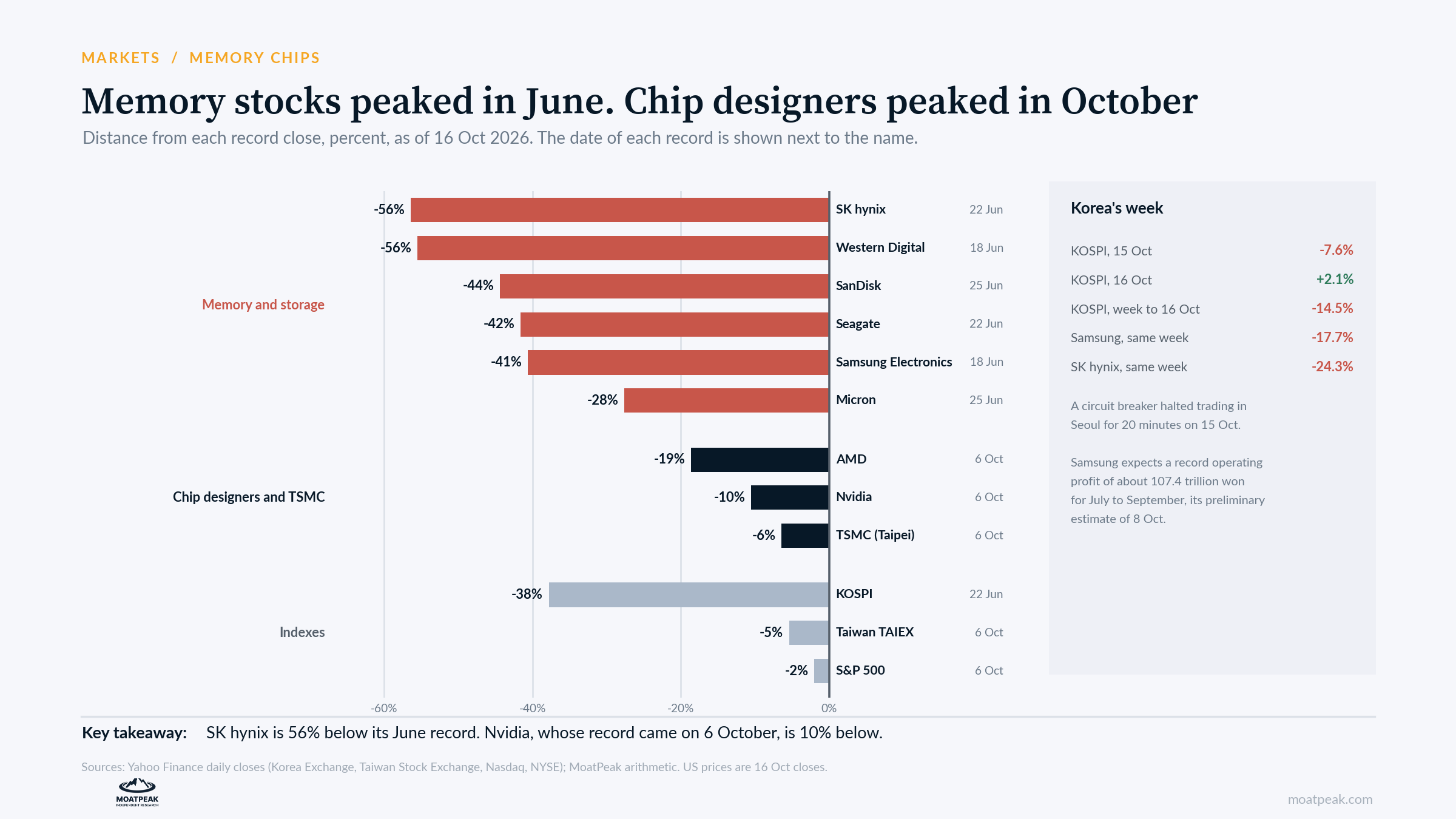
What changed this week
Two things hit Korean memory stocks at once. On 13 October, the Korea JoongAng Daily tied that day’s plunge to China’s CXMT, which plans to start making DDR5 server memory modules by the end of the year. That would bring a Chinese rival into conventional server memory, though not into HBM, the high-end memory used with AI chips. The paper also noted that the two companies’ share buybacks were ending: Samsung had completed a repurchase program for employee stock awards, and SK hynix’s buyback was nearly done.
Why record profits do not protect memory stocks
Memory chips are a commodity business. When prices are high, every maker expands, new supply arrives a year or two later, and prices fall. The stocks tend to move first.
Micron, the US memory maker, shows the pattern. Its gross margin was 86.8 percent in the quarter to 3 September, against peaks of 61.0 percent in 2018 and 47.2 percent in 2022. In both of those cycles, the shares peaked around the time the margin did, in May 2018 and January 2022. Within a year, the margin fell to 28.6 percent in the first case and to minus 32.7 percent in the second. The shares fell 54 percent and 50 percent.
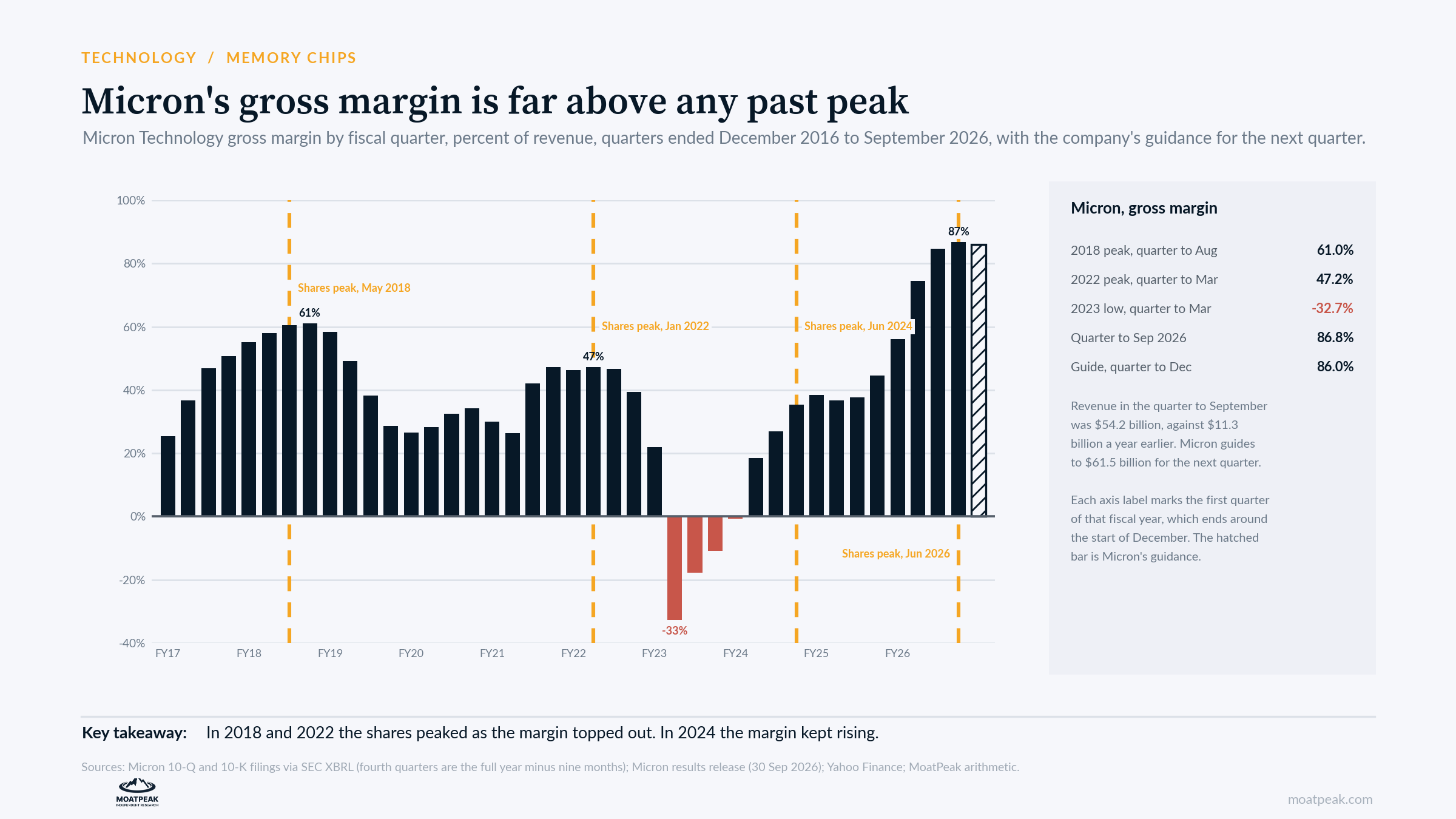
Micron’s own guidance shows the margin leveling off. It expects about 86 percent in the quarter to early December, slightly below the 86.8 percent it just reported. If that holds, it would be the first quarterly decline since the quarter to February 2025. Revenue is still rising: Micron guides to $61.5 billion, up from $54.2 billion.
The case against us
The 2024 slump is the counterexample. Micron’s shares fell 58 percent between June 2024 and April 2025, while the margin barely moved and then climbed. From that low, the shares rose nearly 19-fold to their June record. A sell-off without falling margins turned out to be a buying opportunity.
This cycle could look more like 2024. Customers are paying in advance: Micron took in $12.7 billion of customer deposits in its fiscal year to September. CXMT has yet to show it can make server memory at scale. And SK hynix has already fallen 56 percent, more than Micron’s shares fell in 2018 or 2022.
What it means for your money
Watch margins more than profits. Profits were at or near records when the last two memory slumps began. A falling margin has been the better signal.
Know what you own. Samsung and SK hynix are the two largest companies in Korea’s main index, so a Korea fund is in large part a bet on memory prices.
Separate memory from the rest of AI. Chip designers and TSMC have held up far better, and their earnings depend less on commodity chip prices.
What we are watching
28 October: SK hynix’s third-quarter results and conference call, Seoul time.
Late October: Samsung’s full third-quarter results, with figures for each business.
December: Micron’s next results, and whether the margin holds near the 86 percent it guided to.
Educational research only. Not personalized investment advice. MB “MoatPeak Group”.
Memory stocks peak when investors price in tomorrow’s profits today.