


Meta reports third-quarter results after the close on Wednesday, 21 October. Most of the attention will go to advertising growth and to how much Meta plans to spend next year. We think the number that deserves the closest look sits in the cash flow statement.
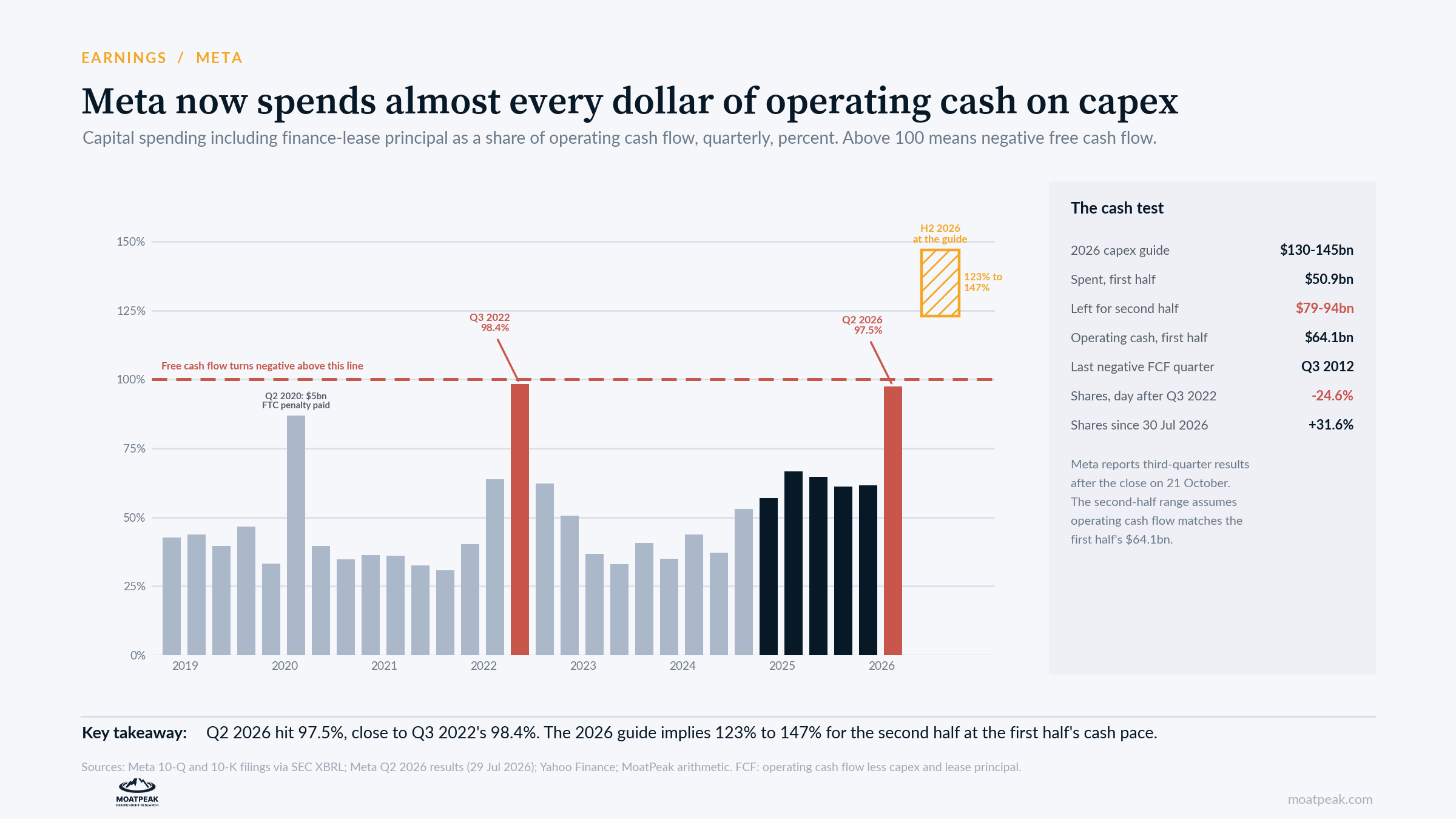
In the second quarter, Meta generated $31.9 billion of operating cash and spent $31.1 billion on capital projects, counting principal payments on finance leases. That left $784 million of free cash flow, the lowest since the third quarter of 2022. Capex absorbed 97.5 percent of operating cash. In that 2022 quarter, it absorbed 98.4 percent.
The second half is where the math gets tight
Meta’s guide for 2026 capex, including finance-lease principal, is $130 billion to $145 billion. It spent $50.9 billion in the first half, leaving $79 billion to $94 billion for the second half, or about $40 billion to $47 billion per quarter.
Operating cash flow in the first half was $64.1 billion. If the second half matches it, Meta would post negative free cash flow of roughly $15 billion to $30 billion. The company has not reported a quarter of negative free cash flow since the third quarter of 2012, its first year as a public company.
Operating cash can grow, and it has been growing: it rose 29 percent in the first half from a year earlier. To fund even the low end of the capex range without going negative, second-half operating cash would need to beat the first half by about 23 percent. At the top of the range, it would need to beat it by about 47 percent.
From buybacks to bonds
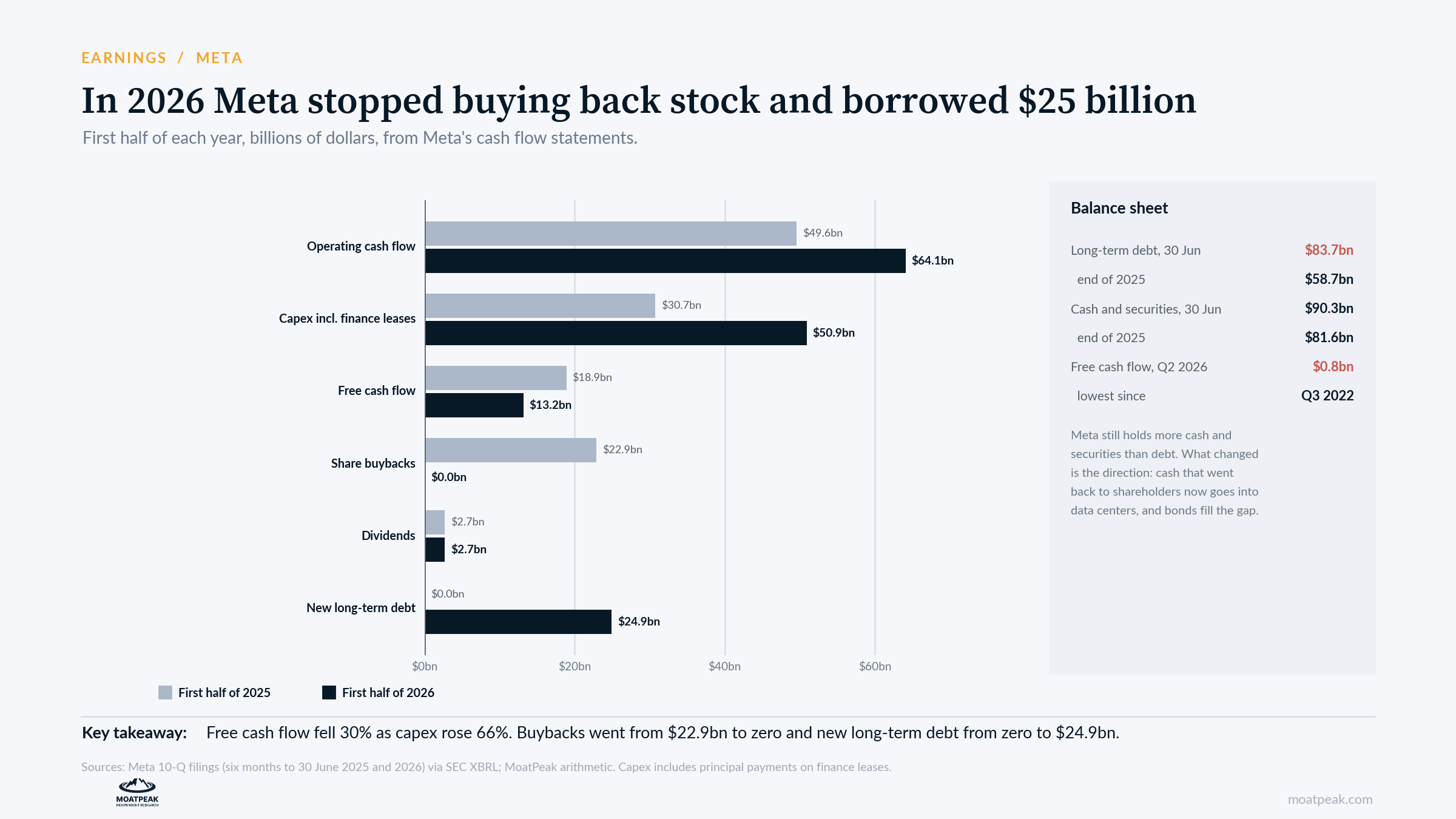
The funding has already changed. In the first half of 2025, Meta bought back $22.9 billion of its own stock and issued no long-term debt. In the first half of 2026, it bought back nothing and issued $24.9 billion of long-term debt, all of it in the second quarter. Long-term debt rose from $58.7 billion at the end of 2025 to $83.7 billion at the end of June. The dividend, $2.7 billion in each half, was untouched.
None of this is distress. Meta held $90.3 billion of cash and marketable securities at the end of June, more than its debt. What has changed is where the money is going. Cash that used to return to shareholders now funds data centers, and bond investors help fill the gap. That makes Meta’s AI build look a little more like the debt-funded build-outs at smaller AI cloud companies, which have come under heavy pressure in recent weeks, though Meta has a far stronger balance sheet.
Why the market shrugs this time
The last time capex took this much of Meta’s operating cash, in the third quarter of 2022, the stock fell 24.6 percent the day after the report. Revenue had fallen 4 percent from a year earlier, and investors saw heavy spending with no clear payoff.
This July, with capex at 97.5 percent of operating cash, the stock fell 8.0 percent the day after the report. It has since risen 31.6 percent, to $709.33 on 16 October, 10 percent below its August 2025 record. Revenue grew 28 percent in the second quarter, and the market is treating the spending as an investment that will pay.
That may prove right. But operating income fell 8 percent in the second quarter as costs and expenses rose 55 percent, and the operating margin dropped from 43 percent to 31 percent. Investors are paying for growth now and cash later.
The case against us
The growth is real. Meta has guided third-quarter revenue to $61 billion to $64 billion, 19 to 25 percent above a year earlier. If ads keep growing at that pace, operating cash flow could close much of the gap.
Some of the second quarter’s costs will not repeat, including $2.40 billion of legal charges and $1.18 billion of severance. Capex plans can also be cut quickly. Meta spent less on capex in 2023 than in 2022, and by the third quarter of 2023, capex took just 33 percent of operating cash.
Borrowing to build is also rational if the assets earn more than the debt costs. Meta’s balance sheet can carry several quarters of negative free cash flow without strain.
What it means for your money
Read the cash flow statement on Wednesday, not just the ad numbers. Third-quarter free cash flow and year-to-date capex will show how fast the second-half spending is arriving.
Treat the 2027 capex outlook as the key number. A bigger 2027 budget without faster cash growth would push negative free cash flow into next year.
Price in the funding shift. With buybacks paused, shareholders lose a source of support for earnings per share.
What we are watching
21 October, after the close: third-quarter results. Analysts expect earnings per share of $6.58, against $1.05 a year ago, when a one-time tax charge of $15.93 billion cut profit, according to FactSet.
Capex and free cash flow for the quarter, and any change to the $130 billion to $145 billion range.
Funding: new bond deals, and whether buybacks restart.
Educational research only. Not personalized investment advice. MB “MoatPeak Group”.