


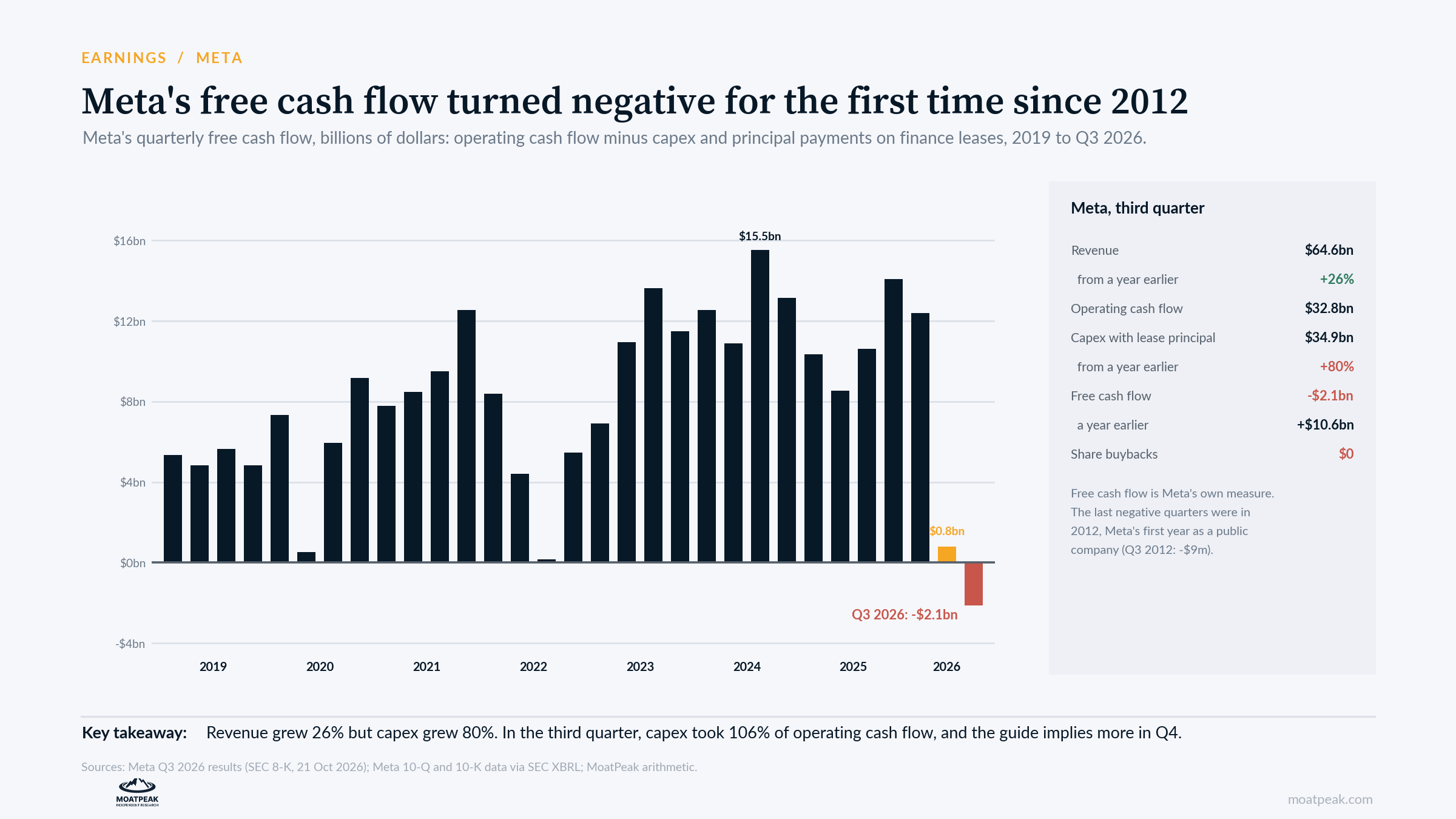
On Tuesday, we wrote that Meta’s spending plan pointed to its first negative free cash flow since 2012. It happened the next day. In the third quarter, Meta generated $32.8 billion of operating cash and spent $34.9 billion on capital projects, counting principal payments on finance leases. Free cash flow, by Meta’s own definition, was minus $2.1 billion. A year earlier, it was plus $10.6 billion.
The advertising business had a strong quarter. Revenue rose 26 percent to $64.6 billion, above the top of Meta’s guidance range. Ad impressions rose 10 percent, and the average price per ad rose 14 percent. Excluding a $9.89 billion legal charge, operating income rose 11 percent to $22.9 billion.
The trouble is the gap between those lines. Revenue grew 26 percent, operating cash flow grew 9 percent and capital spending grew 80 percent. Capex took 106 percent of operating cash in the quarter.
The fourth quarter is bigger
Meta narrowed its 2026 capex guide to $135 billion to $145 billion, from $130 billion to $145 billion. It spent $85.8 billion in the first nine months. That leaves $49.2 billion to $59.2 billion for the fourth quarter, 1.4 to 1.7 times the third quarter’s spending.
Operating cash flow in the fourth quarter of 2025 was $36.2 billion. If it grows 9 percent this year, as it did in the third quarter, fourth-quarter free cash flow would land between about minus $10 billion and minus $20 billion. That’s our arithmetic, not Meta’s forecast.
Two items could make the cash picture weaker than the reported numbers. The legal charge relates to an agreement with 52 attorneys general over teen mental health and social media, which provides for payments of up to about $18.59 billion. The charge cut third-quarter profit, but Meta’s balance sheet suggests most of the payments are still ahead. At the end of June, Meta also had $19.5 billion of capital spending it had booked but not yet paid for, up from $9.3 billion at the end of 2025.
The funding has already changed
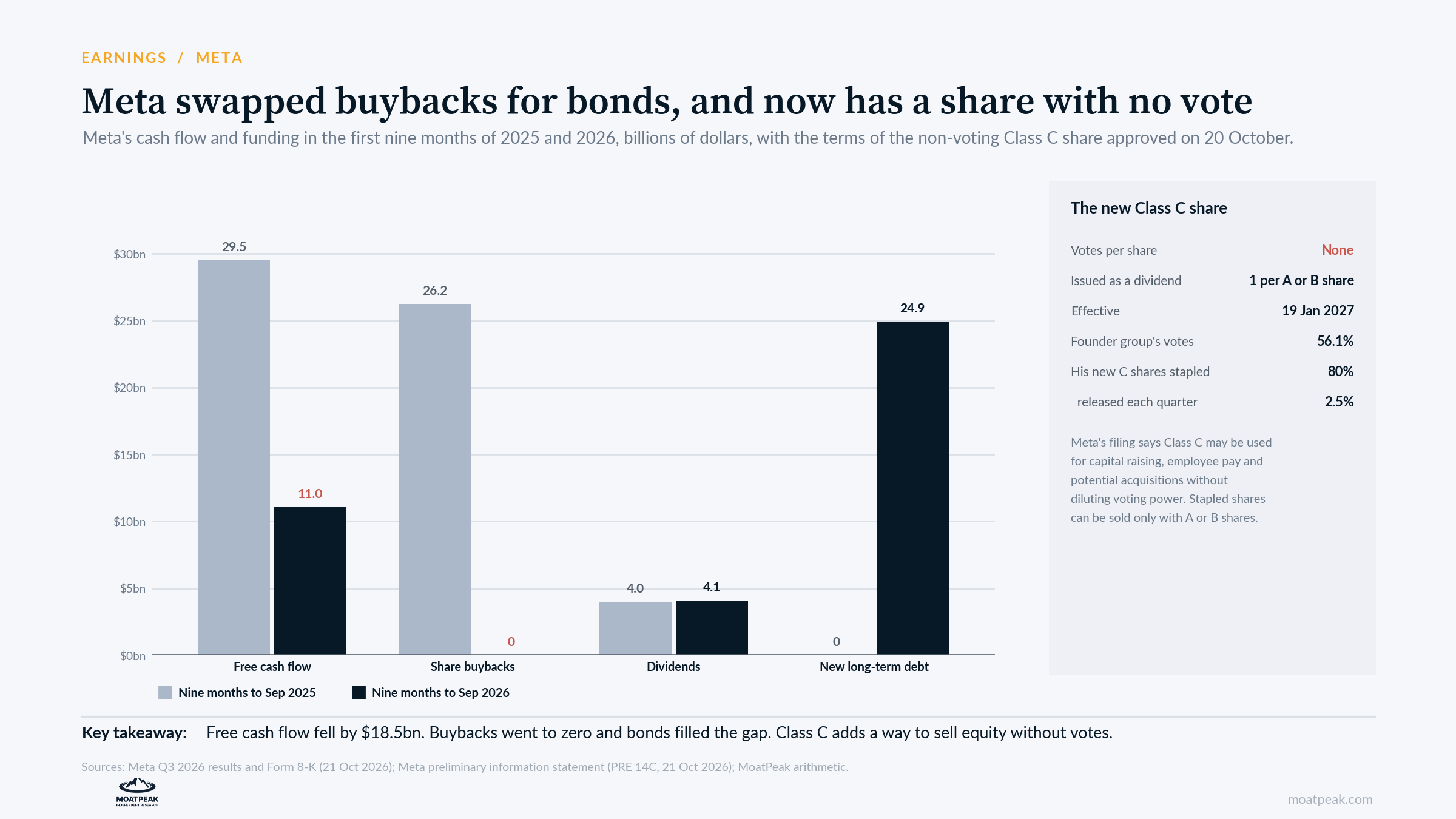
In the first nine months of 2025, Meta bought back $26.2 billion of its stock and issued no long-term debt. In the first nine months of 2026, it bought back nothing and raised $24.9 billion of long-term debt, all in the second quarter. Cash and marketable securities fell to $82.5 billion at the end of September, from $90.3 billion three months earlier. Long-term debt was $80.9 billion, against $58.7 billion at the end of 2025.
None of this is distress. Meta still holds more cash than long-term debt, and its ads are growing fast. But the order of events is clear. Buybacks stopped, and bonds filled the gap. Now free cash flow is negative.
The share class is the bigger news
On 19 October, two days before the results, Meta’s board approved a new class of non-voting Class C stock. Every Class A and Class B shareholder will receive one Class C share for each share they own once the change takes effect on 19 January 2027. Economically, it works much like a two-for-one split. Mark Zuckerberg and entities he controls, which hold about 56.1 percent of the votes, approved it by written consent on 20 October.
Most coverage will treat this as a governance story. We read it as a funding decision. Meta’s information statement says the new shares may be used for “capital raising, employee compensation, potential acquisitions” and other corporate purposes, without diluting the voting power of existing shares. It is also frank about the trade-off. Issuing more Class A stock would dilute both economic and voting interests, and the voting dilution cannot be mitigated “absent a significant use of cash or the creation of a new class of non-voting shares.”
The structure does not look like a quiet exit for the founder. Under a separate agreement, 80 percent of the Class C shares Zuckerberg receives can be sold only if he also sells or converts an equal number of his voting shares. That restriction lifts by 2.5 percent a quarter while he stays in charge. So the main user of the new currency is likely to be the company itself.
Why it matters for shareholders
Creating a share class is not the same as selling it, and Meta has announced no offering. Still, the sequence is hard to ignore. Since 2017, buybacks have cut Meta’s diluted share count by about 13 percent. Now the buybacks have stopped, free cash flow has turned negative and Meta says it will keep “investing aggressively” in 2027. If capex keeps outrunning cash flow, the next source of money could add shares instead of retiring them. Non-voting shares still dilute your claim on profits. They just leave control where it is.
The case against us
The spending is paying off in the core business. Higher ad prices and more impressions suggest AI is making Meta’s ads more valuable, and Meta expects fourth-quarter revenue of $73 billion to $76 billion. Cash of $82.5 billion and an open bond market could fund several quarters of negative free cash flow without any new equity.
Class C may also be used mostly for employee pay, in place of Class A grants. That would protect control without adding any economic dilution beyond what stock pay already causes. And capex plans can change quickly. Meta spent less on capex in 2023 than in 2022, after investors punished its spending.
What it means for your money
Read the cash flow statement first. Meta’s revenue beat its own guidance, but its free cash flow, the money that funds buybacks and dividends, turned negative.
Treat the share count as a variable again. A share class designed in part for raising capital makes issuing equity easier. Meta’s diluted share count, about 2.57 billion, is worth checking every quarter.
Separate votes from value. If Meta issues Class C stock, existing holders keep their votes but own a smaller slice of the profits.
What we are watching
Meta’s 10-Q, usually filed about a week after results: unpaid capital spending at 30 September and any detail on the timing of the attorneys general payments.
19 January 2027: the Class C share takes effect, with the stock dividend paid within five business days.
Meta’s fourth-quarter results, expected in late January: fourth-quarter capex and free cash flow, and the first 2027 capex guide.
Any registration statement for Class C shares, the first sign that Meta plans to sell some.
Educational research only. Not personalized investment advice. MB “MoatPeak Group”.