


On Wednesday we argued that Microsoft’s depreciation bill mattered more than Azure’s growth rate. The results gave both sides of that argument something to point to.
The growth was there. Revenue rose 19 percent to $92.3 billion in the quarter to 30 September. Azure revenue grew 48 percent, or $10.8 billion. Operating income rose 21 percent, and the operating margin reached 49.8 percent.
So was the bill. Capital spending more than doubled to $39.4 billion, and free cash flow fell 27 percent to $18.6 billion. Depreciation, amortization and other noncash charges rose 44 percent to $11.7 billion.
The most revealing numbers, though, sit in two notes to the 10-Q that rarely make the headlines.
Two promises, moving apart
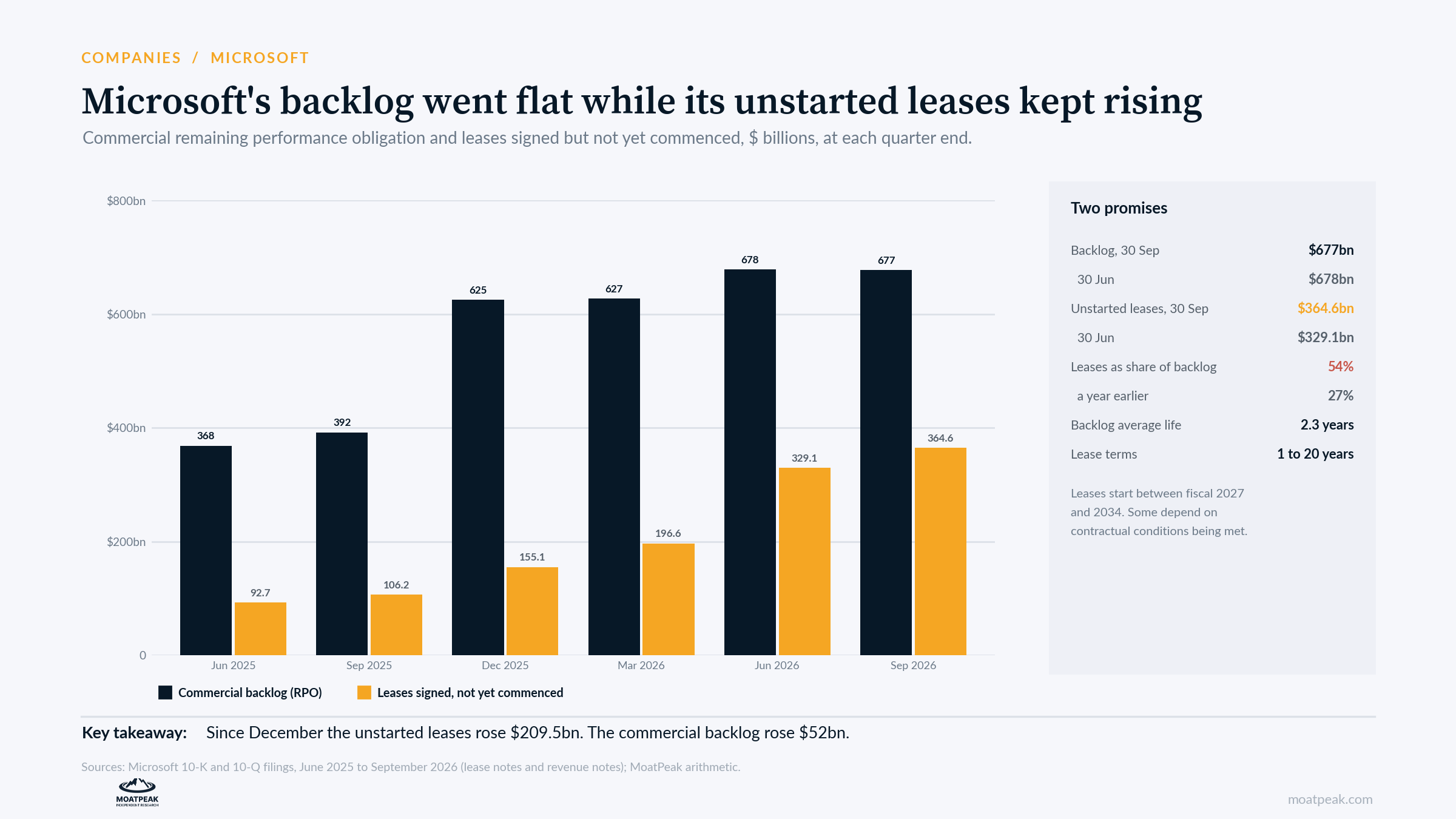
The first is the commercial remaining performance obligation: revenue customers have contracted for that Microsoft has not yet recognized. It stood at $677 billion on 30 September, against $678 billion at the end of June. It is still up 73 percent from a year ago, but most of that came in one quarter: the backlog jumped $233 billion in the three months to December 2025. Since then, it has grown by $52 billion.
The second is in the lease note. Microsoft reports “additional leases, primarily for datacenters, that had not yet commenced.” These are leases it has signed but that have not started, so they are not yet on the balance sheet. They rose to $364.6 billion from $329.1 billion in three months, and from $106.2 billion a year earlier. Since December, they have grown by $209.5 billion.
For every dollar customers added to the backlog since December, Microsoft committed about four dollars of future lease payments. The unstarted leases now equal 54 percent of the commercial backlog, up from 27 percent a year ago.
The time frames don’t match
The two numbers measure different things. One is revenue Microsoft expects to earn; the other is rent it has agreed to pay. The key difference is how long each one lasts.
Microsoft expects to recognize about 30 percent of its backlog as revenue in the next 12 months, and the commercial backlog has a weighted average life of about 2.3 years. The leases run from 1 to 20 years and start between fiscal 2027 and fiscal 2034. Since June, the lease note has added that some arrangements are “subject to certain contractual conditions being met.”
The scale is new, too. On leases that have already started, Microsoft owes $128.3 billion of future payments. The leases waiting to start are 2.8 times that amount.
In plain terms, Microsoft is locking in costs that run for many years against revenue promises that mostly run for two or three. That works as long as customers keep renewing and expanding their contracts. If they slow down, the rent still comes due.
The cash is already tight
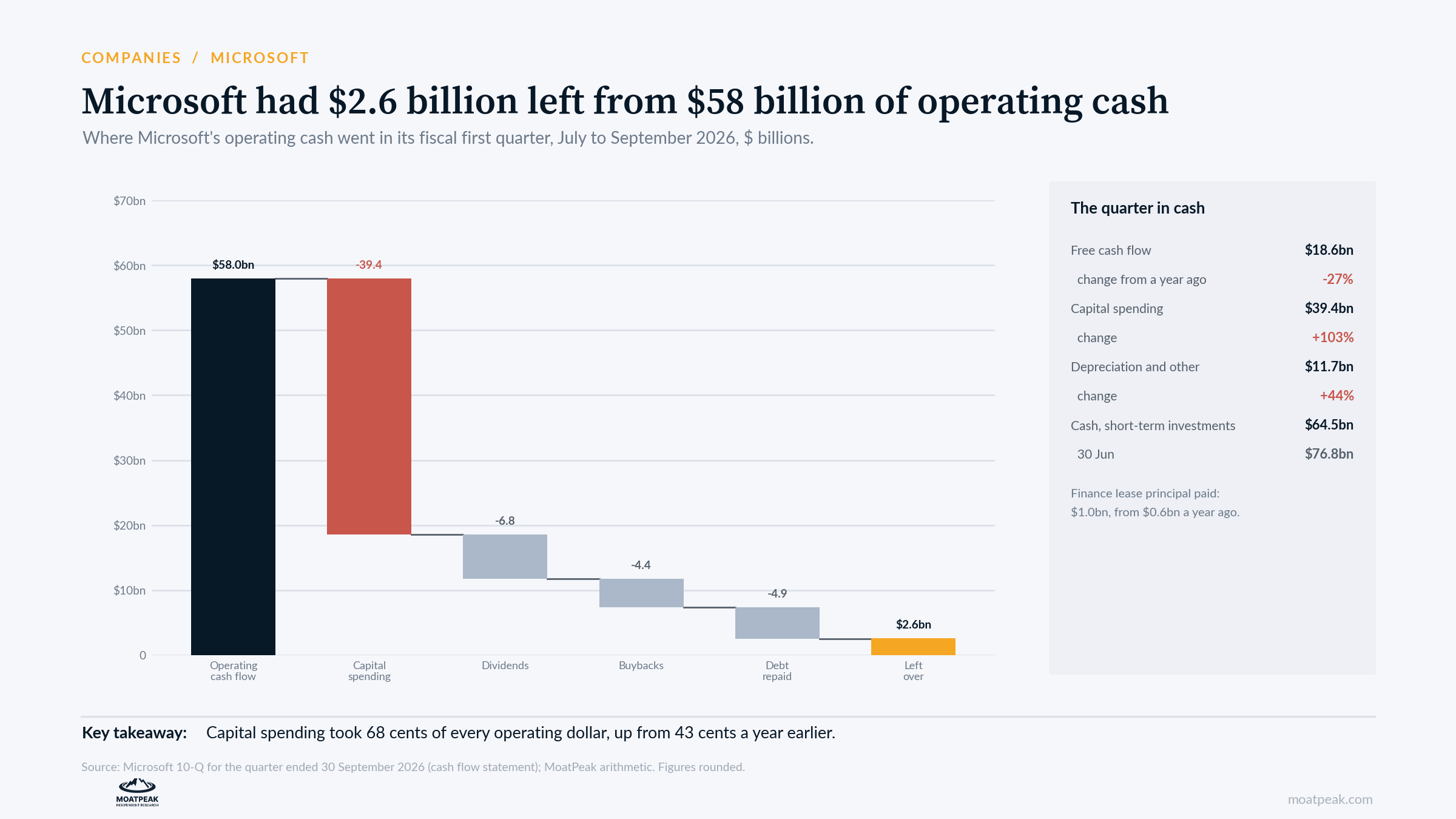
Microsoft generated $58.0 billion of operating cash in the quarter. Capital spending took $39.4 billion, dividends $6.8 billion and buybacks $4.4 billion, and $4.9 billion went to repay debt. That left $2.6 billion. Cash, cash equivalents and short-term investments fell to $64.5 billion from $76.8 billion at the end of June.
Capital spending absorbed 68 cents of every operating dollar, up from 43 cents a year earlier. Even that understates the build, because leased data centers show up as payments spread over many years. Interest and principal on finance leases already reached $1.8 billion in the quarter, up from $1.2 billion. Most of the leases Microsoft has signed have not started yet.
Our read
Microsoft is still the strongest business in the AI build. A 49.8 percent operating margin and a $677 billion commercial backlog are hard to argue with, and Azure is growing at 48 percent.
But the risk has changed shape. A year ago, the question was how much Microsoft would spend. Today, a growing share of that spending is already contracted, through leases of up to 20 years, many of which have yet to begin. A capital budget can be cut in a quarter. A signed lease cannot.
One flat quarter for the backlog does not make a trend. Large contracts arrive in lumps, and the backlog rose $51 billion in the June quarter alone. What matters is the direction of the two lines. If lease commitments keep growing faster than contracted revenue, Microsoft is taking more of the AI demand risk onto its own books.
The case against us
The leases may simply be capacity for demand Microsoft already sees. With Azure growing 48 percent, the company has every reason to lock in data center space early, before competitors do.
Our comparison mixes revenue with costs over different time frames. Twenty years of rent can be covered by many renewals of two-year contracts, and Microsoft’s commercial customers have renewed for decades.
The backlog figure is lumpy. A single large contract in the December quarter could restore its growth.
And the balance sheet can carry a great deal. A company that generates $58 billion of operating cash a quarter can absorb a lot of rent.
What it means for your money
Track two lines, not one. Each quarter, compare the change in commercial backlog with the change in leases not yet commenced. Both are in the 10-Q.
Count leases as spending. Cash capital spending understates the build when a growing share of it arrives through leases.
Watch the cash balance. Cash and short-term investments fell $12.3 billion in a single quarter.
What we are watching
Late January: Microsoft’s fiscal second-quarter report. We want to see whether the backlog resumes growth and whether unstarted leases keep rising.
Lease starts in fiscal 2027: as they begin, they move onto the balance sheet and into the cost base.
Educational research only. Not personalized investment advice. MB “MoatPeak Group”.