


On Monday, Microsoft opened a voluntary exit offer to employees at level 70 and below in participating teams in the United States, Canada, the UK and India. Seattle’s public radio station KUOW reports that about 60,000 people are eligible, roughly a quarter of the 223,000 people Microsoft employed at the end of June. According to KUOW, a company spokesperson said AI is not driving the offer.
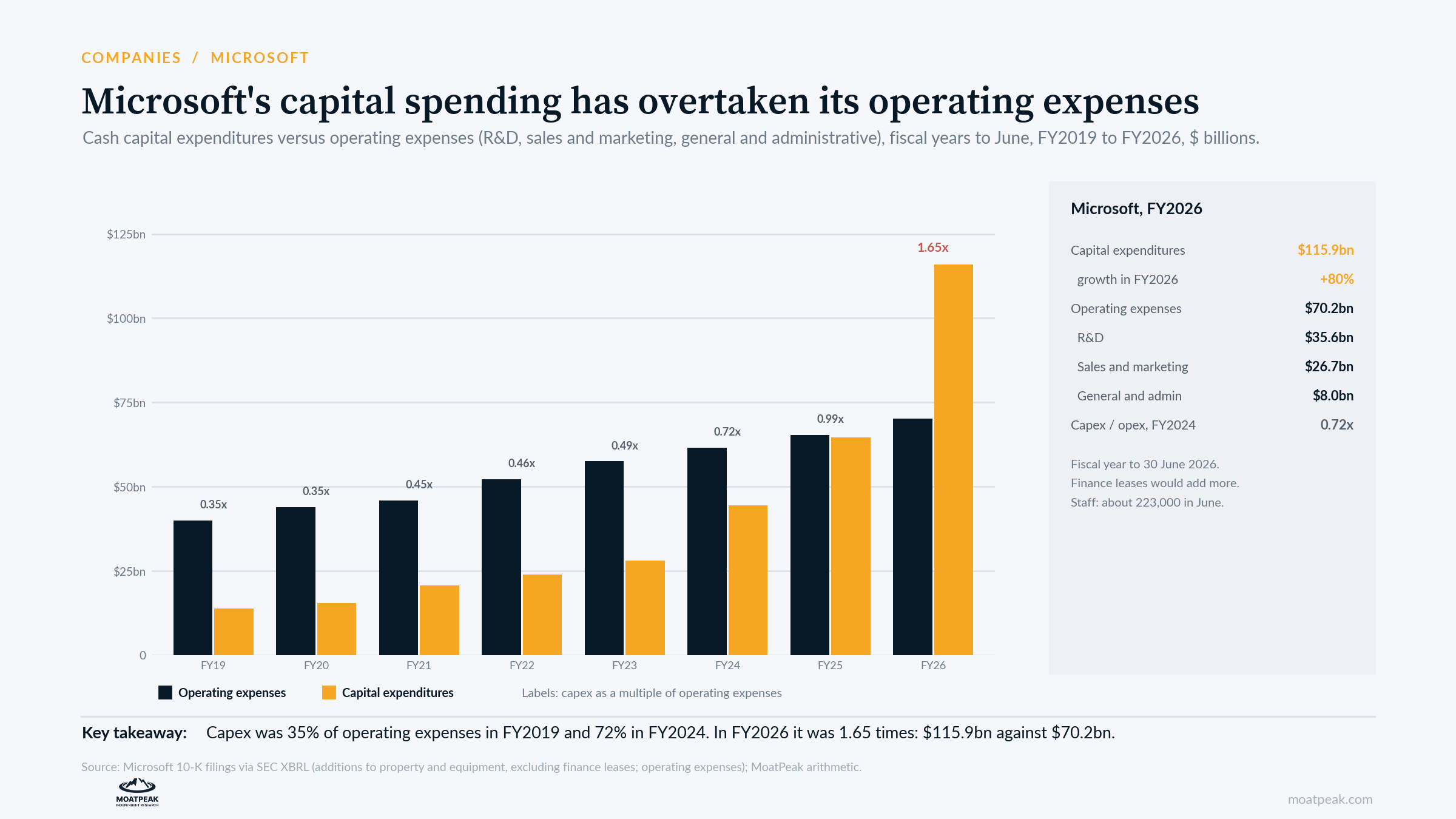
Whatever the motive, Microsoft’s own accounts show where the money is going. In the fiscal year to June, the company spent $115.9 billion on property and equipment, 80 percent more than a year earlier. Its operating expenses, which cover research, sales and administration, came to $70.2 billion. Capital spending was 1.65 times operating expenses, compared with 0.72 times in fiscal 2024 and 0.35 times in fiscal 2019.
The bill arrives later
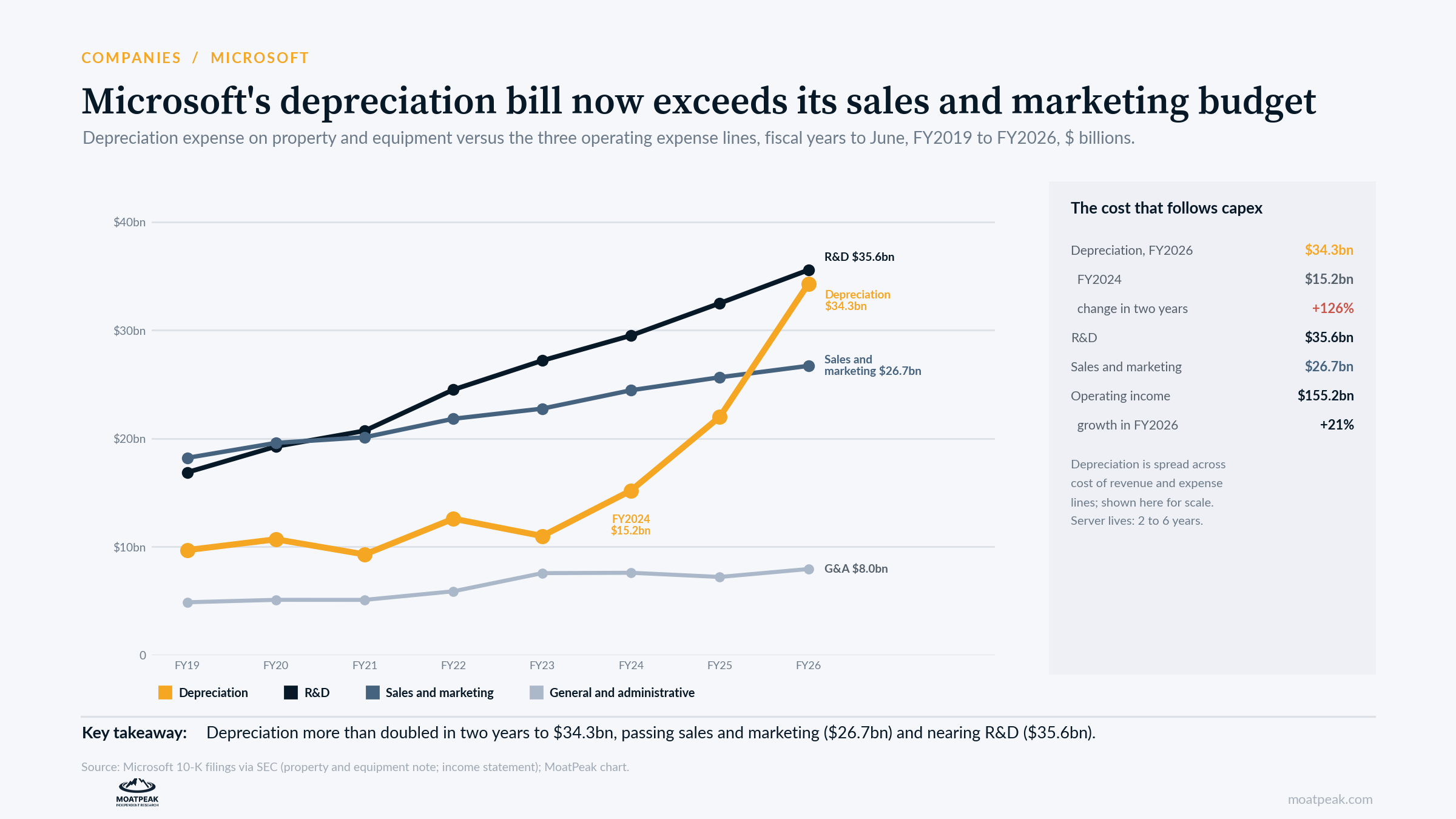
Capital spending affects profits gradually, because depreciation spreads its cost over the assets’ useful lives. According to its annual report, Microsoft depreciates servers over two to six years.
That bill has become significant. Depreciation expense rose from $15.2 billion in fiscal 2024 to $34.3 billion in fiscal 2026, more than doubling in two years. It now exceeds Microsoft’s entire sales and marketing budget of $26.7 billion and is close to its $35.6 billion research budget.
Depreciation is still rising. Quarterly capital spending rose through the year, from $19.4 billion in the September quarter to $35.8 billion in the June quarter. Most of that equipment will be depreciating for years.
Record profit, less free cash
So far, profits have held up. Operating income rose 20.8 percent to $155.2 billion in fiscal 2026, outpacing 17.8 percent revenue growth. Operating cash flow rose 34 percent to $182.9 billion.
Free cash flow went the other way. After capital spending, it fell 6.5 percent to $67.0 billion, from $71.6 billion a year earlier. Capital spending absorbed 63 percent of operating cash flow, up from 47 percent. Dividends and buybacks took $48.7 billion, or 73 percent of the remainder.
At Monday’s closing price of $532.60, Microsoft’s market value was about $3.95 trillion, or 59 times its fiscal 2026 free cash flow. That is a free cash flow yield of about 1.7 percent, against roughly 5 percent on 10-year Treasuries.
Our read
Investors are debating whether AI demand justifies Microsoft’s spending. A nearer question is who pays for the depreciation while revenue catches up. Profit margins hold only if the rest of the cost base grows slowly, and so far it has: operating expenses rose 7.4 percent last year, while revenue grew 17.8 percent. Headcount fell from 228,000 to about 223,000.
An exit offer open to about a quarter of the workforce fits the same arithmetic, whatever the stated reason. Machines are taking a larger share of every dollar Microsoft spends, and the rest of the budget is making room.
The case against us
If AI demand is as strong as Microsoft expects, today’s spending becomes tomorrow’s revenue, and depreciation is simply the cost of growth.
Margins have not suffered yet. Operating income grew faster than revenue in fiscal 2026.
The exit offer is voluntary and builds on an earlier retirement program. The company says AI is not the reason, and far fewer than 60,000 people may accept. KUOW reports that about 30 percent of those eligible took the earlier retirement offer.
What it means for your money
Look past the Azure growth rate. Capital spending, depreciation and free cash flow now say more about Microsoft’s returns.
Check the yield. With a free cash flow yield of about 1.7 percent, Microsoft’s valuation depends on future growth.
Watch the payout. Dividends and buybacks used 73 percent of free cash flow last year. If free cash flow keeps falling, that share rises.
What we are watching
Wednesday 28 October, after the close: Microsoft’s results for the September quarter, especially capital spending, depreciation and operating expenses.
Thursday 29 October: Amazon’s third-quarter results, the next read on cloud spending.
Educational research only. Not personalized investment advice. MB “MoatPeak Group”.
On who pays while revenue catches up: some of it is already contracted. Anthropic's S-1 commits it to at least $44.9B of spend with Microsoft between November 2026 and May 2033, regardless of actual usage, and it can only cancel if Microsoft breaches or doesn't deliver a tranche. So a slice of the future revenue behind that depreciation is a fixed minimum, not a forecast.
I work at Equibles and we checked the S-1's commitments against Microsoft's and the other partners' filings here: https://equibles.com/research/anthropics-s-1-checked-against-amazon-google-microsoft-and-broadcom-filings