


On Thursday, Freddie Mac said the average 30-year fixed mortgage rate rose to 7.40 percent. It was the seventh weekly rise in a row and the highest rate since November 2023. A year ago, the rate was 6.30 percent. In late February, just before the US-Israeli strikes on Iran began, it was 5.98 percent, the lowest since September 2022.
Many people think mortgage rates follow the Federal Reserve. This year shows why that is mostly wrong, and why it matters if you are buying a home, thinking about refinancing or holding housing stocks.
What really sets your mortgage rate
The Fed controls short-term interest rates. Since February, it has raised its target range once, by a quarter point, to 3.75 to 4 percent in September.
A 30-year mortgage is a long loan, so lenders price it off a long-term rate: the yield on the 10-year Treasury note. The mortgage rate usually sits about 2 points above that yield. The gap covers the lender’s costs and risks, and it has barely changed this year.
What has changed is the 10-year yield. Since late February, its weekly average has risen about 1.2 points, from 4.02 percent to 5.26 percent. The mortgage rate rose about 1.4 points. The Fed moved a quarter point.
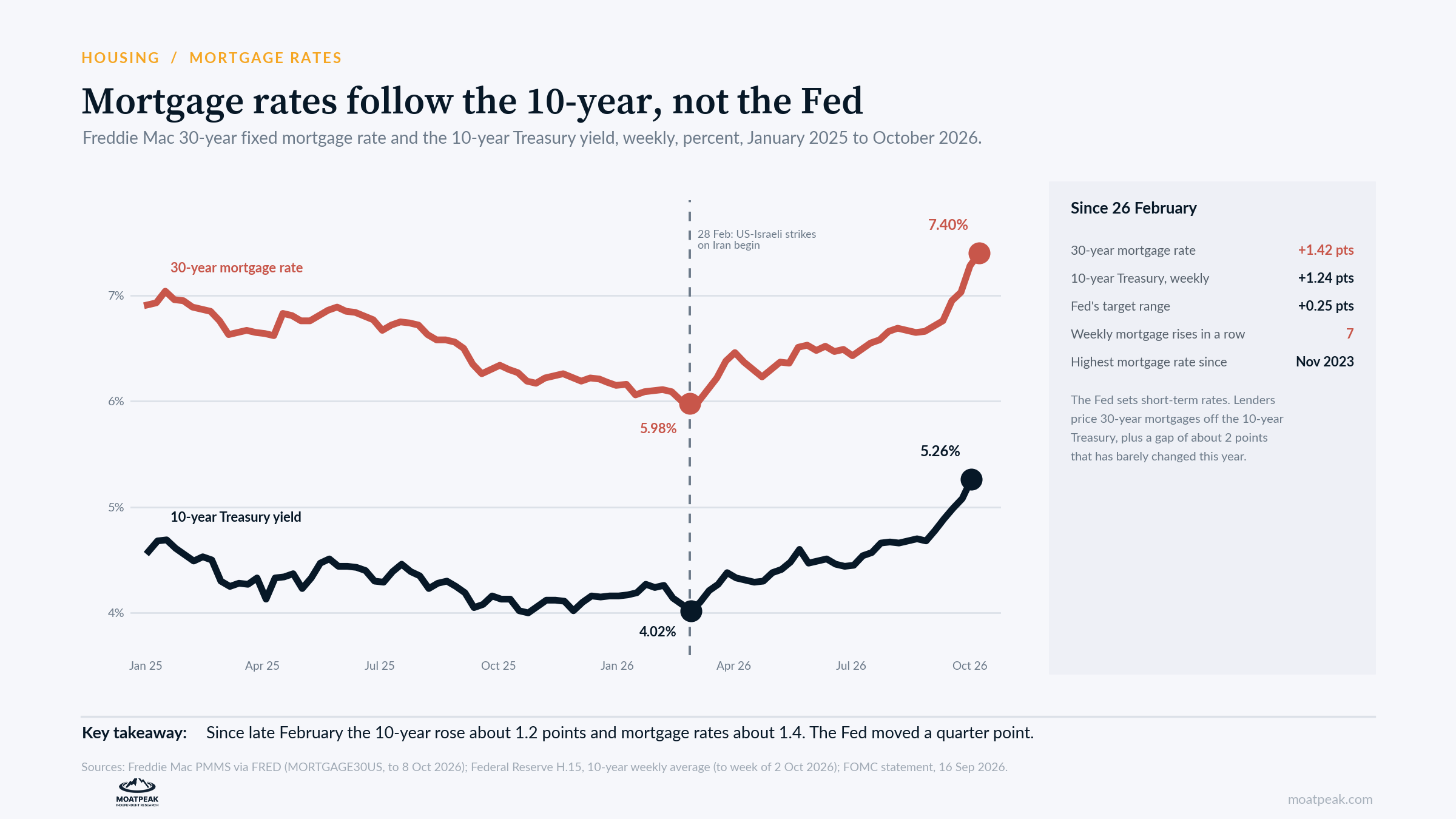
So the thing to watch is not the Fed’s next move. It is where the 10-year yield goes.
What the rise costs
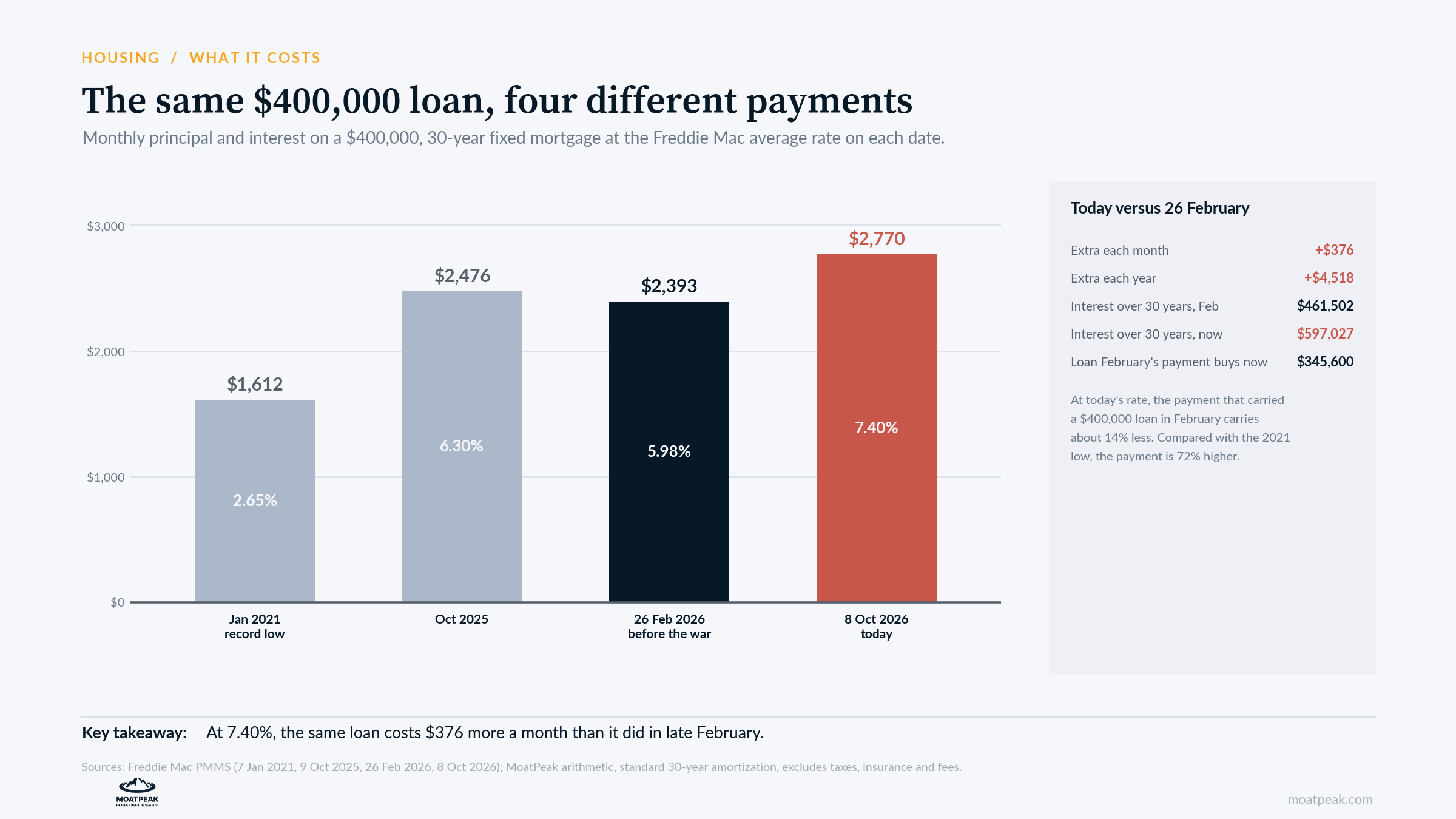
Take a $400,000 loan over 30 years. At February’s rate of 5.98 percent, the monthly payment for principal and interest was $2,393. At 7.40 percent, it is $2,770. That is $376 more every month, or about $4,500 a year, for the same loan.
Over the full 30 years, the total interest rises from about $462,000 to about $597,000.
Put another way, the monthly payment that carried a $400,000 loan in February now carries a loan of about $346,000. A buyer with a fixed monthly budget can borrow about 14 percent less. Compared with the record low of 2.65 percent in January 2021, the payment on the same loan is 72 percent higher.
These figures leave out taxes, insurance and fees.
Who is feeling it
Borrowers are stepping back. The Mortgage Bankers Association said refinance applications fell 8 percent in the week to 2 October and were 56 percent lower than a year earlier. Purchase applications were 15 percent below their level a year ago. The association’s own measure of the 30-year rate rose to 7.49 percent, the highest since November 2023.
“Very few homeowners have an incentive to refinance at these rates, and the jump in borrowing costs has caused many potential borrowers to step back from the purchase market,” said Joel Kan, the association’s deputy chief economist.
What would bring rates down
Mortgage rates will fall when the 10-year yield falls. Right now, three forces are pushing that yield up.
Inflation worries. In the New York Fed’s September survey, households said they expect prices to rise 3.9 percent over the next year, the highest since May 2023.
More Fed hikes. Minutes of the Fed’s September meeting show that most officials thought another increase would likely be appropriate by the end of the year. The next meeting is on 27 and 28 October.
Heavy borrowing. Reuters points to more Treasury issuance and heavy borrowing by tech giants to pay for the AI build-out. On Thursday, the Treasury sold 30-year bonds at 5.618 percent, the highest yield at a 30-year auction since 2000.
Forecasters keep expecting relief. Strategists in a Reuters poll this week put the 10-year yield at 5.00 percent by the end of the year. But the same poll shows that they have underestimated its rise in nine straight monthly surveys this year.
The case against us
Rates can fall quickly. If the war ends, oil prices drop or the economy slows sharply, the 10-year yield could fall and take mortgage rates with it. It has happened before: in late October 2023, the 30-year rate peaked at 7.79 percent. By mid-December, it was 6.95 percent.
Our point is not that rates must keep rising. It is that the Fed is the wrong thing to watch.
What it means for your money
Watch the 10-year yield, not the Fed. This year, mortgage rates have moved with the 10-year, about 2 points above it.
Think in payments, not rates. On a $400,000 loan at today’s level, each 1-point move in the rate changes the monthly payment by about $270.
Refinancing later is not guaranteed. Buying now and refinancing later only works if long-term yields fall, and refinancing costs money.
If you own housing stocks, track the same numbers. The 10-year yield and the weekly mortgage data say more about housing demand than the Fed’s next move.
What we are watching
Every Wednesday: mortgage applications from the Mortgage Bankers Association.
Every Thursday: Freddie Mac’s weekly mortgage rate.
14 October: US consumer prices for September.
27 and 28 October: the Fed’s next meeting.
Educational research only. Not personalized investment advice. MB “MoatPeak Group”.