


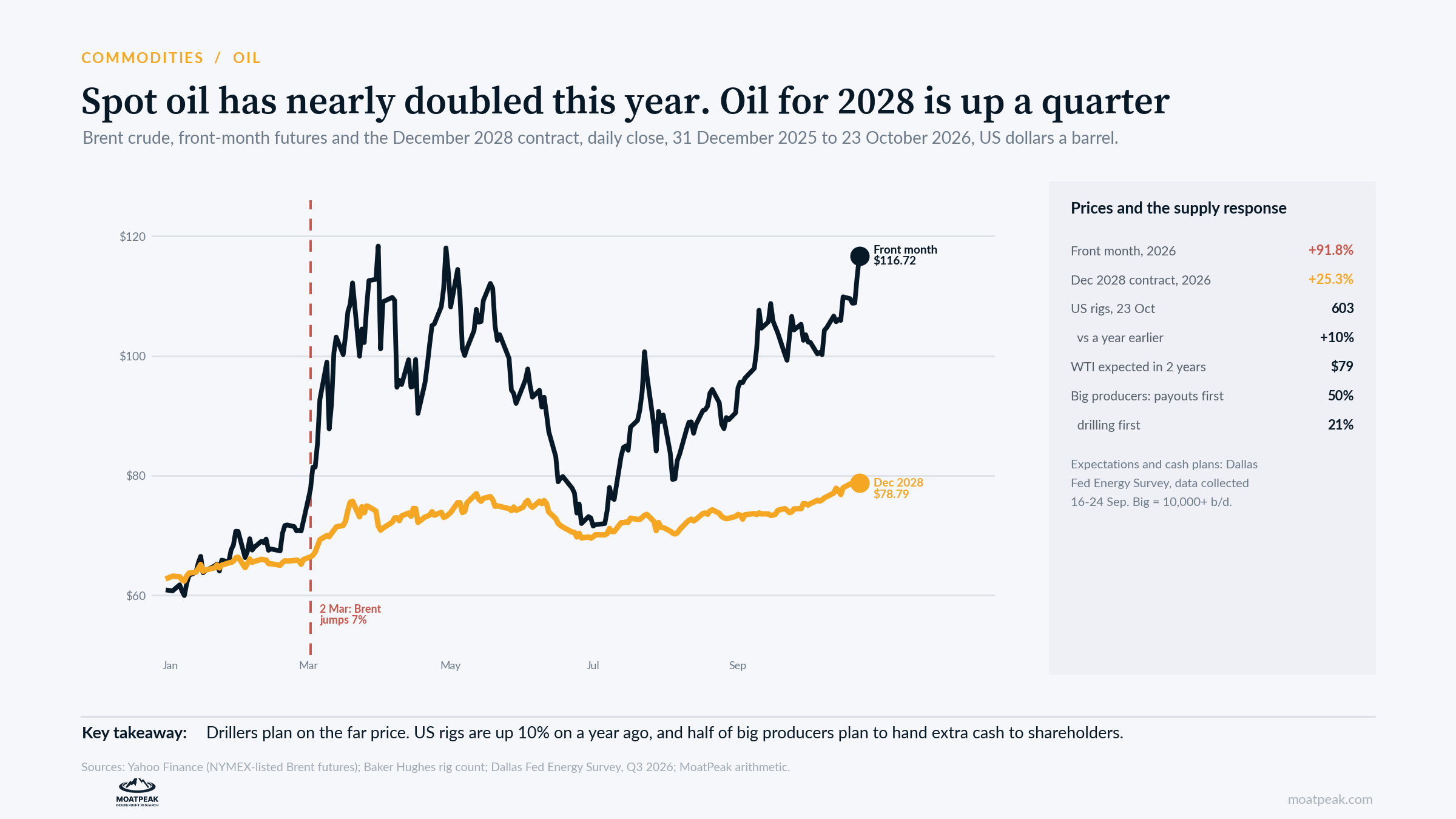
Brent crude closed at $116.72 a barrel on Friday, up 92 percent this year and close to its March high of $118.35. US crude finished at $103.27. The shock is spreading through the economy. In S&P Global’s October survey, companies said oil-based inputs, energy, fuel and freight pushed their costs higher, and they raised selling prices at the fastest rate since August 2022.
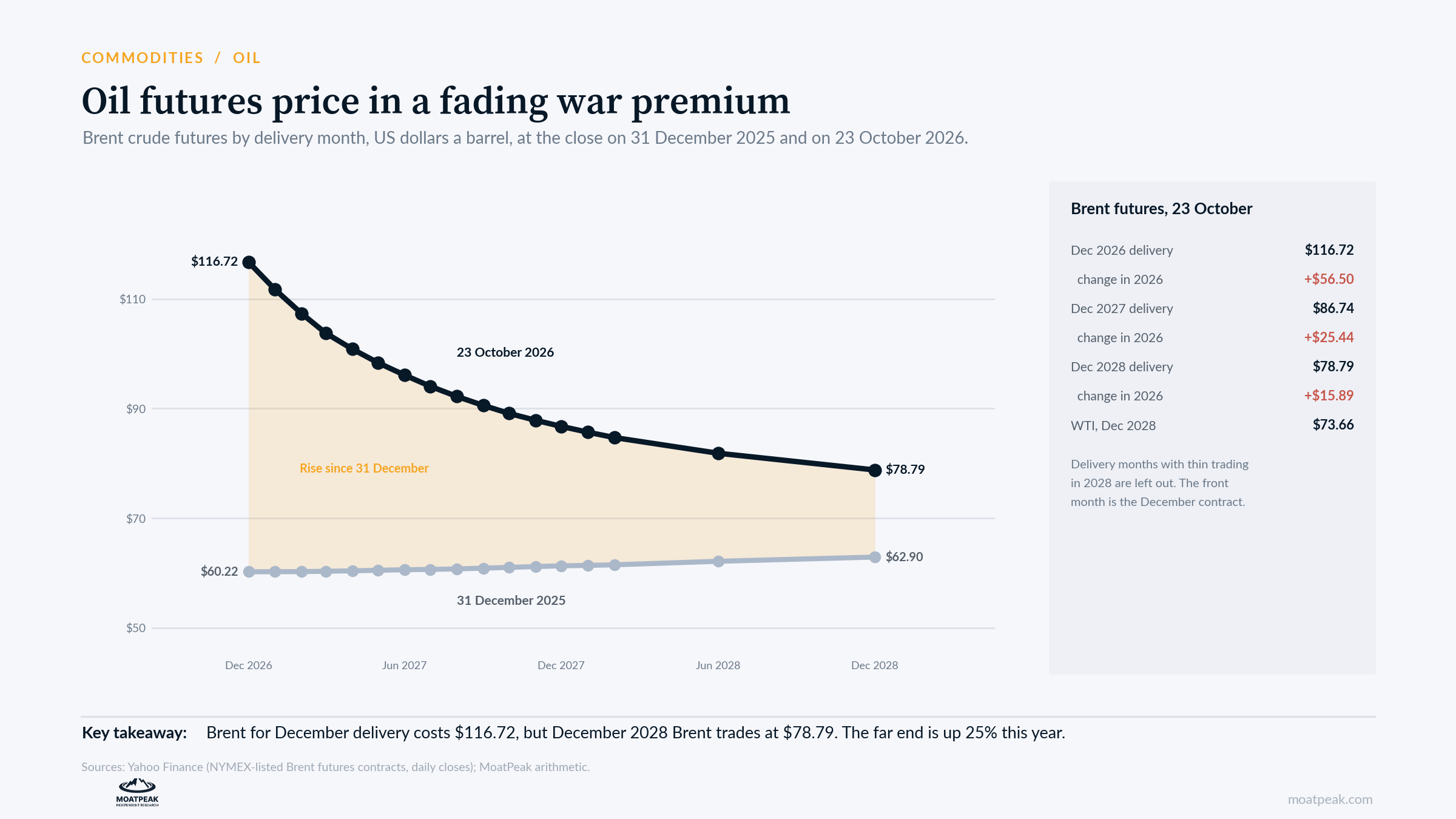
The futures market tells a different story about what comes next. Brent for delivery in December 2027 trades at $86.74 a barrel, and December 2028 Brent at $78.79. At the end of last year, every contract from this December through December 2028 traded between $60 and $63. Since then, the price for this December has climbed $56.50, while December 2028 has risen $15.89.
A curve like this tells drillers to wait
A steep downward slope means the market expects today’s shortage to ease. For a shale producer, that matters more than the spot price. A new well takes months to plan, drill and connect, and much of its oil comes out in the first two years. So drillers plan and hedge against the futures curve, which points to $74 to $79 a barrel by late 2028 (US crude at $73.66, Brent at $78.79).
The industry’s own expectations line up with the curve. In the Dallas Fed’s latest energy survey, taken in mid-September when US crude averaged $98.70, executives expected $88 by the end of this year and $79 two years out.
So the supply response has been modest. The US rig count stood at 603 on Friday, the highest since 2024 and about 10 percent more than a year earlier, with 460 rigs drilling for oil. And when the Dallas Fed asked large producers, which pump more than 80 percent of US oil, where their extra cash would go, 50 percent said they would return it to shareholders. Only 21 percent picked capital spending.
Washington wants more, faster
The White House is trying to speed things up. On 22 October, it issued a second Defense Production Act determination for oil production, refining and logistics, following a first one in April. It authorizes federal purchases, purchase commitments and financial support for projects. The order’s own wording explains the problem: without action, it says, industry “cannot reasonably be expected” to add capacity in time “due to constrained financing, long lead times, permitting and infrastructure bottlenecks, and supply chain limitations.”
Federal money can ease some of that. It does little to shorten the time it takes to drill and connect new wells, and it does not change the price drillers can lock in for 2028.
Our read: respect the curve
We read the curve as the market’s best guess that the war premium will fade, and drillers are acting on it. That matters either way. If the conflict drags on, US supply will not rush in to cap prices, so the squeeze could last longer than the curve implies. If the conflict ends, prices could fall quickly toward the far end of the curve, and anyone who extrapolated $117 oil would be caught out.
Energy stocks are pricing something in between. The energy sector fund (XLE) has returned 58 percent this year, less than the 92 percent rise in spot Brent but well above the 25 percent rise in 2028 Brent.
The case against us
Futures are not forecasts. A steep downward slope can simply reflect how tight supply is today. If the disruption to Middle East supply lasts, including the uncertainty over the Strait of Hormuz, the far end of the curve could rise too, and producers would respond with a lag.
Federal support under the Defense Production Act could also make some projects work at lower prices, and producers might drill more than they say once their hedges are in place.
What it means for your money
Separate spot oil from the long-term price. The spot price reflects today’s shortage. The 2028 price matters more for drilling plans and for what energy companies are worth.
Don’t assume energy stocks missed the rally. XLE has returned 58 percent this year.
Expect fuel-driven inflation to linger. Companies in October’s business survey commonly blamed oil-based inputs, energy, fuel and freight for higher costs.
What we are watching
Every Friday: the Baker Hughes rig count, for signs that drillers are speeding up.
Wednesday 28 October: the Fed’s rate decision, with oil feeding into inflation.
Wednesday 16 December: the Dallas Fed’s next energy survey.
Educational research only. Not personalized investment advice. MB “MoatPeak Group”.