


Last week looked like two different markets running at once. The Dow, full of old-economy names like industrials, banks and healthcare, pushed up into fresh record territory. The Nasdaq, packed with technology and the AI trade, had its worst week in over a year. Same economy, same five days, opposite directions. When that happens, it’s worth asking what the market is actually doing, because it usually isn’t random.
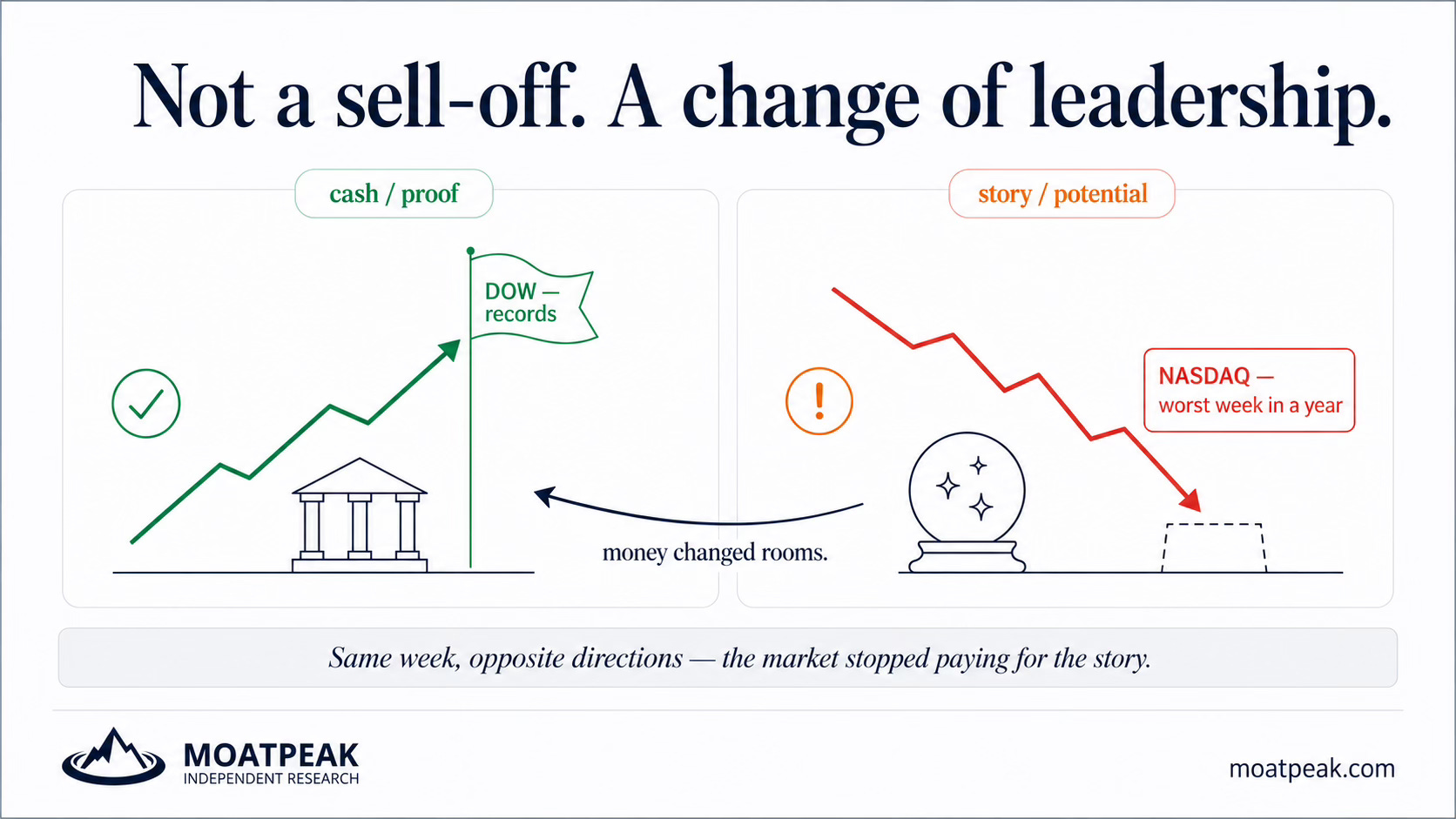
The easy read is “investors panicked and sold tech.” But a panic looks different. In a real risk-off scare almost everything falls together as people scramble for cash. That isn’t what happened. The money didn’t leave the building; it changed rooms. It came out of the most expensive, most crowded corner of the market — chips and AI — and walked into healthcare, industrials and the steadier, cheaper end of things. Healthcare had one of its best weeks in ages. That’s rotation, not flight.
So why rotate now? For two years the market rewarded one thing above all: exposure to the AI story. You didn’t have to prove much, you had to be near the narrative. Last week the standard quietly changed. A memory-chip maker reported one of the great quarters in its history — it roughly quadrupled its revenue and guided even higher — and it still couldn’t keep its own sector from sinking. When the best possible news can’t lift the group, the market is telling you it has stopped paying for the story and started asking a harder question: where are the actual profits, and will they last?
That’s the real shift, and it’s a simple one underneath the jargon. There’s a difference between paying for potential and paying for proof. Potential is a bet on what a company might earn years from now, and it does beautifully when money is cheap and patience is rewarded. Proof is what a company earns today: cash in the door, margins you can point to. When the mood moves from potential to proof, the leadership of the market changes hands, from the exciting names to the boring, profitable ones. That handover is uncomfortable to watch if you happen to own only one side of it.
None of this means AI is finished or that tech can’t lead again. It means the easy phase, where everything wearing the right label rose together, is on pause. For a regular investor the useful move isn’t to chase whichever index is green today. It’s to look at what you own and sort it into two piles: what’s priced on a story, and what’s priced on cash. You don’t have to sell the story names. You just want to know which is which, so a week like last week becomes something you understand instead of something that happens to you. Sorting our own watch-list into exactly those two piles is the work we do on the desk at moatpeak.com.
*Free weekly letter and explainers like this; the daily research, levels and the Daily Compass are at moatpeak.com.*
Educational research only — not investment advice. MoatPeak Group, UAB
.